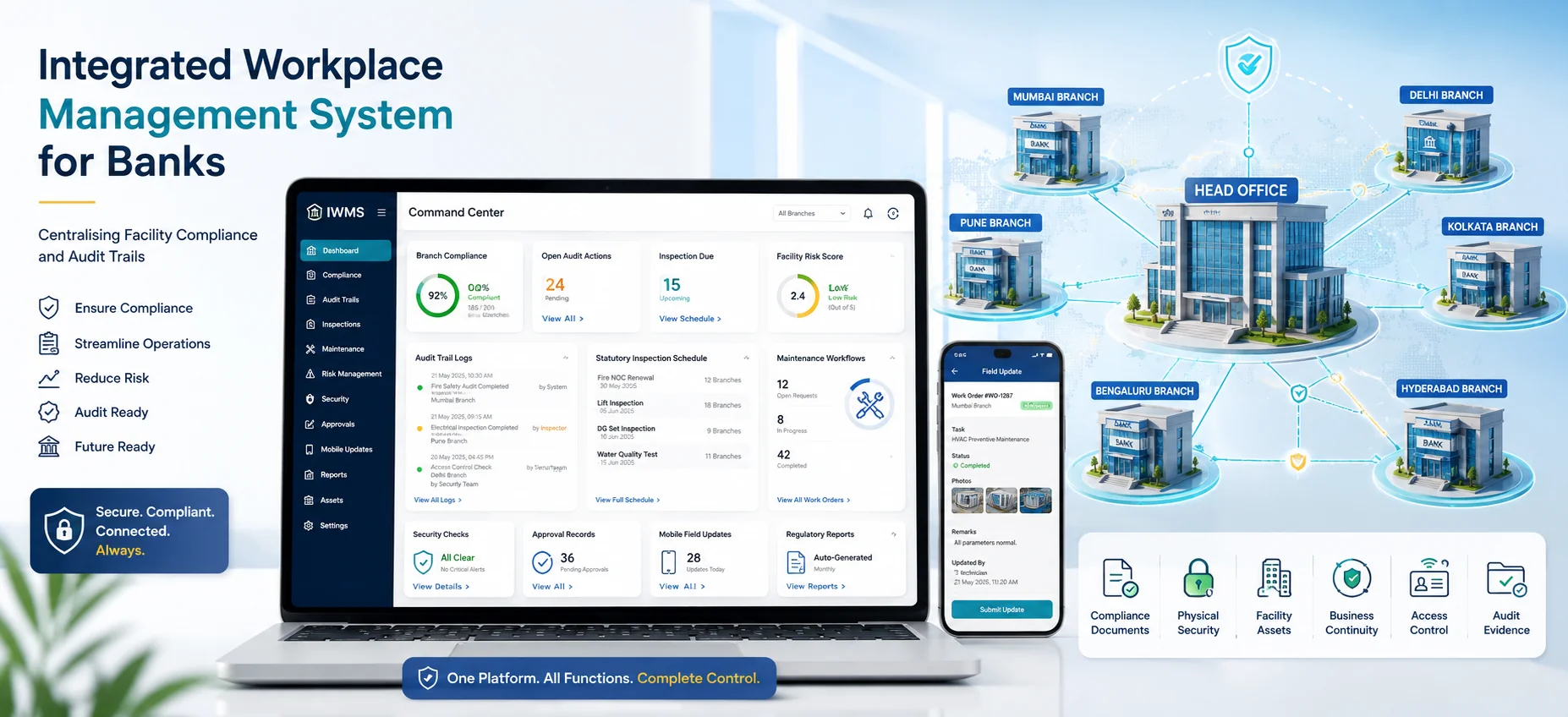
Facility managers in banking organisations must balance strict regulatory compliance with the need for cost-effective, reliable branch facility operations. Legacy systems and manual processes present substantial risks, amplifying audit challenges and exposing banks to compliance failures and inefficiency.
Integrated workplace management system is a centralised software platform that streamlines facility compliance and delivers robust audit trails, specifically tailored for banking facility and operations managers required to meet financial sector regulations.
How does an integrated workplace management system improve banking facility compliance and audit trail management?
An integrated workplace management system centralises regulatory data, automates audit trail reporting, and tracks compliance in real time across all bank branches. This approach eliminates manual errors, ensures transparent, tamper-proof records, and supports rapid audit readiness by providing secure, regulator-ready documentation of all facility operations.
Why Facility Compliance Is Essential in Banking Operations
Regulatory Frameworks Governing Banking Facility Management
Banking facility operations must comply with standards including ISO 22301 for business continuity, Federal Financial Institutions Examination Council (FFIEC) guidelines, and the Sarbanes-Oxley Act. These frameworks govern the physical security, resilience, and sensitive data control of branches. Failure to comply risks hefty fines, damaged reputation, or forced closure.
- Bank branches require clear evidence of adherence to operational and security regulations
- Rigorous compliance protects business continuity and customer trust
Major Pain Points in Bank Branch Compliance Management
Many banks still depend on decentralised, paper-based or incompatible systems, with distributed records and ad hoc processes lacking auditability. This fragmentation leads to data gaps, inconsistent inspections, and burdensome manual work for facility managers charged with coordinating statutory maintenance, risk control, and instant remediation.
- Manual record-keeping increases the risk of error and missed compliance events
- Dispersed branch operations lead to limited visibility for compliance teams
Integrated Workplace Management System Capabilities for Banking Facility Compliance
Centralised Compliance Monitoring and Automated Reporting
Modern integrated workplace management systems provide banks with a single dashboard to monitor compliance status, generate regulatory reports, and track statutory inspection histories at every branch. Audit trails are automated, timestamped, and tamper-proof, supporting both internal and external audit processes.
- Unified dashboards present real-time compliance data across the network
- Automated audit trails satisfy regulatory retention and traceability needs
Workflow Automation for Compliance Tasks and Maintenance
An integrated workplace management system allows banks to automate scheduling, task assignment, and verification of routine compliance inspections and asset maintenance. Role-based controls and detailed logs maintain process security and regulatory evidence, while custom workflows align with financial sector obligations.
- Workflow automation reduces manual oversight and standardises compliance activity
- Mobile support enables field teams to document and verify compliance on site
Interoperability with Asset, Security, and HR Systems
Leading solutions integrate seamlessly with asset management, security, and human resources platforms, breaking down data silos and providing a holistic compliance view. API and mobile-enabled capabilities ensure instant inspection uploads and direct evidence gathering, even in remote branches.
- Data integration improves audit depth and eliminates compliance blind spots
- Mobile applications enhance rapid evidence collection and validation
How to Implement an Integrated Workplace Management System in a Bank
1. Requirements Gathering for Regulatory Alignment
Begin with a cross-functional review—mapping every regulatory, audit, and compliance need across facilities, risk, and operations. Document maintenance cycles, inspection protocols, and audit triggers specific to the banking sector.
- Map regulatory obligations and audit checkpoints for all branches
- Engage compliance and facility teams in process documentation
2. Pilot Deployment and System Customisation
Select a pilot group of branches to automate core compliance and maintenance processes. Customise dashboards, approval paths, and reporting outputs to bank standards, providing staff with hands-on training and support for seamless system adoption.
- Pilot automation of compliance scheduling and audit logging
- Adapt system to bank workflows and provide stakeholder training
3. Scalable Rollout and Continuous Compliance Validation
Expand in phases, tracking key compliance indicators and audit readiness using system dashboards. Establish governance for regular system updates, new regulatory requirements, and continual process improvement informed by audit outcomes.
- Onboard additional branches and centralise operational data
- Implement ongoing compliance reviews and governance
Conclusion
Adopting an integrated workplace management system enables banking facility managers to provide centralised compliance oversight, secure audit trails, and streamlined regulatory reporting. This digital transformation delivers audit readiness, operational efficiency, and scalability—meeting regulatory expectations and supporting resilient, future-ready branch operations.
Key Takeaways
- Integrated workplace management system centralises compliance management, enabling unified oversight and reducing regulatory risk in banking facilities.
- Integrated workplace management system produces tamper-proof audit trails that provide secure, regulator-ready records of all facility compliance activity.
- Integrated workplace management system supports efficient and scalable branch maintenance by digitising workflows and enabling real-time field updates.
Discover how facility compliance software for banks can improve your regulatory audit processes. Schedule a demo with our banking compliance experts today.
FAQ
What is an integrated workplace management system?
An integrated workplace management system is a centralised digital platform that banks use to manage facility operations, automate compliance, and maintain secure audit trails. It streamlines tasks, consolidates records, and simplifies regulatory reporting, specifically supporting banking facility and operations managers in meeting financial sector regulations.
How does an integrated workplace management system compare to traditional branch maintenance platforms?
An integrated workplace management system provides automated, centralised compliance and audit record keeping, whereas traditional systems rely on manual records and decentralised data. Modern systems improve audit readiness, reduce errors, and seamlessly link with core banking platforms across multiple locations.
How should banking facility managers implement an integrated workplace management system?
Banking facility managers should start with requirements mapping and cross-functional collaboration, pilot the system in select branches for customisation and training, then progressively scale, using continuous compliance monitoring and updating features to align with evolving regulations and operational risk priorities.