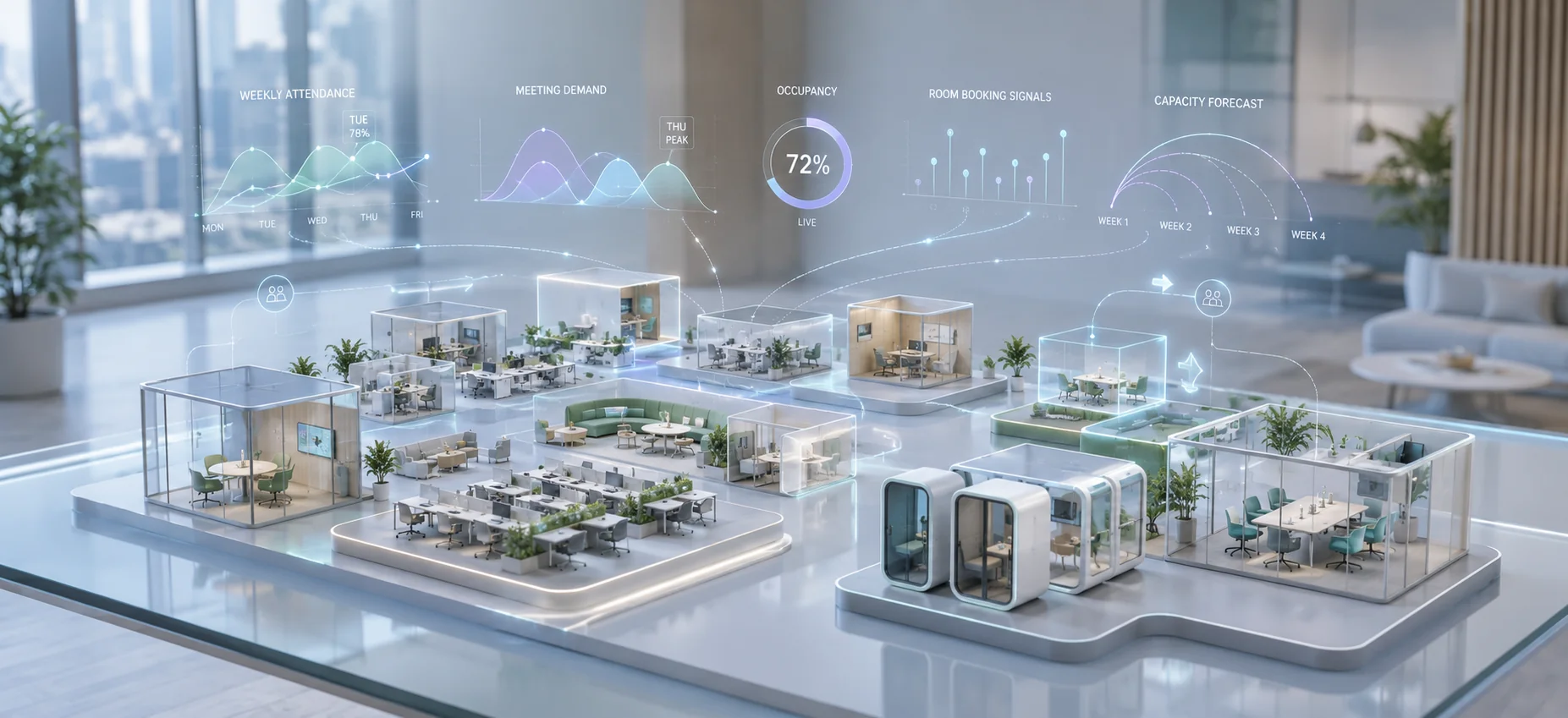
The evolution of hybrid working has transformed how corporate offices are managed, creating challenges for facility managers aiming to optimise space, manage fluctuating attendance, and address dynamic meeting room demand. Efficient workplace planning now demands robust technology solutions to drive agility and maximise real estate efficiency.
Space optimisation software is a technology solution designed to help facility managers in corporate offices maximise workspace utilisation, plan hybrid working capacity accurately, and balance meeting room demand, leading to improved employee experience and reduced operational costs.
How does space optimisation software support hybrid working capacity planning?
Space optimisation software uses real-time occupancy data, automation, and predictive analytics to monitor and manage office utilisation. By enabling proactive hybrid working capacity planning, it empowers facility managers to allocate workspaces dynamically, anticipate changing attendance, and address meeting room demand based on actual patterns.
Why corporate offices need space optimisation software for hybrid work models
Operational challenges with hybrid workspace management
Hybrid working introduces significant volatility in office occupancy, complicating desk and meeting room planning for facilities teams. Managers must forecast fluctuating space requirements while maintaining compliance with safety and health regulations, such as social distancing. Departmental schedules and shifting team collaboration also complicate manual planning.
- Unpredictable attendance patterns make static desk assignments inefficient and costly.
- Manual methods lead to either underutilised workspaces or employee frustration during peak periods.
- Health and compliance requirements can further restrict usable floor space, leading to inefficiency.
Managing meeting room demand in a hybrid environment
Meeting spaces often become bottlenecks due to overbooking, double-booking, or frequent ‘no-show’ cancellations. Without real-time visibility and integrated management, facility teams cannot optimise meeting room supply or minimise productivity losses associated with inefficient bookings.
- Fragmented booking systems cause conflicts and underutilisation of collaboration areas.
- Poor integration with broader workplace management tools disrupts office workflows.
Core capabilities of space optimisation software for corporate offices
Real-time office space utilisation analytics
Advanced space optimisation software leverages occupancy sensors and IoT data analytics to deliver live dashboards and actionable insights. Facility managers can visualise space usage by zone, floor, or individual desk, identify usage patterns, and receive automated alerts for occupancy thresholds.
- Granular tracking enables targeted interventions on underused or congested spaces.
- Predictive analytics inform workspace adjustments for upcoming hybrid attendance trends.
Hybrid working capacity planning workflows
Modern platforms include scenario-modelling and dynamic allocation, such as hot-desking, team zone reservations, and policy-driven assignments. These tools streamline hybrid workspace planning by enabling rapid adaptation to new business requirements and team patterns.
- Scenario modelling supports flexible policy enforcement and space allocation.
- Automated enforcement improves compliance and capacity limit management.
Meeting room demand management features using space optimisation software
Integrated meeting room management offers intelligent scheduling, live availability data, and automation for unused room release. Calendar and notification integrations ensure visibility and accessible collaboration spaces across familiar business tools.
- Booking conflicts and ‘no-shows’ are minimised with automated workflows.
- Real-time integration with Outlook, Google Workspace, or Teams supports seamless user adoption.
Integration with facility management and hybrid collaboration systems
Effective space optimisation software connects with Computer-Aided Facility Management (CAFM), Integrated Workplace Management Systems (IWMS), access control, and building management systems, providing unified data and reporting for holistic facility management.
- Integrations prevent information silos and enhance organisational compliance.
- Unified operations drive better strategic decision-making and workplace efficiency.
Implementing space optimisation software: steps for facility managers
Pilot initiatives: defining KPIs and measuring baseline utilisation
Begin with a targeted pilot in selected office zones, tracking occupancy and meeting room use. Establish KPIs—such as occupancy rates, booking conflict reduction, and desk utilisation ratios—and use pilot results to validate solution effectiveness before wider deployment.
- Choose representative office areas and deploy occupancy sensors and software.
- Set measurable KPIs (e.g. improved space usage, fewer conflicts).
- Assess data quality and validate user adoption before scaling.
Scaling and continuous optimisation for hybrid working
Expand the rollout across the organisation, integrating hybrid policy requirements, user training, and transparent change management. Use data-driven reviews to refine space allocation policies and inform longer-term real estate strategies as hybrid working matures.
- Configure software for hybrid policies and flexible scheduling.
- Deliver training for facilities teams and end-users on booking workflows.
- Communicate process changes to build engagement and buy-in.
Conclusion
Space optimisation software is essential for corporate offices adapting to hybrid working models. By delivering real-time workspace insights, automating capacity planning, and simplifying meeting room management, it empowers facility managers to drive operational efficiency, reduce real estate waste, and create agile, responsive workplaces for employees.
Key Takeaways
- Space optimisation software enables agile hybrid working capacity planning by delivering real-time data and predictive analytics to facility managers.
- Space optimisation software reduces meeting room conflicts and improves workspace scheduling through automated bookings and real-time availability.
- Space optimisation software delivers enhanced office utilisation and a stronger employee experience using integrated facility management workflows and flexible seating automation.
Discover how eFACiLiTY can optimise your facility management operations. Schedule a demo today.
FAQ
What is space optimisation software?
Space optimisation software is a digital platform that enables facility managers to monitor and maximise workspace utilisation, manage hybrid working schedules, and efficiently coordinate meeting room bookings. By using real-time data and automation, it helps improve office productivity, cut costs, and adapt to changing workplace requirements.
How does space optimisation software compare to traditional tools?
Unlike traditional systems reliant on manual tracking and static planning, space optimisation software provides real-time analytics, dynamic allocation, automated meeting room management, and seamless integration with facility and collaboration platforms, resulting in greater efficiency and improved employee access to workspaces.
How should facility managers implement space optimisation software?
Facility managers should start with a pilot phase to establish baseline utilisation and KPIs, validate solution effectiveness, and then scale gradually across the organisation. Training, clear communication, and ongoing review of analytics are key to successful adoption and continuous workplace improvement.