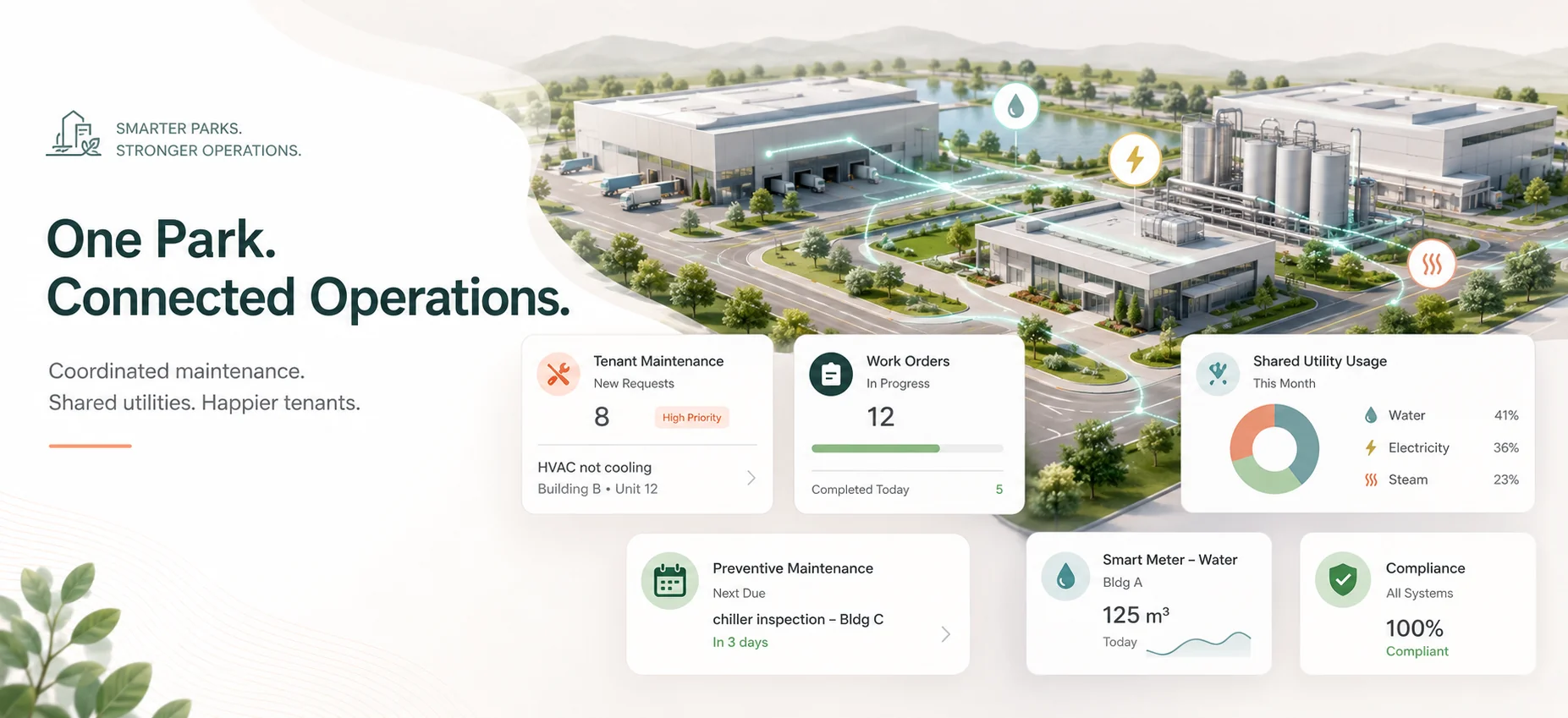
Industrial parks with multiple tenants and shared infrastructure face complex facility management challenges. Operations and estate managers must coordinate maintenance, handle shared utilities, and maintain regulatory compliance while delivering transparency and cost control across diverse stakeholders and assets.
IWMS for industrial parks is an integrated digital platform that centralises multi-tenant maintenance coordination and shared utility management, delivering greater transparency, efficiency, and cost control for estate managers and tenants.
How does IWMS help industrial parks coordinate multi-tenant maintenance and shared utility management?
An Integrated Workplace Management System helps industrial parks centralise tenant maintenance requests, automate work orders, and monitor real-time utility consumption, ensuring transparent operations, faster response, and accurate cost allocation across tenants and shared infrastructure.
Why industrial parks require IWMS for multi-tenant maintenance coordination
Operational complexities in multi-tenant industrial environments
Managing a large industrial estate with multiple tenants and shared assets introduces unique challenges, especially when manual processes dominate. Operations teams frequently face communication breakdowns, accountability issues, and complex utility billing disputes, increasing the risk of delays, disruption, and operational inefficiencies.
- Fragmented communication slows maintenance response and creates silos between tenants and park managers.
- Lack of centralised asset and work order tracking leads to unclear responsibilities and missed tasks.
- Manual utility billing is prone to error, leading to disputes and financial inaccuracies.
- Limited real-time visibility hinders proactive interventions, putting cost control and compliance at risk.
Compliance and regulatory obligations in industrial parks
Industrial parks must comply with ISO 41001 and strict local environmental regulations, making robust documentation and automated workflows essential. Continuous, auditable records of maintenance, inspections, and utility reporting not only support compliance but also uphold business continuity for tenants.
- Comprehensive maintenance logs and inspection history for regulatory audits
- Automated workflows minimise the risk of business disruption during planned or emergency works
- Accurate environmental and utility reporting to comply with legal obligations
IWMS core capabilities for industrial park multi-tenant and utility management
Tenant work order portals for transparent maintenance tracking
Modern IWMS platforms offer dedicated digital portals where tenants can submit issues, track their requests in real time, and review historical data. Automated workflows assign, escalate, and prioritise work orders, closing accountability gaps and reducing resolution times.
- Self-service work order submission and tracking for each tenant
- Live work order status dashboards and SLA monitoring
- Automated escalation and approval processes
Shared utility management with real-time metering and analytics
IWMS integrates with IoT smart meters and building automation systems for accurate, real-time tracking of electricity, water, and gas usage. Automated billing modules allocate costs based on actual consumption, offering clarity and eliminating manual errors or disputes.
- Continuous tenant-level utility monitoring and anomaly alerts
- Automated utility cost allocation and transparent billing
- Analytical dashboards for efficiency, forecasting, and sustainability insights
Coordinated preventive maintenance and asset lifecycle management
With centralised asset registers, IWMS assigns maintenance responsibilities, schedules preventive tasks, and equips mobile field teams with digital tools for efficient, auditable service delivery. Preventive regimes are set to minimise tenant disruption and extend asset longevity.
- Centralise and track shared and tenant-dedicated assets
- Schedule preventive maintenance aligned with risk levels
- Enable mobile workforce with real-time updates and checklists
- Automate notifications and SLA management for proactive resolution
Operational analytics and automated compliance management
Industrial park managers gain access to dashboards tracking KPIs such as mean time to repair, SLA performance, and utility spend per tenant. Each maintenance or inspection action is digitally recorded, supporting ISO-standard documentation and rapid regulatory audits.
- Automated digital audit trails for compliance reporting
- Proactive alerts for overdue maintenance or unusual consumption
- Seamless integration with ERP and building automation platforms
How to implement IWMS in industrial parks: step-by-step roadmap
Pilot phase: assessment and requirement analysis
Begin by mapping assets, utility infrastructure, and current processes. Engage tenants and front-line teams through workshops to identify pain points, prioritise automation opportunities, and align IWMS features with estate needs.
- Catalogue high-value assets and shared systems
- Perform workflow gap analysis
- Conduct stakeholder workshops for tailored system design
Scale-up phase: customisation and integration
Configure tenant portals, reporting dashboards, and system integrations (ERP, IoT meters, BAS). Deliver focused training for both estate operations staff and tenant representatives, improving adoption and data integrity.
- Customise portals and dashboards for each tenant
- Onboard staff and tenants with role-based training
- Integrate with facility and utility IoT infrastructure
Full deployment: ongoing optimisation and value expansion
Monitor operational KPIs in real time, continually refine workflows using system analytics, and introduce advanced modules for space utilisation, security, or ESG reporting as the estate’s needs mature.
- Track KPIs and drive continuous improvement
- Optimise processes based on real-world performance data
- Expand to additional modules for greater operational value
Conclusion
Implementing an IWMS for industrial parks transforms the coordination of multi-tenant maintenance and shared utility management. By replacing fragmented manual processes with intelligent digital automation, estate managers achieve greater transparency, efficiency, compliance, and operational control. This positions both management and tenants for long-term, sustainable estate performance and robust competitiveness.
Key Takeaways
- IWMS for industrial parks enables centralised maintenance coordination by integrating work order portals, automated workflows, and transparent progress tracking.
- IWMS for industrial parks reduces utility billing disputes and energy waste through real-time metering, analytics, and automated cost allocation for each tenant.
- IWMS for industrial parks delivers measurable improvements in compliance, tenant satisfaction, and operational cost control via advanced analytics and digital audit trails.
Discover how eFACiLiTY’s integrated workplace management system can transform your industrial estate operations. Schedule a demo with our team to explore IWMS for industrial parks.
FAQ
What is IWMS for industrial parks?
IWMS for industrial parks is a digital platform designed to centralise facility management, including multi-tenant maintenance and shared utility management. It streamlines workflows, delivers transparency, and improves resource allocation for both estate managers and tenants across complex, multi-occupier environments.
How does IWMS compare to traditional facility management software for industrial estates?
IWMS offers automated work order handling, real-time utility monitoring, compliance-ready reporting, and seamless integration with sensors and ERP systems. In contrast, traditional software often relies on manual processes, infrequent data capture, and limited analytics, hindering transparency and scalability.
How should industrial parks implement IWMS for maximum benefit?
Industrial parks should begin with a detailed asset and workflow assessment, engage all stakeholders in requirement scoping, and pilot the IWMS with tailored tenant portals. System integration and user training are critical, followed by ongoing performance monitoring and module expansion to maximise operational value.