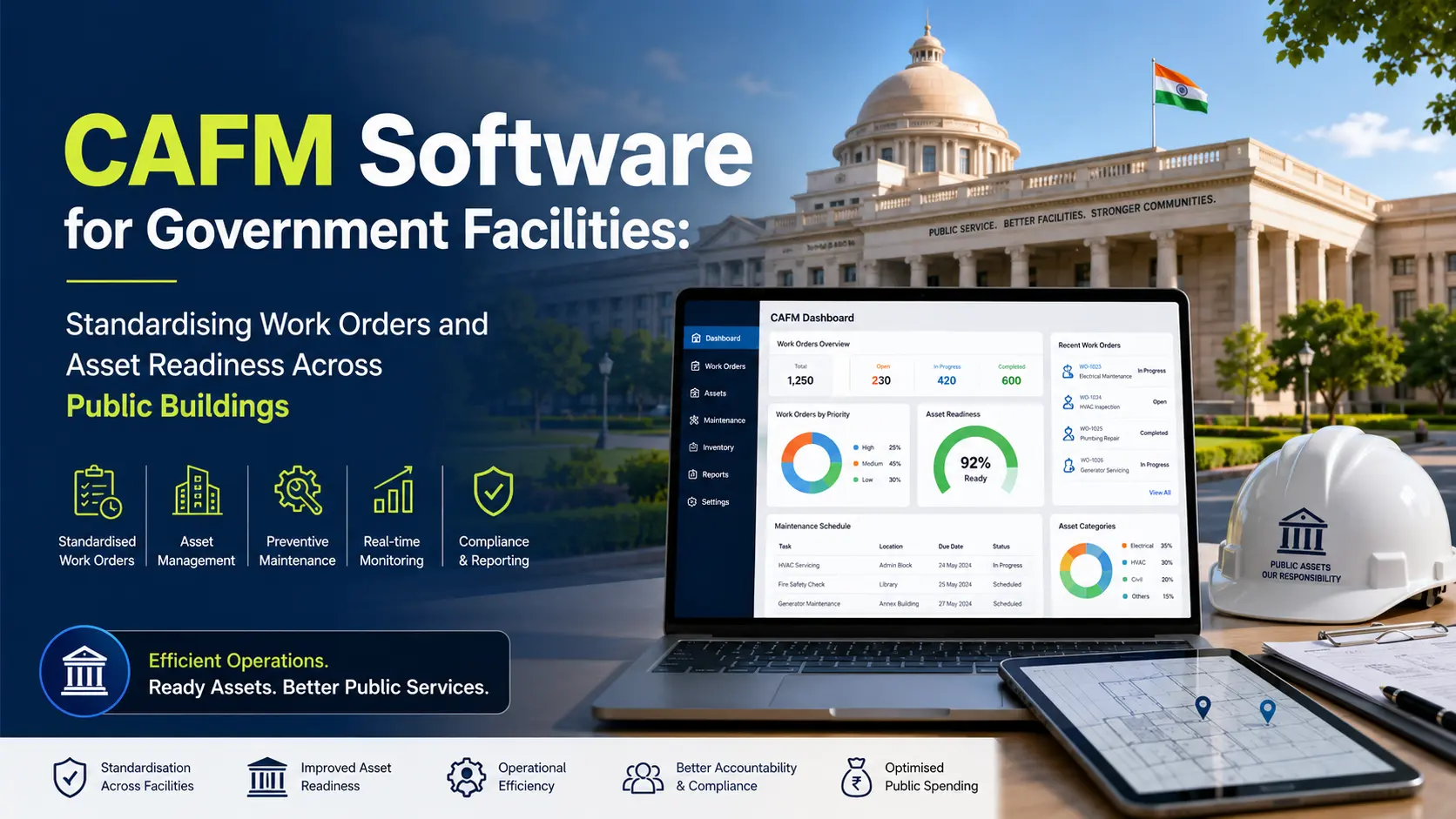
Public sector building management is often hindered by fragmented systems, diverse compliance requirements, and the inherent complexities of operating large, multi-site property portfolios. From administrative centres and educational campuses to hospitals, each facility faces resource challenges and operational inefficiencies due to inconsistent manual processes and poor data visibility.
CAFM software for government facilities is a centralised digital platform that automates work order management and asset readiness, ensuring operational efficiency and statutory compliance across public sector buildings.
How does CAFM software help government facilities standardise work orders and asset readiness?
CAFM software for government facilities delivers centralised work order tracking, real-time asset monitoring, and embedded statutory workflows. Automation reduces human error, ensures compliance, and provides transparent, audit-ready maintenance records, enabling facility managers to deliver consistent, efficient services across diverse public buildings.
Why government facilities require dedicated CAFM software for standardised work order management and asset readiness
Overcoming operational complexity in diverse public buildings
Government organisations oversee wide-ranging property portfolios—historic civic buildings, healthcare settings, educational sites—each with unique assets and regulatory profiles. Manual or isolated digital processes fragment service data, causing slow response to issues, heightened compliance risk, and hampered oversight.
- Multiple property types with varied asset maintenance needs
- Outdated, paper-based processes and disconnected systems
- Reduced transparency and delayed remedial action
Meeting rigorous compliance and regulatory requirements in the public sector
Government buildings must adhere to thorough regulations covering planned preventative maintenance, health and safety inspections, accessibility, and environmental standards. Missing an inspection or failing to maintain audit-ready records can carry serious repercussions.
- Strict planned maintenance and inspection schedules
- Legal, financial, and reputational impact of non-compliance
- Need for integrated, digital audit trails
Managing resource constraints and ensuring fiscal accountability
Facility teams must maximise asset lifespan, minimise downtime, and do so under budget scrutiny. CAFM software helps deliver proactive, cost-effective maintenance and transparent stewardship of taxpayer-funded assets despite limited resources or staff numbers.
- High expectations with limited staffing and budgets
- Proactive maintenance reduces emergencies and costs
- Data-led evidence of resource allocation and asset performance
Core capabilities of CAFM software for government facilities
Streamlined and standardised government work order workflows
CAFM systems provide automated, centralised ticketing with assignment rules that ensure jobs reach qualified personnel. Escalation for compliance-critical tasks and use of standard templates reduce human error and variability. Live dashboards provide oversight for all stakeholders.
- Automated work order creation and assignment
- Escalation triggers for statutory maintenance
- Live work status dashboards and history logs
Real-time asset readiness monitoring and condition reporting
A unified asset register gives facility managers instant insight into building system status. Predictive maintenance schedules, automated inspection alerts, and dynamic filtering by compliance criteria prevent inspection gaps and unscheduled failures.
- Real-time asset tracking across all locations
- Predictive maintenance workflows
- Automated alerts for inspections and compliance requirements
Embedded compliance management and statutory reporting
CAFM platforms embed compliance directly into workflows, triggering work orders for regulatory checks, managing digital permits, and generating audit packs. No activity or deadline goes unnoticed, with instant access to evidential records for audits.
- Automatic inspection scheduling
- Digital, readily accessible audit trails
- Automated compliance reporting for external reviews
Mobile access for facilities field teams
Mobile-enabled CAFM systems equip technicians with access to job data, asset records, and digital checklists onsite. Facilities teams can upload proof, close jobs, and keep records up to date in real time, all via smartphone or tablet.
- Instant on-site access to work orders and histories
- Digital forms replace manual paperwork
- Faster communication and centralised progress updates
Seamless integration with government management systems and IoT
Modern CAFM platforms support API and out-of-the-box integration with ERP, HR, BIM, and IoT sensors. This enables end-to-end visibility and real-time alerts (e.g., for water leaks or temperature anomalies), plus advanced analytics to pinpoint spend and asset strategies.
- Unified property, asset, and compliance data
- Sensor-driven event logging
- Deeper analytics for informed resource planning
Implementing CAFM software in government facilities: A phased, practical approach
Pilot rollout and needs assessment
Start by deploying CAFM in a sample of buildings. Map current workflows, identify process and compliance gaps, and configure baseline features to resolve these. Preserve valuable legacy records during system migration.
- Select pilot sites for CAFM rollout
- Assess and map existing FM workflows and compliance
- Configure features to resolve pain points
Scaling CAFM adoption across the government estate
After initial validation, expand CAFM software to all buildings. Standardise templates, coding systems, and data capture for consistency and provide comprehensive staff training to support adoption.
- Extend CAFM to remaining sites
- Standardise work order and asset management templates
- Deliver onboarding and training to all FM teams
Continuous optimisation using CAFM analytics
Leverage analytics dashboards to monitor workflow efficiency, compliance rates, and asset trends. Implement feedback loops with onsite teams and use gathered data to refine task allocation, strategic planning, and ensure ongoing improvement.
- Monitor KPIs and trends via dashboards
- Seek regular feedback from facilities teams
- Refine processes and compliance strategies based on real data
CAFM software vs traditional FM systems in government: Key differences for public sector facilities
| Feature | CAFM Software (Government) | Traditional FM Systems |
|---|---|---|
| Work Order Standardisation | Automated, centralised, rules-driven | Fragmented, siloed, manual |
| Asset Readiness Monitoring | Real-time dashboards, predictive | Reactive, periodic, paper-based |
| Compliance Management | Integrated, audit-ready, automated | Manual tracking, error-prone |
| Mobile & Field Access | Full-featured mobile apps | Limited or none |
| Integration Capability | Connects with ERP, BIM, IoT | Standalone, poor integration |
| Reporting & Analytics | Advanced, customisable | Limited, ad-hoc |
Real-world example: Standardising work orders and asset readiness with CAFM in a government setting
A UK county council unified management for 120 public buildings using CAFM software. Previously, work orders were tracked in spreadsheets, compliance documentation in paper files, and emergency repairs were frequent. The CAFM roll-out introduced automated scheduling, standard templates, and mobile enablement, resulting in real-time visibility, consistent audit readiness, and a sharp reduction in urgent repairs and missed inspections.
Practical considerations for government facility managers adopting CAFM software
- Change management and early leadership buy-in are critical for staff engagement.
- Legacy asset and maintenance data should be properly cleansed and migrated.
- Select a CAFM solution able to support complex compliance needs and government IT standards.
- Continuous improvement must be embedded through analytics and regular process review.
For in-depth examples, see our sector overview on government facility maintenance software adoption, and explore guides such as government building compliance tracking best practices and predictive maintenance for public sector estates.
Conclusion
CAFM software for government facilities replaces fragmented manual systems with a unified, digital-first approach to work order standardisation and asset readiness. Facility managers benefit from real-time monitoring, automated statutory compliance, and consistent, audit-ready records. This modernisation ensures government buildings are operated efficiently, cost-effectively, and always in line with regulatory standards.
Key Takeaways
- CAFM software for government facilities enables work order standardisation by centralising processes and automating job allocation.
- CAFM software for government facilities improves asset readiness using real-time monitoring and predictive, compliance-driven maintenance.
- CAFM software for government facilities delivers audit-ready statutory compliance through embedded tracking and automated reporting.
Discover how eFACiLiTY can optimise your facility management operations. Schedule a demo today.
FAQ
What is CAFM software for government facilities?
CAFM software for government facilities is a digital system that automates work order management, tracks asset readiness, and embeds statutory compliance. It serves as a central solution for facility managers to efficiently manage public sector buildings, streamline maintenance, and remain audit-ready.
How does CAFM software for government facilities compare to traditional FM systems?
CAFM software standardises and automates workflows, provides real-time asset monitoring, and embeds compliance management. Traditional FM systems are often manual, fragmented, and reactive, lacking real-time insights, automation, and integration capabilities crucial for modern government portfolios.
How should government facility managers implement CAFM software?
Government facility managers should begin with a phased CAFM rollout in pilot sites, map current processes, and migrate legacy data. Expansion across the estate should follow standardisation, comprehensive staff training, and analytics-driven continuous improvement to maximise efficiency and compliance outcomes.