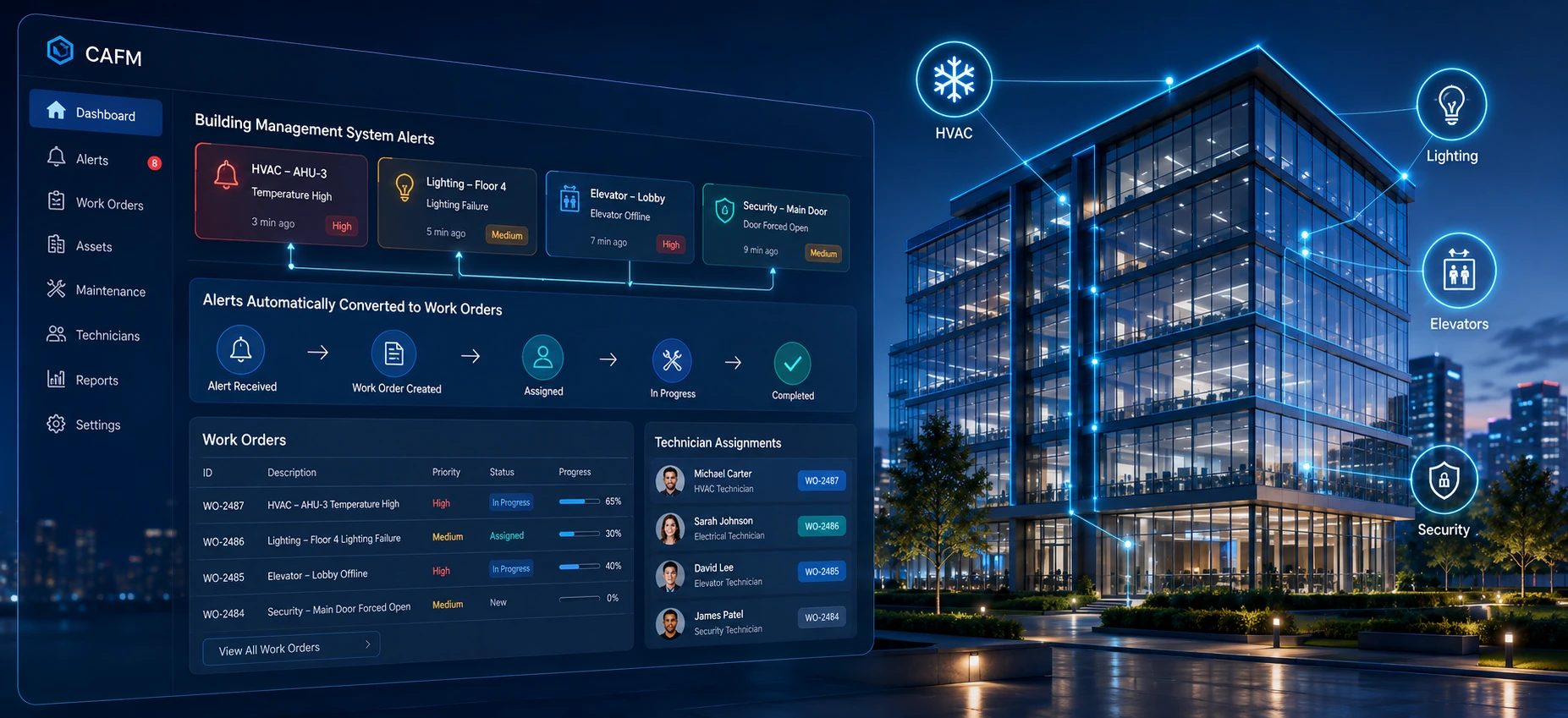
Smart buildings use advanced IoT devices and Building Management Systems (BMS) to optimise comfort, energy efficiency, and safety. However, this sophistication can create significant operational complexity for building operations managers, especially when managing large volumes of real-time BMS alerts and corresponding maintenance tasks.
CAFM software for smart buildings is a digital facility management platform that automates maintenance by integrating real-time BMS alerts with work orders, enabling building operations managers to deliver faster, data-driven facility management across modern portfolios.
How does CAFM software integrate Building Management System alerts with work orders?
CAFM software for smart buildings connects directly to BMS, ingesting alerts from IoT sensors and converting them into prioritised work orders in real time. This streamlines workflows, reduces manual errors, and ensures rapid responses to facility issues, supporting predictive and proactive maintenance for optimal building performance.
Why Building Operations Managers Need CAFM Software for Smart Buildings
Key Challenges in Managing Smart Building Maintenance
Modern smart buildings contain thousands of IoT sensors generating frequent BMS alerts. Facility teams face difficulties managing high volumes, prioritising alerts, and converting notifications into timely, actionable maintenance tasks, which can increase downtime and affect occupant satisfaction.
- High alert volumes create manual tracking challenges, risking delayed responses.
- Manual conversion of alerts to work orders increases the potential for human error.
- Alert prioritisation without automation can result in urgent issues being overlooked.
- Disconnected BMS and facility systems hinder visibility and coordination.
How CAFM Software Resolves Maintenance Challenges in Smart Buildings
CAFM software addresses these challenges by integrating BMS alerts with maintenance workflows, providing automation, advanced prioritisation, and operational visibility to facility teams. Automated processes reduce errors, speed up responses, and enhance compliance.
- Automatic transformation of BMS alerts into actionable, prioritised work orders.
- Unified dashboards for real-time operational oversight and transparency.
- Intelligent assignment and escalation of maintenance tasks based on urgency.
- Digital audit trails to support compliance and reporting needs.
CAFM Software Capabilities for Automated Smart Building Work Orders
Real-Time BMS Alert Processing and Work Order Lifecycle Automation
CAFM software orchestrates every stage of the maintenance lifecycle in smart buildings, from real-time ingestion of BMS alerts to closure of work orders—reducing downtime and enabling predictive, data-driven asset care.
- Ingest real-time signals from HVAC, lighting, energy, and security systems.
- Automatically generate work orders, assign priority, and link asset history.
- Route jobs to qualified engineers using mobile notifications for status updates and job closure.
- Enable predictive and condition-based intervention using IoT sensor data to trigger maintenance proactively.
Advanced Reporting and Analytics for Smart Building Operations
CAFM platforms include analytics to help facility leaders and building managers track and improve performance by leveraging real-time and historical IoT/BMS data.
- Monitor KPIs such as response times, closure rates, and asset uptime.
- Drive predictive maintenance decisions informed by trend and fault analysis.
- Generate operational reports to justify budgets, compliance, and asset lifecycle investment.
Implementing CAFM Software with BMS Alert Integration in Smart Buildings
Phased Implementation Roadmap
Organisations should approach CAFM and BMS integration using a phased deployment to control risk and support operational change management.
- Pilot high-impact systems, automating maintenance for critical BMS alerts.
- Scale integration to more systems and sites, optimising workflows.
- Roll out enterprise-wide, establishing training and continuous improvement protocols.
Best Practices for Effective CAFM and BMS Integration
Following industry standards and cross-functional collaboration maximises the benefits of CAFM platforms within smart building environments.
- Engage IT, operations, and maintenance teams early for seamless connectivity.
- Adopt open protocols such as BACnet, Modbus, or MQTT for IoT device integration.
- Define clear alert rules for escalation and asset-criticality-based task assignment.
- Regularly seek user feedback to refine workflows and enhance system value over time.
Conclusion
CAFM software for smart buildings is essential for unifying BMS alerts and automated work order management. This integration reduces downtime, supports predictive maintenance, and ensures building operations teams can optimise asset performance and occupant comfort with confidence, compliance, and efficiency.
Key Takeaways
- CAFM software for smart buildings enables faster, data-driven maintenance by integrating real-time BMS alerts with automated work orders.
- CAFM software for smart buildings reduces maintenance downtime and manual errors through IoT-enabled alerts and condition-based workflows.
- CAFM software for smart buildings delivers predictive maintenance and strategic planning outcomes via analytics and operational reporting.
Discover how IoT-integrated facility management solutions can advance your smart building operations.
Schedule a demo for your property portfolio today.
FAQ
What is CAFM software for smart buildings?
CAFM software for smart buildings is a digital platform integrating facility management functions such as maintenance, asset tracking, and space utilisation with IoT technology. It automates work orders from BMS alerts, helping operations managers improve efficiency, resource allocation, and building performance.
How does CAFM software for smart buildings compare to CMMS in BMS alert management?
CAFM software for smart buildings provides automated, real-time BMS alert integration and advanced workflow automation, while CMMS platforms often require manual processes and offer limited IoT connectivity. CAFM systems suit complex, multi-site smart building portfolios requiring scalable, data-driven maintenance.
How should building operators implement CAFM software for smart buildings?
Building operators should follow a phased implementation: pilot CAFM with critical systems, scale integration across more assets and sites, and build structured training and refinement cycles. Engaging multidisciplinary teams and using standard IoT protocols ensures a smooth and effective deployment process.