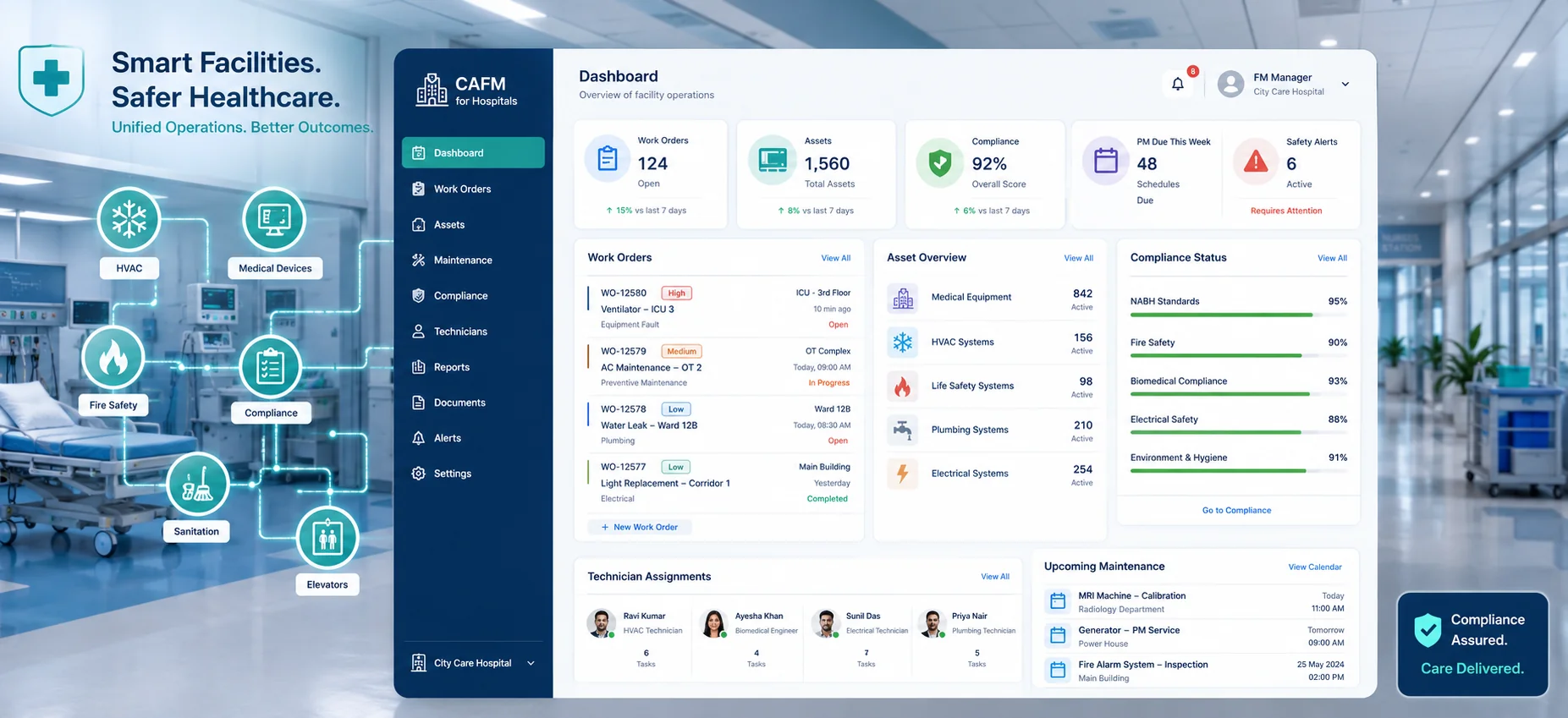
Hospital estates teams face ever-increasing complexity—from critical equipment oversight to strict regulatory demands and the relentless need to prevent downtime. Legacy, manual facilities management methods struggle to keep pace, threatening patient safety and compliance.
CAFM software for hospitals is an integrated digital platform designed to centralise and automate work order management, healthcare asset tracking, and clinical compliance—empowering hospital estates managers to optimise operational efficiency and regulatory adherence in healthcare environments.
What is CAFM software for hospitals and why is it critical?
CAFM software for hospitals is a dedicated solution that streamlines facilities management by automating work orders, centralising asset tracking, and ensuring compliance with healthcare standards. It enhances visibility, reduces downtime, and enables hospitals to maintain continuous operational and regulatory control.
Why Hospitals Need CAFM Software for Facility Operations
Clinical-Area Challenges That Drive Downtime
Managing hospital estates is uniquely complex, with high-value clinical assets, time-sensitive maintenance, and rigorous sector regulations. Traditional approaches often result in missed maintenance, delayed response, and increased compliance risk.
- Constant scheduling pressures in treatment areas and high-dependency zones
- Asset diversity, including medical devices, infrastructure, and building systems requiring unified oversight
- Multiple regulatory regimes such as HTM, ISO 13485, and CQC mandates demanding precise audit trails
- Departmental silos causing fragmented communication amongst clinical, estates, and engineering teams
- Equipment downtime directly impacting patient safety and service delivery
CAFM Software for Hospitals: Core Capabilities
Work Order Lifecycle: Intake to Verified Closure
Modern CAFM platforms optimise every stage of the maintenance workflow, from automated work order creation through to escalation and documented closure, ensuring nothing is missed—even in high-pressure clinical settings.
- Automated triage by asset criticality and proximity to patient risk
- Mobile workflows for instant updates and verification at the point of work
- Scheduled and preventative maintenance tasks generated at compliant intervals
- Centralised dashboard for tracking status, response times, and completion evidence
Healthcare Asset Management and Lifecycle Tracking
CAFM software builds a unified, digital asset register encompassing clinical, plant, and FM items, providing complete visibility across the estate while supporting regulatory traceability.
- Barcode, RFID, or IoT-enabled location/status monitoring for all hospital assets
- Linking all maintenance, test, and compliance records to individual asset profiles
- Lifecycle tracking, condition monitoring, and data-driven replacement planning
Clinical Compliance Management with CAFM Software for Hospitals
With regulatory requirements spanning HTM, ISO 13485, and Care Quality Commission protocols, hospitals need seamlessly embedded compliance management—not just document storage.
- Digital compliance registers for standards adherence, due dates, and inspection evidence
- Automated document workflows to store certifications and manage remedial actions
- Direct integration with clinical and building systems to contextualise compliance outcomes with operational data
How Hospitals Should Implement CAFM Software
Phased Approach for Successful Rollout
Transitioning to a hospital CAFM platform is a strategic process, best achieved through phased implementation to encourage adoption and ensure compliance.
- Conduct a comprehensive requirements assessment across clinical and estates functions
- Select a hospital-focused CAFM solution with proven integration and compliance support
- Deliver targeted training for all user groups and champion mobile, collaborative workflows
- Migrate legacy asset data and compliance records securely, retaining past audits
- Monitor adoption, measure key metrics, and continuously optimise usage and integrations
For practical guidance, see our insights on digital transformation in hospital facility management.
Conclusion
CAFM software for hospitals transforms facility management by bringing maintenance coordination, asset tracking, and compliance management onto a unified platform. Hospital estates teams adopting these systems achieve lower equipment downtime, seamless regulatory readiness, and improved collaboration with clinical areas—delivering safer, compliant patient care at scale.
Key Takeaways
- CAFM software for hospitals delivers responsive work order management by automating intake, prioritisation, and cross-team communication.
- CAFM software for hospitals enhances asset lifecycle management through real-time tracking, condition monitoring, and proactive replacement planning.
- CAFM software for hospitals minimises compliance risk via digital documentation, automated audit trails, and hospital information system integration.
Discover how eFACiLiTY hospital facility management software can optimise your hospital’s compliance and operational processes. Schedule a demo with our healthcare solutions team today.
FAQ
What is CAFM software for hospitals?
CAFM software for hospitals is a dedicated digital system that streamlines work order coordination, asset management, and regulatory compliance within healthcare estates. It automates maintenance, centralises asset life cycles, and ensures clinical standards are continuously met across complex hospital environments.
How does CAFM software for hospitals compare to traditional FM solutions?
Unlike traditional FM tools, CAFM software for hospitals automates workflows, delivers real-time asset and compliance visibility, and integrates fully with clinical and digital hospital systems. This results in reduced downtime, fewer compliance gaps, and greater cross-department collaboration.
How should hospitals implement CAFM software successfully?
Hospitals should begin with a clear needs assessment and phased system rollout, involving all key stakeholders. Data migration must be secure and followed by targeted training. Ongoing performance monitoring and workflow optimisation will help embed the system and maximise return on investment.