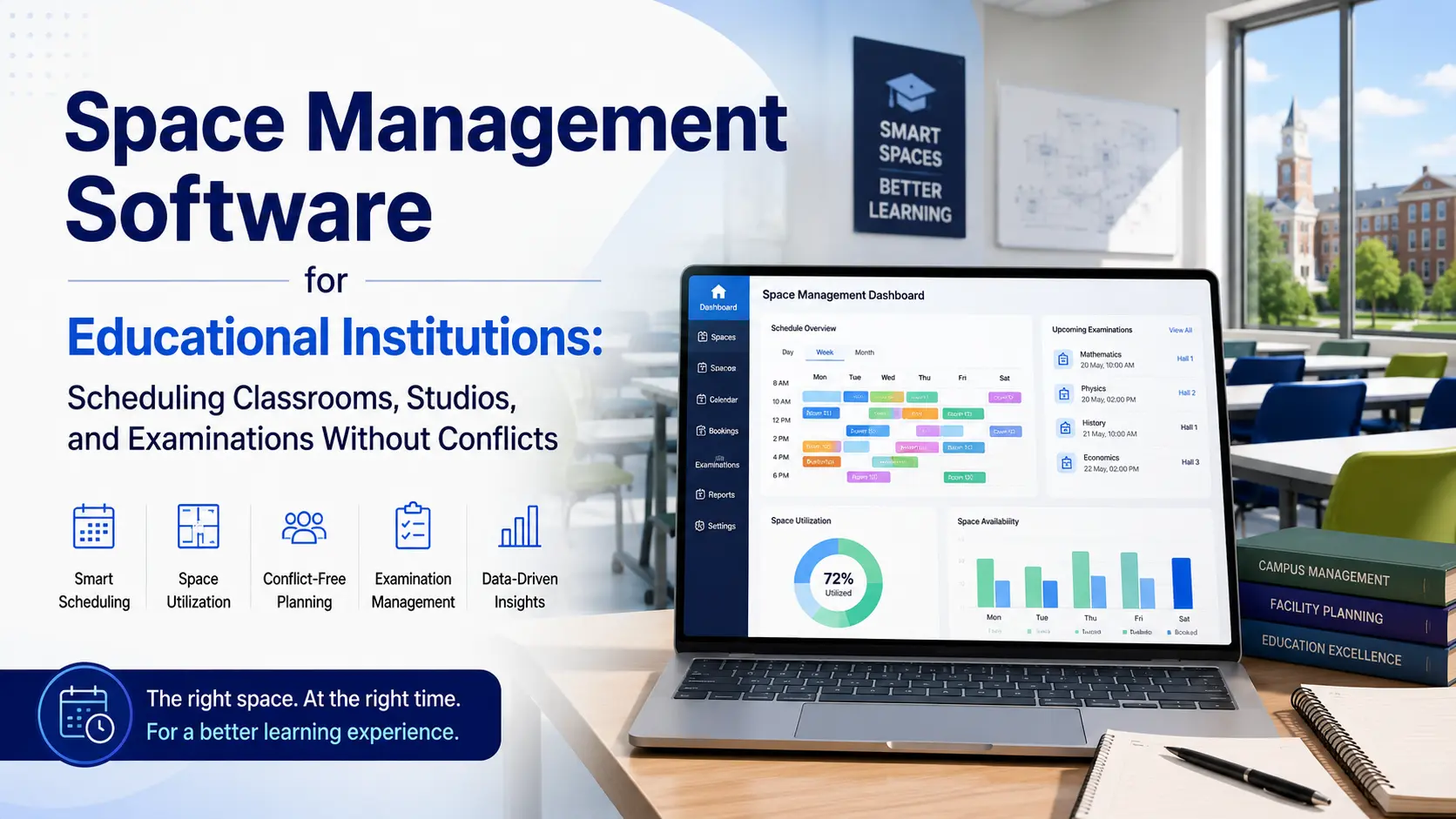
Efficiently managing classrooms, studios, and exam halls across a busy educational campus is a complex challenge. Without dedicated tools, manual scheduling can quickly result in double bookings, underutilised spaces, and ongoing administrative stress for both staff and students.
Space management softwareis a digital platform that enables educational institutions to efficiently centralise, automate, and optimise scheduling of classrooms, studios, and examination venues, eliminating conflicts and improving campus operations.
How does space management software prevent scheduling conflicts in educational institutions?
Space management software uses a central booking calendar and automated conflict detection to prevent double bookings and overlapping events. Custom booking rules, live availability dashboards, and integrations with academic systems ensure that room allocations are visible, accurate, and comply with institutional policies—delivering consistent, conflict-free schedules for all users.
Why do educational institutions struggle with classroom and exam space management?
Common challenges in campus space allocation and scheduling
Colleges and universities often face a range of operational difficulties when allocating limited teaching and assessment spaces. Challenges include:
- Frequent double bookings due to disconnected systems or manual tracking
- Reliance on spreadsheets and data silos, increasing error risk
- Conflicting demands from faculty, administration, student societies, and external bookings
- Special requirements for studios, labs, or specialist venues needing custom setup or equipment
- Complicated exam logistics involving seating, compliance, accessibility, and proctor coordination
How space management software streamlines conflict-free classroom, studio, and exam scheduling
Core functionalities supporting educational space management
Leading space management software for educational institutions offers functionality such as:
- Automated conflict detection and rules-based resolution for bookings
- Centralised, real-time room booking dashboards accessible campus-wide
- Instant notifications for schedule changes or pending approvals
- Integration with academic calendars, student information systems (SIS), and HR platforms
- Configurable policies reflecting unique departmental or event requirements
Automation workflows for campus scheduling
Automation built into space management software supports repetitive scheduling, including:
- Bulk creation of semester class timetables aligned with academic calendars
- Coordinating exams with automated seating plans, venue management, and invigilator assignment
- Block booking specialist rooms or studios with required equipment and setup intervals
Best practices for implementing space management software in educational institutions
Step-by-step roadmap for successful software adoption
Adopting space management software follows a strategic process:
- Conduct requirements analysis involving stakeholders to identify all pain points
- Engage faculty, administrators, and IT for unified planning and buy-in
- Integrate with existing student information and scheduling systems
- Run pilot programmes in select areas, iterating based on real feedback
- Deliver targeted training and ensure support resources are available
- Scale campus-wide, monitor performance via analytics, and optimise routinely
Overcoming common challenges in implementation
- Tackle user resistance by demonstrating early wins and designating super-users
- Audit and cleanse existing schedule data thoroughly before migration
- Enforce strong role-based permissions to protect data integrity and control access
Space management software vs specialist exam scheduling tools: Key differences for educational institutions
| Feature | Classroom Scheduling Software | Exam Scheduling Tools |
|---|---|---|
| Scheduling focus | Recurring classes, semester routines | One-off and multi-session exams |
| Conflict management | Instructor and room clash detection | Seating plans, exam protocols, invigilator allocation |
| Resource handling | Standard AV, teaching aids, and furniture | Secure materials, multi-room logistics, accessibility needs |
| System integration | Academic calendars, learning systems | Student information system, governance modules |
| User roles | Faculty, department schedulers | Exam officers, administrative managers |
| Reporting | Utilisation and occupancy trends | Exam attendance, results, compliance statistics |
Measuring the impact of space management software on campus operations
Key performance indicators (KPIs) for space management software success
- Reduction in double bookings and last-minute schedule changes
- Increase in space utilisation rates through data-driven insights
- Administrative time savings—often up to 25%—from automation workflows
- Higher user satisfaction as measured by surveys and feedback channels
Case examples: Quantified benefits for educational space management
Many institutions adopting space management software report a 30% decrease in booking conflicts within the first academic year. Automation for exam scheduling alone typically realises significant administrative savings, while transparent booking platforms result in fewer complaints and improved satisfaction among staff and students.
Conclusion
Space management software gives educational institutions a comprehensive solution for eliminating facility scheduling conflicts, maximising classroom and venue utilisation, and reducing administrative workload. By integrating classroom, studio, and exam scheduling into a unified, automated platform, institutions achieve greater transparency, operational efficiency, and end-user satisfaction—building a reliable foundation for lasting academic excellence.
Key Takeaways
- Space management software enables educational institutions to deliver conflict-free scheduling for classrooms and exam spaces by automating and centralising bookings.
- Space management software reduces scheduling errors and administrative strain by providing real-time visibility and intelligent conflict detection.
- Space management software delivers improved campus-wide communication and user satisfaction by unifying classroom, studio, and examination scheduling on a transparent platform.
Discover how smart campus scheduling software can optimise your institution’s space utilisation and simplify operations. Schedule a demo today to experience the benefits.
FAQ
What is space management software?
Space management software is a digital solution for educational institutions to centralise and automate the scheduling of classrooms, studios, and exam venues. It delivers real-time visibility, prevents booking conflicts, and helps maximise campus space utilisation through intelligent booking management.
How does space management software compare to specialist exam scheduling tools?
Space management software covers all campus rooms, recurring classes, studios, and exams in one system, while exam scheduling tools focus solely on exam logistics, seating, and protocols. Unified platforms provide broader visibility and reduce administrative duplication.
How should educational institutions implement space management software effectively?
Institutions should start with a needs assessment involving key stakeholders, plan integration with existing systems, run a pilot deployment, provide robust training, and use real-time analytics to monitor adoption and continually refine scheduling processes campus-wide.