Software companies across India are adapting to workplace models that combine hybrid work, rapid hiring, project-based staffing, and expansion into multiple office locations. As development teams, support functions, and business units alternate between office and remote work, managing desks, meeting spaces, and departmental seating has become significantly more complex. Relying on spreadsheets or static floor plans often leads to inaccurate occupancy data, inefficient seating allocations, and slower workplace decisions.
Office space management software is a digital solution that helps facility and workplace managers plan, allocate, monitor, and optimise office spaces, enabling efficient hybrid workplace management, improved space utilisation, and informed expansion decisions.
Facility and workplace managers need clear visibility into how office space is actually being used. Reliable insights into occupancy, seating patterns, and workplace demand help organisations improve employee experiences while making informed decisions about office expansion, consolidation, or reconfiguration.
How does office space management software help software companies manage hybrid workplaces?
Office space management software helps software companies coordinate hybrid seating, workspace allocation, occupancy monitoring, and office planning from a central platform. It enables workplace managers to improve space utilisation, support flexible work schedules, simplify team moves, and make data-driven real estate decisions while enhancing employee workplace experiences.
Why office space management software is increasingly important for hybrid workplaces in India
Hybrid work has changed how software companies across India use their offices. Attendance can fluctuate significantly depending on sprint planning, product launches, client meetings, onboarding sessions, or work-from-home schedules. This makes it difficult to estimate daily occupancy using historical assumptions or permanent seating models.
Many organisations experience situations where some office zones remain underused while employees struggle to find suitable desks on peak attendance days. Development teams often need to work together during release cycles, new hires require immediate seating during recruitment drives, and departments may be reorganised as projects evolve. Organisations with offices in Bengaluru, Hyderabad, Pune, Chennai, Gurugram, or Noida must also coordinate workplace planning across multiple locations while maintaining consistent workplace policies.
Manual planning quickly becomes outdated because employee attendance patterns change frequently. As a result, organisations may assume additional office space is required even though existing capacity could be used more efficiently with better visibility into actual occupancy.
A workspace reservation system enables employees to book desks before arriving at the office while allowing facility teams to anticipate occupancy levels and allocate workspaces more effectively. This proactive approach reduces last-minute seating issues, supports collaboration, and provides greater confidence in daily workplace planning.
For organisations operating within large technology parks or multi-building campuses, workplace planning can also align with broader business park operations, including visitor access, parking, shared amenities, security processes, and common infrastructure management.
Operational challenges facility managers encounter
Facility managers commonly face challenges such as:
- Hybrid seating conflicts caused by unpredictable attendance.
- Team collaboration requirements that demand flexible seating arrangements.
- Uncertainty around office expansion because occupancy information is inconsistent.
- Meeting room congestion during peak office days.
- Limited visibility into actual workplace utilisation.
How office space management software improves seating, team moves, and office utilisation
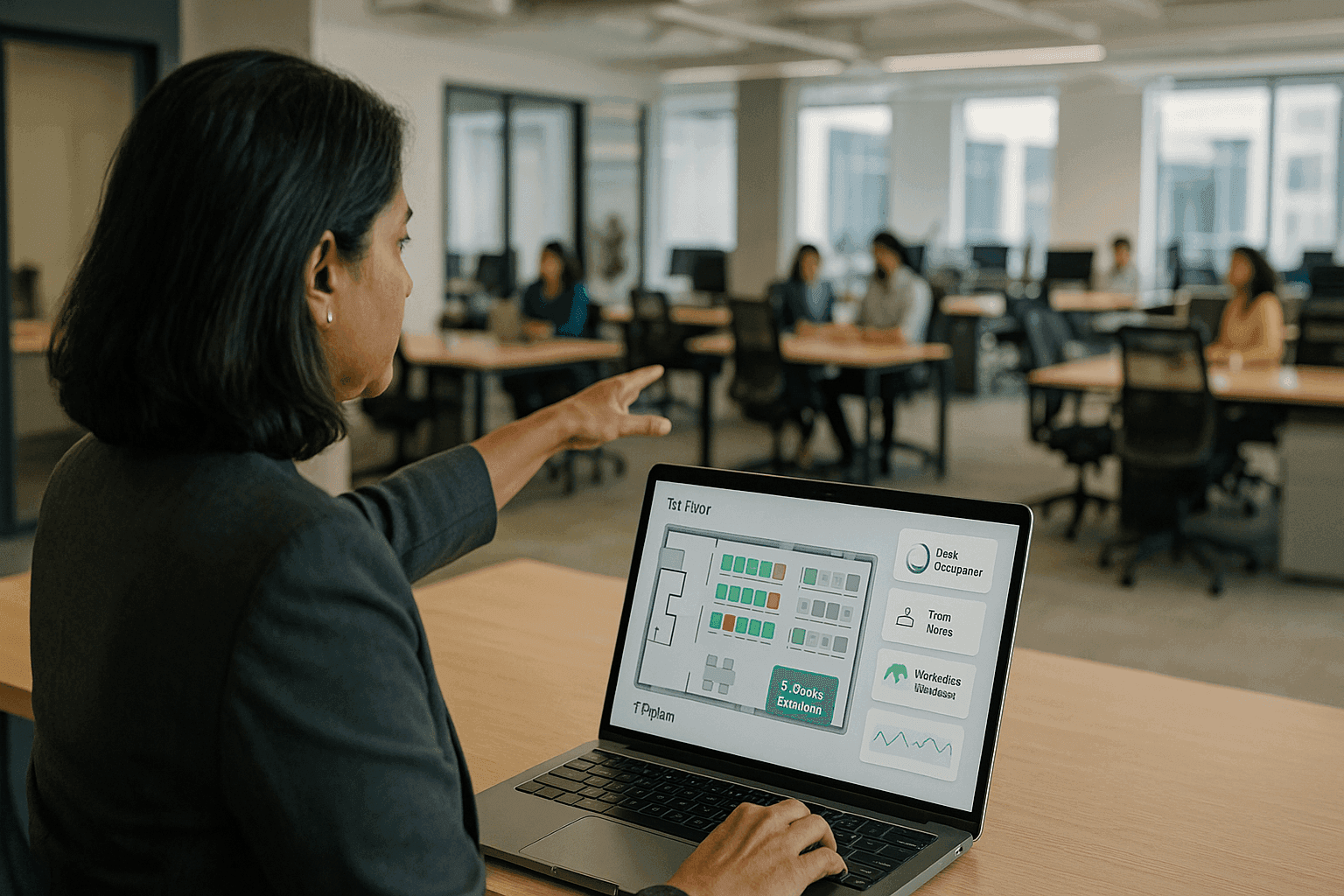
Digital workplace planning replaces static floor plans with interactive layouts that provide real-time visibility into desks, meeting rooms, collaboration areas, and departmental allocations. Facility managers can identify available workspaces quickly, adjust seating plans, and coordinate office moves without relying on disconnected spreadsheets.
Automated seat assignment enables organisations to allocate desks according to business rules such as department, project team, reporting structure, or scheduled office attendance. This reduces administrative effort while helping colleagues who frequently collaborate remain seated within the same neighbourhood or workspace zone. During internal reorganisations or office relocations, managers can compare different seating scenarios before making changes, reducing operational disruption.
Occupancy analytics provide evidence-based insights rather than assumptions. By analysing attendance trends, peak occupancy periods, departmental utilisation, and workspace demand, organisations gain a clearer understanding of how their offices support day-to-day operations. Historical reporting also helps identify recurring occupancy patterns, making it easier to plan for seasonal recruitment, project growth, or changes in hybrid working policies.
Space optimisation software strengthens workplace planning further by identifying underused desks, collaboration areas, or office zones that can be repurposed before additional real estate is leased. For growing software companies in India, this can delay or even eliminate unnecessary expansion costs while improving the employee experience.
Supporting flexible seating with office space management software
Flexible workplace strategies require more than desk booking alone. Many software companies now combine desk reservations, neighbourhood seating, shift-based allocations, and project-specific seating arrangements to accommodate changing work patterns while preserving collaboration.
For example, development, quality assurance, operations, cybersecurity, and customer support teams may rotate through different shifts depending on business priorities. Rather than manually assigning desks each day, automated workplace allocation can assign suitable workspaces based on predefined business rules, availability, or scheduled attendance. Employees know where they will be seated before arriving, while facility teams spend less time managing exceptions and last-minute requests.
Using office space management software to support growth without unnecessary expansion
Growing software companies often assume additional office space is needed as headcount increases. In practice, workplace analytics frequently reveal that existing offices can accommodate more employees through better utilisation.
Space utilisation software measures desk occupancy, identifies surplus capacity, highlights consistently underused areas, and helps evaluate whether seating policies should be adjusted before investing in new office leases. This evidence-based approach supports more informed budgeting, lease negotiations, and long-term workplace planning while reducing the risk of paying for unused office capacity.
Implementing office space management software across software offices in India
Successful implementation begins with understanding current workplace usage before introducing new technology. Organisations should establish occupancy baselines, review attendance patterns, assess seating policies, identify operational bottlenecks, and define measurable objectives for workplace improvement.
A phased rollout generally delivers better adoption than attempting a complete workplace transformation at once. Typical implementation includes:
- Digitising floor plans.
- Integrating HR systems and employee directories.
- Configuring workplace policies.
- Introducing desk reservations.
- Monitoring adoption through occupancy reporting.
Starting with one office or business unit allows organisations in India to refine workflows before expanding the solution across multiple locations.
Integration plays an important role in workplace coordination. Connecting office space management software with calendar applications, access control systems, visitor management platforms, and broader facilities management tools reduces duplicate administration while providing a consistent operational view of workplace activity.
Technology alone does not guarantee successful adoption. Employees need clear guidance on how desk reservations, neighbourhood seating, and hybrid workplace policies operate in practice. Facility teams also benefit from governance around seating rules, reporting responsibilities, exception handling, and ongoing workplace optimisation. When these processes are well defined, the platform becomes a trusted source of workplace information rather than simply another software application.
Organisations operating managed offices or flexible workspaces may also assess how internal workplace management aligns with shared workspace operations. Understanding these operational differences helps determine whether separate workflows or a unified workplace strategy is more appropriate.
Measuring long-term business outcomes with office space management software
The value of office space management software extends well beyond daily seating coordination. Strategic workplace decisions become more reliable when organisations measure actual office usage over time instead of relying on assumptions.
Key workplace metrics include desk occupancy, peak attendance, departmental utilisation, collaboration space demand, meeting room usage, workspace reservation trends, and expansion readiness. Together, these indicators help workplace leaders determine whether current office layouts support business growth or require redesign.
Occupancy analytics also strengthen budgeting and lease planning by highlighting utilisation trends across multiple buildings and office locations. If engineering teams consistently require collaborative spaces while support teams primarily use flexible seating, future workplace investments can be aligned with observed business requirements rather than estimates.
Similarly, space optimisation software helps organisations reduce unnecessary real estate costs by improving utilisation before expanding their property portfolio. Better workplace design can enhance employee experiences while making more effective use of existing office space. Over time, these insights support broader property planning, office refurbishments, portfolio optimisation, and long-term facilities management strategies based on measurable workplace data.
Conclusion
As software companies across India continue to grow while supporting hybrid work, workplace planning requires greater visibility and operational flexibility than manual processes can provide. Office space management software helps organisations coordinate seating, simplify team moves, optimise workplace utilisation, and make informed decisions about office expansion using reliable occupancy data. By balancing employee flexibility with efficient space management, organisations can create workplaces that support business growth, operational efficiency, and a better office experience.
Key Takeaways
- Office space management software enables efficient hybrid workplace operations through workspace reservations, occupancy visibility, and structured workplace planning.
- The platform improves space utilisation by combining automation with occupancy analytics to support informed office expansion decisions.
- This workplace management approach enhances employee experiences while helping organisations maximise the value of existing real estate investments.
Ready to improve workplace planning across your software offices? Explore how eFACiLiTY can help your organisation manage hybrid seating, workplace utilisation, and future office growth with greater confidence. Schedule a demo.
FAQ
Q1. What is office space management software?
Office space management software is a digital workplace solution that helps organisations plan, allocate, monitor, and optimise office spaces. It enables facility and workplace managers to improve space utilisation, manage hybrid seating, coordinate office moves, and use occupancy insights to support informed operational and real estate decisions.
Q2. How does office space management software support hybrid seating?
It enables employees to reserve desks, supports neighbourhood seating, automates workspace allocation based on attendance patterns and business rules, and provides real-time visibility into desk availability. These capabilities reduce scheduling conflicts, improve collaboration, simplify daily workplace management, and help organisations deliver a more flexible office experience.
Q3. What workplace metrics should organisations track before expanding office space?
Organisations should monitor desk occupancy, workspace utilisation, meeting room demand, departmental seating patterns, collaboration space usage, reservation trends, and peak attendance levels. These metrics provide reliable evidence for determining whether existing office space can be optimised before committing to additional real estate investment.
Q4. Can office space management software integrate with existing workplace systems?
Many office space management solutions integrate with HR systems, employee directories, calendar applications, visitor management platforms, access control systems, and facilities management software. These integrations improve data accuracy, streamline workplace operations, reduce manual administration, and provide a unified view of office occupancy and workplace activity.