Introduction
Managing preventive maintenance across multiple facilities in India is rarely straightforward. Large organisations often oversee offices, manufacturing plants, hospitals, educational campuses, retail outlets, hotels and mixed-use properties spread across different cities and states. Without a consistent approach, each location may develop its own maintenance routines, documentation methods and vendor practices, making it difficult to maintain uniform service quality and asset performance.
These inconsistencies can lead to higher equipment downtime, unexpected repair costs, compliance challenges and shorter asset lifecycles. For facility managers responsible for geographically distributed operations, standardising maintenance processes has become an operational priority. This is where computer-aided facility management software helps organisations replace fragmented processes with structured digital workflows that support consistent execution across every site.
Computer-aided facility management software is a digital platform that helps facility managers standardise maintenance workflows, manage assets, schedule preventive maintenance and monitor performance consistently across multiple facilities, improving operational visibility and asset reliability.
What is computer-aided facility management software?
Computer-aided facility management software is a centralised solution that enables facility managers to plan, automate, monitor and standardise maintenance activities across multiple locations. It improves asset reliability, streamlines work orders, enhances compliance reporting and provides consistent operational visibility for organisations managing distributed facilities in India.
As organisations expand into multiple regions of India, maintaining consistent preventive maintenance becomes increasingly complex. A digital platform provides a shared operational framework so that maintenance teams follow common processes while still accommodating local operational requirements, climate conditions and business priorities. This balance allows organisations to maintain governance without overlooking the practical differences between facilities operating in different parts of the country.
Why Preventive Maintenance Becomes Difficult Across Multiple Facilities
Every facility operates within its own environment. A manufacturing plant in Gujarat, a hospital in Bengaluru, a retail outlet in Mumbai and an educational campus in Chennai all experience different operating conditions, staffing levels and maintenance priorities. Over time, these differences often result in inconsistent maintenance practices, particularly when individual sites rely on local spreadsheets, paper records or independently developed procedures.
A lack of standardisation also makes it more difficult for head office teams to compare performance across sites, identify recurring asset issues or verify whether maintenance has been completed on time. As organisations grow through expansion, mergers or acquisitions, these challenges often become more pronounced because assets, processes and documentation may differ significantly between locations.
Common operational challenges include:
- Different preventive maintenance schedules between locations.
- Paper-based inspection records that are difficult to consolidate.
- Variations in technician training and task execution.
- Inconsistent contractor and vendor performance.
- Communication gaps between regional teams and head office.
India’s regional diversity adds further complexity. Climate variations, infrastructure differences and varying operational demands influence maintenance frequency and resource planning. Coastal facilities may require more frequent inspections of corrosion-prone assets, while locations experiencing higher temperatures or seasonal monsoon conditions may need different maintenance intervals for HVAC systems, electrical equipment or drainage infrastructure. Rather than forcing identical workflows everywhere, computer-aided facility management software helps organisations establish standard operating procedures while allowing appropriate site-level flexibility where operational conditions require it.
When preventive maintenance lacks consistency, operational risks increase across the organisation. Equipment failures become more frequent, emergency repairs consume larger maintenance budgets and management teams struggle to demonstrate consistent maintenance records during internal or external reviews. In customer-facing environments such as hotels, hospitals or retail outlets, inconsistent maintenance can also affect occupant experience and business continuity.
How Computer-Aided Facility Management Software Standardises Preventive Maintenance
A computer-aided facility management system creates a single source of truth for maintenance operations. Instead of maintaining separate spreadsheets or paper records at individual sites, all maintenance information is managed within one platform, making it easier to monitor work across geographically distributed facilities in India.
Typical capabilities include:
- Central asset registers with complete maintenance histories.
- Automated preventive maintenance schedules.
- Standardised digital inspection checklists.
- Electronic work order management.
- Mobile access for technicians and supervisors.
Centralisation enables facility managers to ensure preventive maintenance activities are scheduled consistently regardless of location. Standardised checklists reduce variation in technician execution, while mobile applications allow engineers to receive work orders, update task status, upload photographs, capture meter readings and record observations directly from the field. This reduces paperwork, improves data accuracy and provides maintenance records that are immediately available for review.
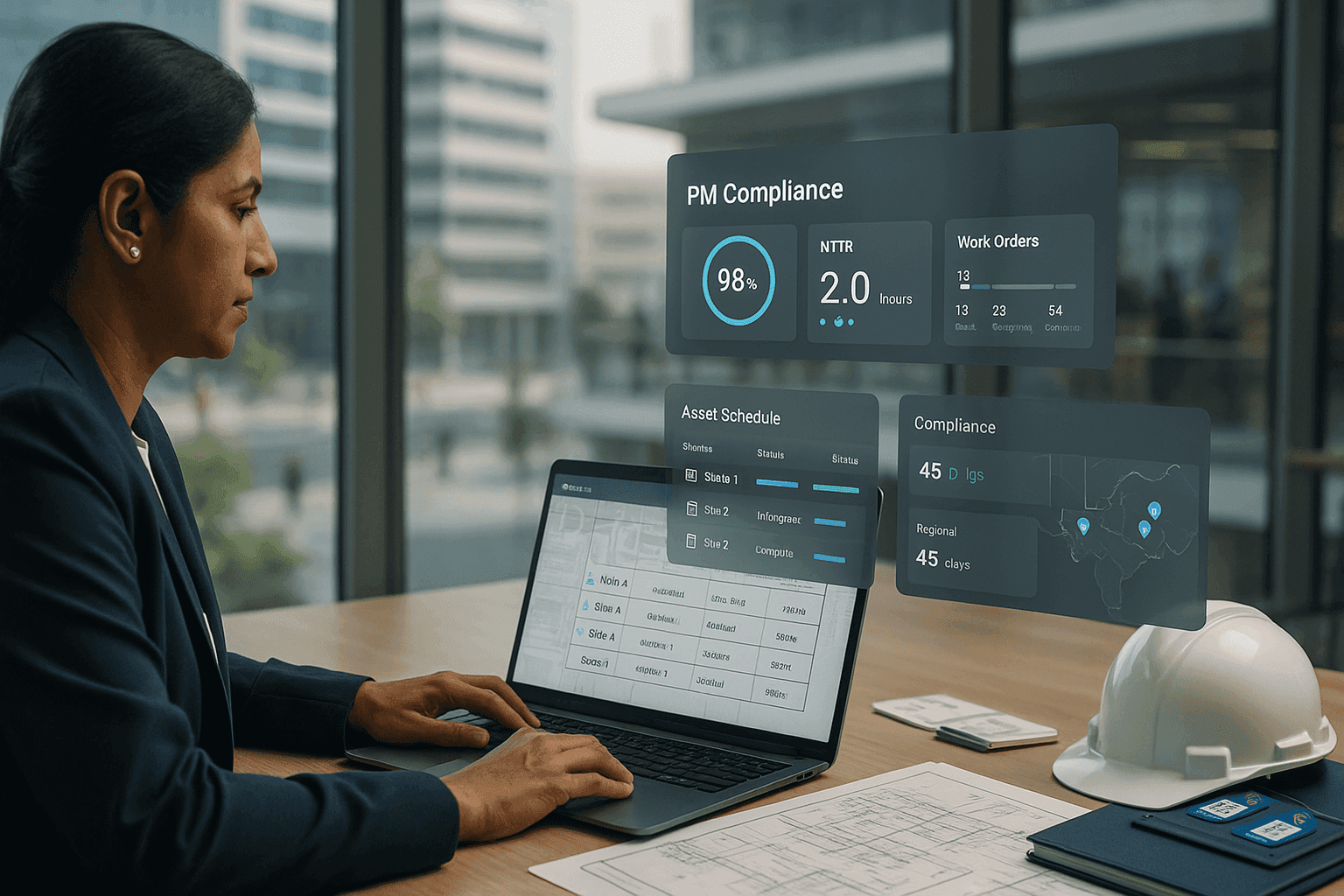
A modern facility management platform also improves visibility across distributed operations. Regional managers can monitor maintenance completion rates, identify overdue work orders, analyse recurring equipment failures and review asset performance without waiting for manual reports from individual facilities. Consistent reporting supports stronger governance by ensuring approved maintenance templates and workflows are used throughout the organisation.
Preventive maintenance also becomes more effective when connected with wider workplace and facility operations. Maintenance planning can be coordinated with occupancy schedules, production activities or operational calendars so that servicing takes place at suitable times, reducing disruption to building users and business operations.
Integrated workplace management capabilities can connect maintenance with space management, occupancy planning, workplace requests and long-term asset planning. Likewise, integrated facility management capabilities improve collaboration between maintenance teams, housekeeping, security, helpdesk functions and external contractors. Shared dashboards provide better visibility of key performance indicators (KPIs), service level agreements (SLAs), maintenance backlogs and operational priorities, enabling managers to make more informed decisions about staffing, budgeting and future asset investments.
Implementing Computer-Aided Facility Management Software Across Multiple Sites in India
Implementing computer-aided facility management software should be approached as an operational improvement programme rather than simply a technology deployment. Successful projects combine process standardisation, data quality improvements and user adoption to create lasting operational consistency.
A phased implementation approach typically includes:
- Cleansing and validating asset data before migration.
- Developing standard preventive maintenance templates and workflows.
- Prioritising rollout according to facility type or operational criticality.
- Training technicians, supervisors and administrators.
- Encouraging mobile application adoption for field teams.
- Monitoring KPIs and refining workflows during implementation.
Beginning with a pilot site allows organisations to validate workflows, identify practical issues and gather user feedback before extending deployment across additional locations. Lessons learned during the pilot can improve adoption, reduce implementation risks and create internal champions who support wider rollout.
Because maintenance requirements vary between industries, organisations should also review applicable Indian compliance requirements, internal policies and sector-specific operational obligations before implementation rather than assuming a single maintenance framework applies to every facility.
Measuring Performance Across Multiple Facilities
Standardisation only delivers long-term value when supported by meaningful performance measurement. Facility managers commonly monitor preventive maintenance compliance, Mean Time Between Failures (MTBF), Mean Time to Repair (MTTR), asset availability, maintenance cost per asset, technician productivity and work order completion rates. Comparing these metrics across multiple facilities helps management identify regional trends, recurring equipment issues and opportunities for process improvement.
For example, if one region consistently reports higher MTTR or lower preventive maintenance completion rates, managers can investigate whether the underlying cause relates to technician capacity, spare parts availability, contractor performance or asset age. Addressing these issues early helps prevent local problems from affecting broader organisational performance.
Practical Learning Resources and Real-World Applications
Many organisations strengthen their implementation planning by reviewing deployment experiences shared through industry blogs, implementation stories and operational case studies. These resources often explain practical rollout approaches, lessons learned during adoption, common implementation challenges and measurable operational improvements achieved after standardising maintenance workflows.
Sector-specific guidance can also provide additional operational value. Hotels, for example, must balance guest comfort, uninterrupted services and timely maintenance while minimising disruption to occupied rooms and public areas. Manufacturing facilities may prioritise production uptime, while hospitals focus on the reliability of critical building systems. Although operational priorities differ between sectors, the principles of preventive maintenance standardisation, consistent asset information and centralised reporting remain broadly applicable across commercial offices, healthcare facilities, educational institutions, manufacturing plants, retail outlets and hospitality properties throughout India.
Conclusion
As organisations continue expanding across India, maintaining consistent preventive maintenance standards becomes increasingly challenging without a structured digital approach. Different operating environments, maintenance teams and regional conditions can quickly introduce unnecessary variation that affects asset reliability, operational efficiency and reporting accuracy.
Computer-aided facility management software enables organisations to standardise maintenance schedules, workflows, asset records and reporting across multiple facilities while preserving appropriate operational flexibility. By replacing fragmented maintenance practices with data-driven processes, facility managers can improve asset performance, strengthen operational visibility, control maintenance costs and support long-term operational excellence.
Key Takeaways
- Computer-aided facility management software centralises maintenance schedules, asset information and work order processes to improve consistency across multiple facilities.
- The platform reduces maintenance variability through standardised workflows, mobile execution and performance reporting, supporting more reliable preventive maintenance.
- This approach improves asset reliability, operational visibility and long-term maintenance planning while accommodating regional operating conditions across India.
Ready to bring greater consistency to preventive maintenance across your facilities in India? Schedule a demo to see how eFACiLiTY can support standardised maintenance workflows and improved operational visibility through Schedule a demo.
FAQ
Q1. What is computer-aided facility management software?
Computer-aided facility management software is a digital platform that helps facility managers manage assets, schedule preventive maintenance, automate work orders and monitor operational performance from a central location. It improves maintenance consistency, reporting accuracy and asset reliability across single or multiple facilities while supporting better operational decision-making.
Q2. How does computer-aided facility management software improve preventive maintenance across multiple sites?
It centralises maintenance schedules, standard operating procedures, asset records and technician workflows within one platform. This enables every location to follow consistent maintenance processes, reduces missed preventive tasks, improves reporting quality and gives managers clear visibility into maintenance performance across geographically distributed facilities throughout India.
Q3. How do integrated workplace management and integrated facility management capabilities support facility teams?
Integrated workplace management capabilities connect maintenance with workplace functions such as occupancy planning and space management, while integrated facility management capabilities coordinate maintenance with services including housekeeping, security and helpdesk operations. Together they improve communication, planning, reporting and operational visibility across multiple facilities.
Q4. What should organisations consider before implementing a facility management platform across multiple facilities?
Organisations should assess asset data quality, standardise maintenance processes, train maintenance teams, define measurable KPIs and plan a phased rollout. They should also consider integration with existing enterprise systems, user adoption, reporting requirements and operational governance to achieve consistent long-term maintenance performance across all sites.