Introduction
US manufacturing Operations Directors must balance equipment availability, throughput, maintenance spending, skilled-labour constraints and ageing assets across plants with different production demands. When work orders, spreadsheets, spare-parts records, condition data and asset histories remain disconnected, allocating maintenance labour and capital becomes harder.
Enterprise asset management is a coordinated software and operating approach for managing physical assets, maintenance, costs, performance and lifecycle decisions across US manufacturing operations.
How does enterprise asset management improve manufacturing operations?
Enterprise asset management gives manufacturing Operations Directors a unified way to manage asset records, maintenance work, labour, spare parts, inspections, costs and performance data. By connecting these processes across equipment and sites, an enterprise asset management system can reduce fragmented maintenance practices, improve asset visibility and support more consistent reliability and lifecycle decisions.
For US manufacturers, the practical benefit is consistency at operational scale. Fragmented processes can result in overdue preventive maintenance, incomplete failure histories, unavailable parts and reactive labour allocation across production machinery, material-handling equipment, utilities and infrastructure.
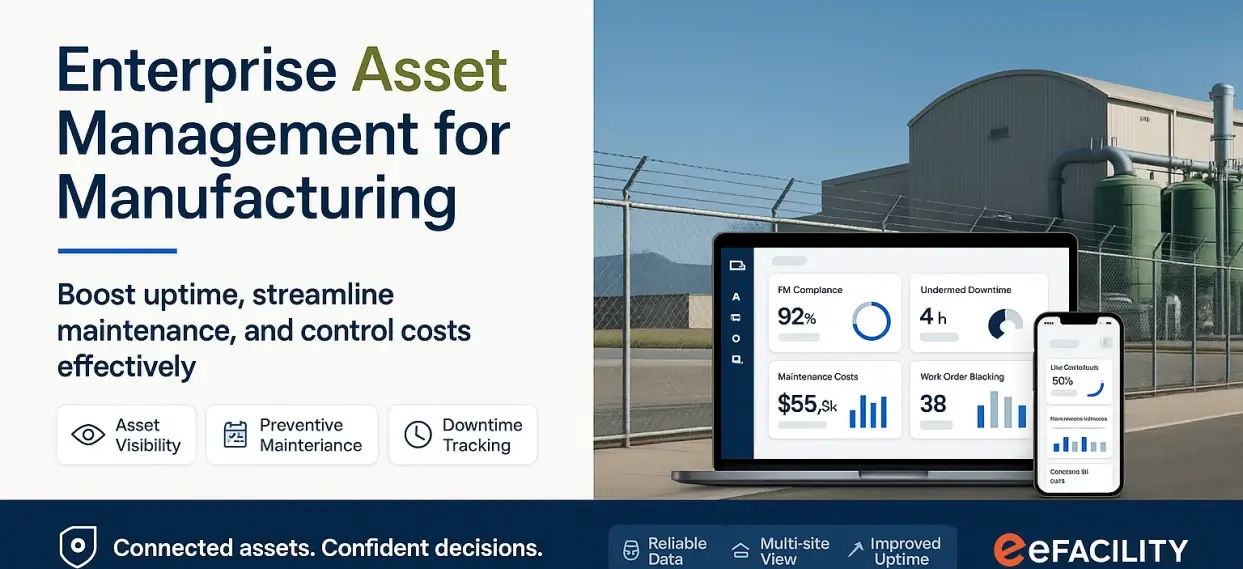
Standardised asset hierarchies, failure codes, work classifications and KPI definitions make measures such as preventive maintenance (PM) compliance, downtime, mean time between failures (MTBF), mean time to repair (MTTR), backlog and maintenance cost more useful for cross-plant decisions. Safety, environmental and regulatory requirements should be assessed against authoritative requirements applicable to each US facility.
How enterprise asset management connects maintenance with lifecycle decisions
From EAM work orders to reliability intelligence
A computerised maintenance management system (CMMS) commonly provides the execution capabilities manufacturers already recognise: scheduling preventive work, issuing work orders, recording technician activity and maintaining service histories. A broader EAM strategy connects those activities with asset hierarchies, inspections, condition information, labour, spare-parts inventory, purchasing, warranties and lifecycle costs.
This connection turns maintenance transactions into decision evidence. If reliable work history identifies repeated failures on a production-critical motor, an Operations Director can examine downtime, parts consumption, labour requirements and condition trends. The evidence can inform whether to adjust the PM strategy, conduct root-cause analysis, overhaul the equipment or plan replacement.
EAM software becomes more useful when it exchanges reliable data with ERP, procurement, inventory, production, IoT or condition-monitoring systems and mobile technician workflows. Integration also reduces duplicate entry and gives operational teams a clearer view of the relationship between maintenance activity, asset performance and cost.
Extending enterprise asset management beyond production equipment
Production continuity also depends on compressed air, electrical distribution, HVAC, process utilities, buildings, yards and other supporting infrastructure. Enterprise facility management can connect these dependencies with production priorities instead of maintaining separate views of facility and manufacturing assets.
This matters when a supporting asset can constrain several production lines. Asset criticality should therefore reflect operational dependency and production consequence, rather than equipment value alone. Related approaches, such as IWMS for telecom campus asset operations, apply a similar connected-asset principle in other complex environments but are distinct from US manufacturing use cases.
How to implement an enterprise asset management system across US manufacturing sites
Build the EAM operating model before scaling technology
Implementation should begin with production-critical assets and defined operating problems rather than an attempt to cleanse every historical record. Establish asset hierarchy, ownership, naming conventions, criticality, work types, failure codes, PM standards, parts relationships and KPI calculations first. Weak source data can otherwise produce convincing but unreliable dashboards.
A representative US plant or asset group provides a practical pilot. Teams can validate technician mobile workflows, integration behaviour, approvals and data ownership before creating repeatable standards for other facilities. Role-based training should address how and why information is captured during everyday maintenance, rather than focusing solely on software screens.
Multi-site governance should create comparable information while preserving legitimate plant-specific requirements. For example, two facilities might use a common failure-code structure while applying different preventive-maintenance intervals because equipment duty cycles, production schedules or operating environments differ.
Measuring the business case for enterprise asset management software
Establishing a baseline before implementation makes subsequent performance changes easier to evaluate. Useful measures include unplanned downtime hours, emergency work, PM compliance, maintenance labour productivity, parts availability, inventory value, repeat failures, contractor spending and maintenance cost per asset or production unit.
The objective is not simply greater software utilisation. US manufacturing Operations Directors need evidence that EAM supports production continuity, maintenance planning, parts readiness, workforce deployment and better repair, overhaul or replacement decisions.
Multi-site reporting can also identify plants where comparable assets experience materially different failure rates, maintenance costs or work patterns. Such comparisons are credible only when KPI definitions and data-capture practices are standardised. A recurring-failure alert, for example, has limited value unless the organisation can change maintenance tactics, remove a root cause or support an evidence-based capital decision.
When evaluating enterprise asset management software, manufacturers should prioritise manufacturing workflow fit, integration capability, technician mobile execution, scalability, governance and trustworthy decision data. These factors usually provide more operational insight than comparing long feature lists without reference to actual plant workflows.
Conclusion
Enterprise asset management connects daily maintenance execution with longer-term reliability, cost and lifecycle decisions across US manufacturing operations. For an Operations Director, the objective extends beyond digitising work orders: it is to create consistent asset intelligence that supports production continuity and capital planning. Start with measurable operational problems, trustworthy data, practical technician workflows and governance that can scale across US plants.
Key Takeaways
- Enterprise asset management connects maintenance activity, asset condition, costs, parts and lifecycle history to strengthen operational decisions.
- An enterprise asset management system establishes consistent asset data, workflows, measures and governance across multi-site US manufacturing operations.
- EAM software combines critical-asset data, technician workflows, integrations and performance baselines to support reliability and lifecycle decisions.
Explore how eFACiLiTY can support maintenance standardisation, asset visibility and lifecycle decision-making across US manufacturing operations. Contact us to discuss an integrated EAM strategy.
FAQ
Q1. What is enterprise asset management?
Enterprise asset management is the coordinated management of physical assets throughout their operational lifecycles using software, standardised processes and reliable asset data. For manufacturing operations teams, it connects maintenance work, labour, parts, costs, condition information and performance history to support equipment availability, reliability and evidence-based repair, overhaul or replacement decisions.
Q2. What is the difference between EAM and CMMS software?
CMMS software commonly focuses on maintenance execution, including work orders, schedules, preventive maintenance and service records. EAM typically extends this visibility across asset lifecycle costs, performance, inventory, procurement and multi-site processes. Capabilities can overlap, so US manufacturers should evaluate actual workflows, integrations and operational decision requirements rather than relying on software category labels.
Q3. What should manufacturers consider before implementing enterprise asset management software?
Manufacturers should define desired business outcomes, critical assets, data standards, maintenance workflows, integrations, mobile requirements, reporting definitions and governance before implementation. Baseline relevant operational KPIs and pilot representative equipment or a US plant first. The resulting lessons can then guide repeatable standards and controlled deployment across additional manufacturing facilities.