Imagine an assistant that understands your operations, acts immediately, and carries out every instruction without repeated follow-up.
It sounds ideal…
Until it executes the wrong objective perfectly.
That is the dilemma enterprises face as artificial intelligence moves beyond answering questions and begins initiating actions. Gartner predicts that up to 40% of enterprise applications will include task-specific AI agents by 2026, compared with less than 5% in 2025.
For facility leaders, this shift is not merely a technology development. Decisions initiated by AI can affect asset reliability, employee safety, statutory compliance, operational costs, service continuity, and business revenue.
The critical question is therefore no longer whether agentic AI in facility operations can act.
It is whether the organisation has defined what AI should be allowed to decide, when it must seek approval, and when it should not act at all.
Facility Operations Have a Coordination Problem
Facility operations depend on the coordination of assets, technicians, contractors, spare parts, service requests, safety permits, approvals, SLAs, and compliance obligations.
A single maintenance requirement may involve several teams and systems. The request must be understood, prioritised, assigned, monitored, escalated, verified, and closed. When information is fragmented, or coordination depends on manual follow-up, delays quickly accumulate.
The consequences are operational and financial:
- Service requests remain unresolved longer
- Maintenance backlogs increase
- Technicians lose time to administrative coordination
- SLA risks are identified too late
- Critical work competes with routine requests
- Vendor and approval delays extend repair cycles
- Managers spend more time chasing updates than improving performance
These pressures make agentic AI in facility operations attractive.
Unlike traditional automation, which follows fixed instructions, agentic AI can interpret information, select appropriate actions, initiate workflows, and coordinate activities towards an operational objective with limited human intervention.
Used appropriately, it can shorten work-order cycles, reduce manual follow-up, improve technician utilisation, surface operational exceptions earlier, and lower exposure to avoidable downtime.
But this value depends on more than the AI’s ability to complete a task.
It depends on whether the AI understands the wider operation that task affects.
When AI Optimises the Task but Misses the Operation
An AI agent may complete exactly what it was instructed to do and still produce the wrong operational outcome.
Consider a work order that has remained open beyond its SLA. An AI agent focused on closure performance may prioritise a temporary repair, update the required fields, and move the task towards completion.
The workflow appears efficient.
But the underlying asset problem remains unresolved.
The temporary intervention may lead to another failure, an additional technician visit, higher maintenance costs, and longer future downtime. Meanwhile, the closed work order improves the reported SLA performance, creating an inaccurate picture for management.
A similar failure could begin with incorrect work prioritisation:
A routine task is prioritised ahead of a critical asset intervention. The technician is dispatched, the critical repair is delayed, the asset fails, operations are disrupted, and the organisation incurs financial loss. When leadership asks why the decision was made, ownership is unclear.
Agentic AI can also quietly weaken control when:
- Work orders close without sufficient evidence
- Tasks are assigned without validating certifications
- Maintenance schedules change without engineering review
- Approval stages become routine confirmations
- Permit requirements are missed
- Incomplete data drives confident recommendations
- One performance target is optimised at the expense of wider operational risk
These failures do not remain within the workflow. They can increase expenditure, prolong downtime, weaken compliance, distort management reporting, and expose the organisation to safety, legal, financial, and reputational consequences.
The greater enterprise risk is not simply that AI makes an incorrect decision.
It is that decision authority becomes blurred, human scrutiny declines, and the organisation remains responsible for actions it no longer fully controls.
Where Autonomy Works and Where It Should Stop
Agentic AI creates the greatest value when work is:
- Structured
- Repeatable
- Low-risk
- Governed by clear rules
- Reversible if something goes wrong
Within these boundaries, AI can classify service requests, route work, monitor SLAs, send reminders, compile summaries, initiate predefined workflows, and coordinate routine follow-ups.
Autonomy becomes more sensitive when decisions involve:
- Safety-critical assets
- Statutory or regulatory compliance
- Financial commitments
- Changes to critical maintenance plans
- Permits to work
- Contractor competency
- Incomplete or conflicting information
- Actions that are difficult to reverse
In these situations, AI should support human judgement rather than replace it.
The goal is not maximum autonomy.
It is appropriate autonomy, where the level of decision authority given to AI reflects the risk and consequence of the action.
The C3A2 Framework for Governed Autonomy
The C3A2 Framework evaluates five conditions that determine whether AI should act independently, seek approval, or escalate: Context, Authority, Confidence, Consequence, and Accountability.
Before an AI agent is allowed to act independently, these five conditions should be clear.
1. Context
Does the AI understand the asset, its maintenance history, location, operational criticality, SLA, technician requirements, contractor obligations, and wider business dependency?
Context requires more than access to records. AI must understand how assets, workspaces, people, contracts, workflows, risks, and business services relate to one another.
An AI operational layer can bring these connected signals together, helping the system interpret what is happening, why it matters, which dependencies are affected, and what operational controls should apply before any action is taken.
2. Authority
Is the AI explicitly permitted to act within the applicable user role, site, workflow, asset class, and approval structure?
The ability to execute an action does not automatically provide the authority to make the decision.
3. Confidence
Is the available information accurate, complete, and reliable enough to justify autonomous action?
When confidence falls below an accepted threshold, the AI should request clarification or escalate the decision.
4. Consequence
What could happen if the decision is incorrect?
Low-impact and reversible actions may permit greater autonomy. Safety-sensitive, financially significant, or irreversible decisions require stronger human control.
5. Accountability
Can the enterprise trace why the action occurred, what information influenced it, which rules were applied, and who remains responsible for the outcome?
Accountability cannot disappear simply because the action was automated.
When context is incomplete, authority is unclear, confidence is low, consequences are significant, or accountability cannot be established, AI should escalate rather than execute.
This is the foundation of AI governance in facility management.
Turning Autonomy into Accountable Action
Governed autonomy requires controls that are embedded into operational workflows rather than added after deployment.
These include:
- Role-based access and permissions
- Approval thresholds for high-impact actions
- Confidence-based escalation
- Human review for safety, compliance, and financial decisions
- Reliable operational and master data
- Traceable AI recommendations and actions
- Exception management
- Clearly assigned decision ownership
- The ability to reverse or stop authorised actions
The governance challenge can become more complex when multiple specialised AI agents coordinate different parts of a workflow. Each agent may operate correctly within its individual task, while their combined actions create an unintended result.
Enterprises must therefore govern both individual agent authority and the interactions between agents, systems, users, and workflows.
These controls do not reduce the value of AI-driven facility operations. They protect enterprises from gaining speed at the cost of accountability, resilience, and operational trust.
What Governed Agentic AI Looks Like in Practice
Governed autonomy cannot be achieved through an intelligent agent alone. The agent requires a connected operational context.
Most AI assistants understand language. Enterprise AI must also understand operational relationships, governance policies, business context, and decision authority
This is where eFACiLiTY® AI Cortex becomes relevant.
eFACiLiTY® AI Cortex operates as the intelligence and orchestration layer within the eFACiLiTY® enterprise-grade IWMS & CAFM platform. It connects natural-language interaction and AI-driven coordination with operational data, workflows, permissions, approvals, responsibilities, and escalation paths.
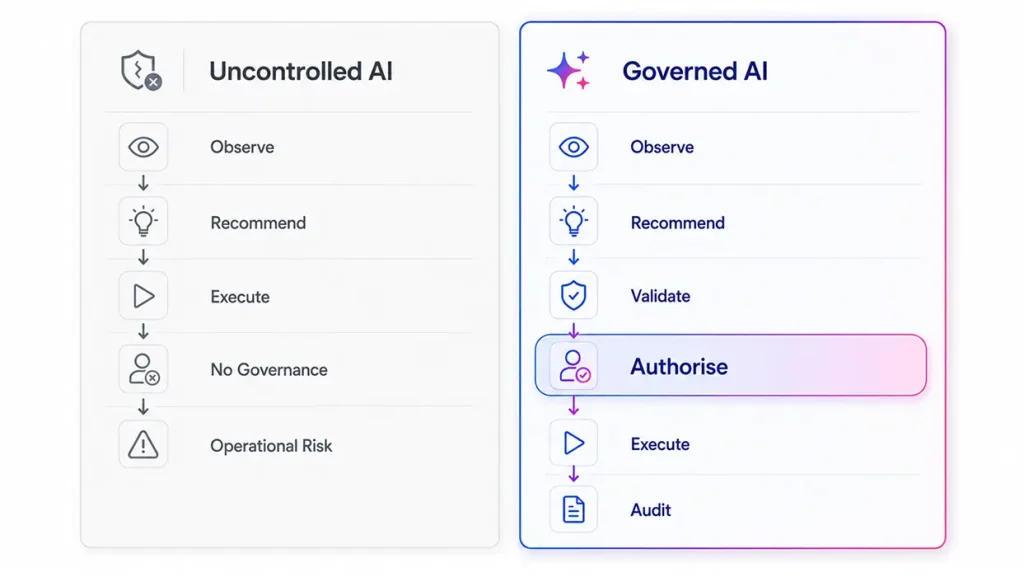
Within this connected environment, AI Cortex can support a controlled progression of action:
- Observe operational conditions
- Interpret requests and exceptions
- Recommend the next appropriate action
- Initiate authorised workflows
- Coordinate routine activities
- Escalate when risk, uncertainty, or authority thresholds are crossed
Its value is not defined merely by the number of activities it can automate.
eFACiLiTY® AI Cortex helps enterprises reduce coordination effort, accelerate response, improve decision consistency, and turn connected operational information into accountable action, without compromising governance, compliance, or human authority.
Governed AI depends on the wider operational platform beneath it. Explore our guide on how to choose the right facility management software for your enterprise.
Autonomy Should Remove Friction, Not Authority
Agentic AI can reshape how facility operations respond, coordinate, and act.
But enterprise AI should not be measured by how many decisions it can make independently. It should be measured by how effectively it removes routine friction while preserving human control over decisions involving operational, financial, safety, and compliance consequences.
In enterprise facility management, responsible autonomy will become a competitive advantage, not because it automates more decisions, but because it protects the decisions that matter most.
The future of enterprise facility operations will not belong to the AI that acts the fastest.
It will belong to the AI that knows when not to act.