Introduction to Workplace Management Systems for Manufacturing in Egypt
Manufacturing Directors in Egypt must protect production continuity while coordinating assets, maintenance teams, contractors, utilities, space and facility requests across complex industrial sites. High ambient temperatures, dust exposure, energy-intensive building services and multi-shift operations can place additional pressure on supporting infrastructure. When facility services fail, the consequences can extend beyond maintenance costs to production schedules, working conditions and product quality.
A workplace management system is a digital platform that gives manufacturing leaders a coordinated view of facilities, assets, maintenance, space, utilities, service requests and workplace operations, helping them improve plant reliability, cost control and operational decision-making.
How can a workplace management system improve manufacturing operations in Egypt?
A workplace management system helps manufacturers in Egypt centralise facility, asset, maintenance, space, energy and service data. Manufacturing Directors can use this visibility to prioritise preventive work, coordinate internal teams and contractors, reduce avoidable downtime, monitor facility costs and make faster decisions across plants operating demanding production schedules.
Why Egyptian Manufacturing Plants Need a Connected Workplace Management System
Production equipment depends on the facility infrastructure around it. HVAC, electrical distribution, fire and life-safety assets, utilities, building services and compressed-air systems, where applicable, can directly affect production continuity. In Egyptian plants facing heat, dust, intensive equipment use and multiple shifts, operating conditions can influence inspection priorities, maintenance frequencies and asset lifecycle decisions.
Disconnected systems make these dependencies harder to manage. A work order may sit in one application while contractor records, asset histories, manuals and cost information remain elsewhere. This fragmentation can contribute to delayed escalation, duplicated effort, incomplete maintenance histories and weak visibility of service performance and plant-level costs.
Manufacturing facility management connects these activities to production-support requirements. For Manufacturing Directors, the important shift is from isolated reactive maintenance to operational context: what failed, where it failed, which production-support process depends on it, who owns the response and what the asset has cost over its lifecycle.
A shared system can also improve consistency between sites. Asset naming conventions, priority definitions and maintenance workflows can be standardised at enterprise level while individual Egyptian plants retain appropriate permissions, asset hierarchies and local operating procedures.
Workplace management system capabilities that support plant reliability
A workplace management system should be evaluated by workflow outcomes rather than feature count. When a fault is detected or reported, information should move through prioritisation, assignment, mobile execution, verification, cost capture and asset-history updates without unnecessary manual re-entry. Connected records give managers a clearer basis for reliability and investment decisions.
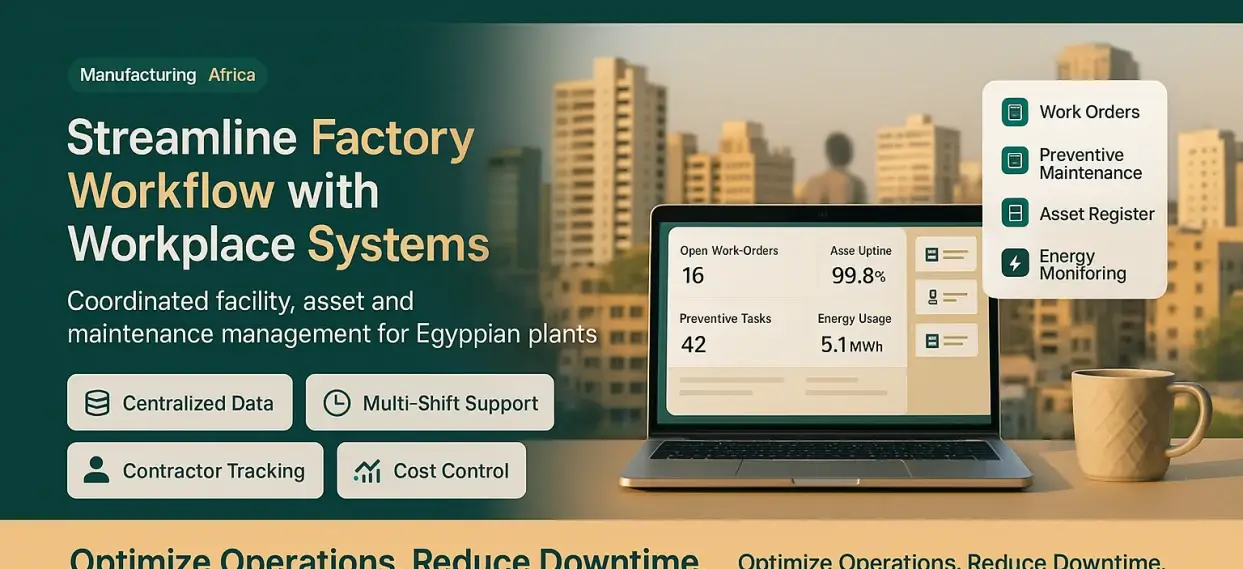
Useful capabilities include work-order management, preventive maintenance scheduling, asset registers, inspections, service requests, document control, contractor workflows, dashboards and energy or utility monitoring where supported. Mobile access can help technicians receive tasks, review asset information and record completion data closer to the point of work.
Manufacturing Directors may also encounter terms such as integrated workplace management software, integrated facility management software and computer aided facility management software. These approaches overlap in their use of connected data for assets, locations, space, maintenance and workplace services. For a manufacturing environment, the practical test is whether the platform can support plant-specific dependencies rather than simply maintaining administrative property records.
Manufacturing facility management software should therefore connect asset condition, maintenance activity, contractor performance and production-support infrastructure. A team should be able to trace a reported fault through response and verified resolution while retaining labour, contractor, parts and other relevant cost information against the appropriate asset or location.
How to implement a workplace management system and measure ROI
Implementation should begin with measurable operational problems, such as excessive reactive work, slow service response, incomplete asset histories, poor contractor visibility or weak facility-cost allocation. Rather than migrating every legacy record, manufacturers in Egypt can prioritise critical production-support assets and cleanse identifiers, locations, ownership details, maintenance schedules and useful work-order history.
Integrations should also follow business value. Depending on the plant and available systems, a workplace management platform may exchange relevant information with ERP, building management, access control, IoT, metering, HR or identity systems. Integration should remove useful manual hand-offs or improve decisions rather than simply increase technical scope.
A bounded pilot in one plant area or workflow can test data quality, mobile adoption, permissions, reporting and process ownership before wider deployment. Governance should establish accountability for master data, workflow configuration, KPI definitions and continuous improvement. Application rationalisation is equally important: manufacturers should identify overlapping maintenance and workplace applications rather than introducing another disconnected layer.
Measuring workplace management system ROI
ROI should be compared with credible pre-implementation baselines. Useful measures include preventive versus reactive maintenance, facility-related downtime, mean time to repair, maintenance backlog, SLA performance, contractor spend, asset lifecycle cost, technician productivity and energy or utility consumption where dependable data exists. Direct savings, avoided costs, productivity gains and operational-risk reduction should be reported separately rather than combined into an unsupported headline figure.
Conclusion
For manufacturing operations in Egypt, a workplace management system creates value when facility information supports operational decisions rather than merely replacing spreadsheets. Starting with high-impact workflows, reliable asset data, purposeful integrations and measurable baselines can strengthen production continuity, lifecycle cost visibility, maintenance forecasting and scalable governance across one plant or multiple Egyptian sites.
Key Takeaways for Workplace Management Systems
- A workplace management system connects asset information, maintenance workflows, facility services, utilities and operational reporting to improve production-support reliability.
- The platform reduces fragmented decision-making by establishing consistent workflows and data across teams, contractors, assets and manufacturing locations.
- This connected approach supports measurable value when implementation begins with critical workflows, trusted asset data, purposeful integrations and baseline KPIs.
Explore how eFACiLiTY can support asset reliability, maintenance visibility and scalable facility operations across manufacturing sites in Egypt. Contact us to learn more about its workplace and facility management capabilities.
FAQ
Q1. What is a workplace management system?
A workplace management system is software that centralises facility, asset, maintenance, space, service and workplace information in a coordinated operational environment. For Manufacturing Directors, it provides structured workflows and performance data that help teams coordinate maintenance, improve facility reliability, control costs and make informed decisions across manufacturing sites.
Q2. How should a manufacturer implement a workplace management system?
Manufacturers should start with defined operational problems, critical assets, reliable facility data and measurable baseline KPIs. A controlled pilot can then validate workflows, mobile adoption, integrations and reporting before wider deployment. Clear governance for asset data, permissions, process ownership and performance measurement should support subsequent expansion across plants.
Q3. What should Manufacturing Directors look for in facilities management software?
Manufacturing Directors should assess facilities management software for asset and work-order control, preventive maintenance, mobile execution, contractor workflows, reporting, integration, data governance and multi-site scalability. The strongest fit supports plant-specific processes and production-support infrastructure while providing consistent information for maintenance, operational and capital-investment decisions.