CAFM software supports this exact use case.
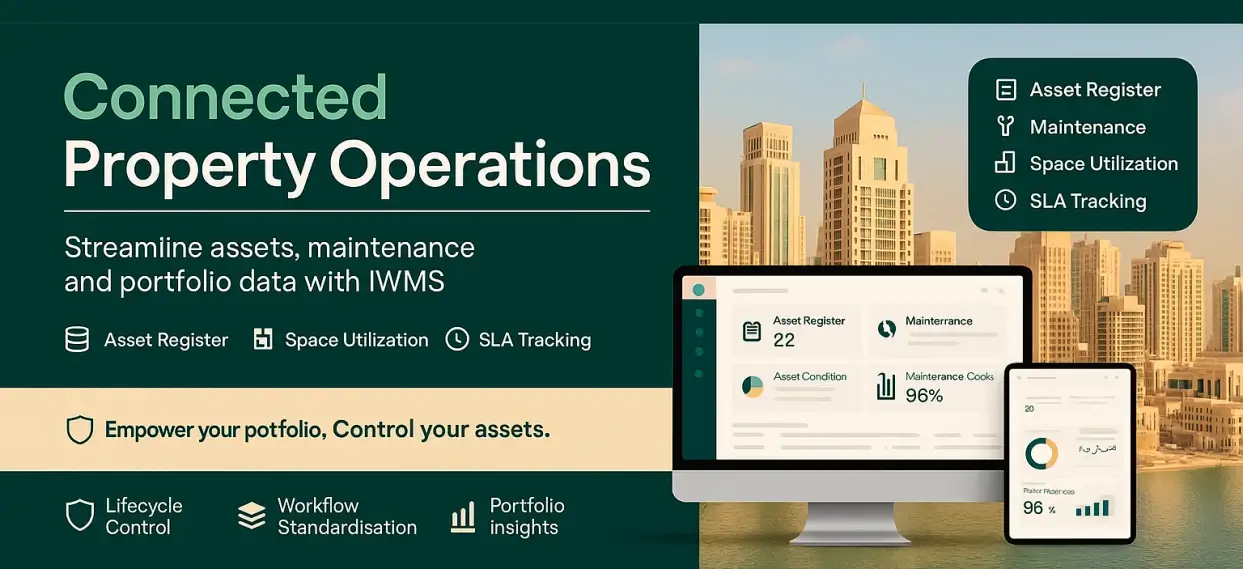
IWMS Software is an integrated digital platform that helps property developers and real estate operators manage facilities, assets, maintenance, space, service providers and portfolio data throughout the operational property lifecycle.
Introduction to IWMS Software for UAE Property Developers
UAE property developers face a significant operational transition when newly commissioned assets become occupied, revenue-generating properties. Handover records, asset registers, warranties, maintenance plans, contractor information and space data often sit in separate systems. Across residential, commercial, retail, hospitality and mixed-use portfolios, this fragmentation can weaken lifecycle visibility just as cooling-intensive MEP operations and service-provider coordination become critical.
For UAE-listed property groups, IWMS Software can create a connected operational data layer between development, facilities management and portfolio reporting rather than simply digitising work orders.
How does IWMS Software help property developers at UAE-listed property groups?
IWMS Software helps UAE-listed property developers connect asset, maintenance, space, contractor and portfolio data within one operational environment. It improves facilities management handover, standardises workflows across properties, strengthens reporting and auditability, and provides clearer lifecycle information for controlling operating costs, service quality, asset condition and long-term property performance.
Why UAE Property Developers Need IWMS Software Beyond Project Handover
Practical completion does not necessarily mean operational readiness. Equipment may have been installed, tested and commissioned while asset naming, warranties, O&M documents, preventive-maintenance requirements, BIM information and equipment hierarchies remain inconsistent. Simply importing those records can create a digital version of the same fragmentation.
An IWMS should preserve validated handover information in a structure that operations teams can use repeatedly across successive developments. Asset records should be associated with locations, specifications, warranties, documents, criticality classifications and maintenance requirements before they become part of day-to-day FM workflows.
This is particularly relevant in the UAE, where high cooling demand, critical MEP systems, outsourced FM contracts, mixed-use developments and demanding service expectations place immediate pressure on operational information. Defect and warranty records need to remain traceable while planned maintenance begins. Incomplete handover information can therefore become an OPEX, service-level and warranty-recovery issue.
Existing technology does not necessarily need to be replaced. A computer-aided facility management system, facilities management platform or existing maintenance application may already support service delivery. The priority is to establish governed data and workflows that can operate within, or integrate effectively with, the wider IWMS environment.
How IWMS Software Creates Portfolio-Wide Operational Control
A reliable operational chain begins with a verified asset register. Assets can then be linked to maintenance strategies, scheduled work, technician or contractor execution, SLA tracking, costs and failure histories. Consistent location hierarchies and naming conventions are important because management cannot meaningfully compare properties when each development describes equipment and work differently.
IWMS Software can turn this property-level activity into portfolio intelligence. UAE property groups can analyse recurring failures, downtime, contractor performance, asset condition, maintenance expenditure and space utilisation using consistent information across multiple developments.
This traceability can also strengthen governance and audit readiness for listed property groups, although software alone does not guarantee compliance. Applicable UAE data, building, safety, cybersecurity and corporate requirements should be assessed against current authoritative sources and the organisation’s specific obligations.
Integrated facilities management data can also support repair-versus-replacement decisions, warranty recovery, maintenance optimisation and future capital planning. ROI should be measured against a pre-implementation baseline using indicators such as planned-to-reactive work ratios, repeat failures, SLA performance, maintenance costs and administrative effort.
Connections with BIM handover information, building management systems (BMS), ERP and procurement platforms, IoT sensors and document repositories can extend this visibility. Each integration should serve a defined operational workflow or reporting requirement rather than transferring data simply because it is available.
How to implement IWMS Software across a UAE property portfolio
Establish the operational data model before IWMS Software migration
Implementation should start with the operating model rather than bulk data migration. UAE property groups should define asset taxonomy, location hierarchy, criticality classifications, master-data ownership, document requirements, SLA definitions and management reporting outputs. Otherwise, transferring incomplete development records into IWMS Software merely makes inconsistent information easier to access.
A controlled pilot on a representative operating property or new handover can test asset structures, maintenance workflows and reporting before wider deployment. A mixed-use UAE development can be particularly useful because it exposes operational interfaces between common areas, different property uses, contractors and MEP systems.
Build governance, integrations and adoption into IWMS Software deployment
Roles and permissions should reflect how development teams, FM personnel, technicians, external contractors and management actually work. Mobile execution, workflow ownership, integration testing and data-quality controls require comparable attention. Access controls and audit trails become particularly important when several service providers can create, modify or close operational records.
Success should be assessed after go-live through adoption and operating KPIs rather than deployment alone. Asset-data completeness, preventive-maintenance completion, repeat failures, contractor SLA performance and lifecycle forecast quality can indicate whether the IWMS is improving operational control.
Conclusion: IWMS Software for UAE Property Groups
IWMS Software can give UAE-listed property groups continuity from development handover through everyday FM execution, portfolio reporting and long-term asset decisions. Its value depends on verified data, standard workflows, appropriate integrations and sustained adoption. Developers that define operational information requirements before handover are better positioned to scale consistent facilities management as their UAE portfolios expand.
Key Takeaways for IWMS Software
- IWMS Software enables lifecycle continuity by preserving usable asset information from development handover through maintenance and replacement planning.
- The platform improves portfolio visibility by connecting assets, contractors, workflows, costs and performance data within a governed operational environment.
- This approach reduces operational fragmentation through consistent master data, standard workflows, purposeful integrations and measurable portfolio KPIs.
See how eFACiLiTY can support an integrated approach to asset, maintenance and facilities operations across a growing UAE property portfolio. Schedule a demo to explore the fit.
FAQ
Q1. What is IWMS Software?
IWMS Software is an integrated workplace management platform that centralises information and workflows for facilities, assets, maintenance, space and related property operations. For UAE property developers and real estate groups, it provides a common operational environment for managing buildings after handover, coordinating service providers and monitoring performance across multiple properties.
Q2. How should a UAE property developer prepare for an IWMS implementation?
A UAE property developer should define consistent property, location and asset hierarchies, validate handover records, assign data owners and document priority workflows and KPIs. Implementation should then address integrations, user permissions, contractor access, mobile execution and data controls, ideally through a controlled pilot before wider portfolio deployment.
Q3. What integrations matter most for an integrated workplace management software platform?
Integration priorities depend on the property group’s technology environment and operating model. Common candidates include ERP and procurement platforms, BIM and digital handover data, building management systems, IoT platforms, identity management and document repositories. Each integration should support a defined operational workflow, control or reporting requirement.