Introduction
After a merger or acquisition, ownership may consolidate quickly, but an Indian real estate portfolio rarely does. Real estate managers can inherit buildings, leases, vendors, asset registers, maintenance practices and reporting structures spread across spreadsheets, CAFM tools, ERP records and local processes. Across offices, commercial buildings and business parks in multiple Indian cities, this fragmentation makes costs, occupancy and service performance difficult to compare.
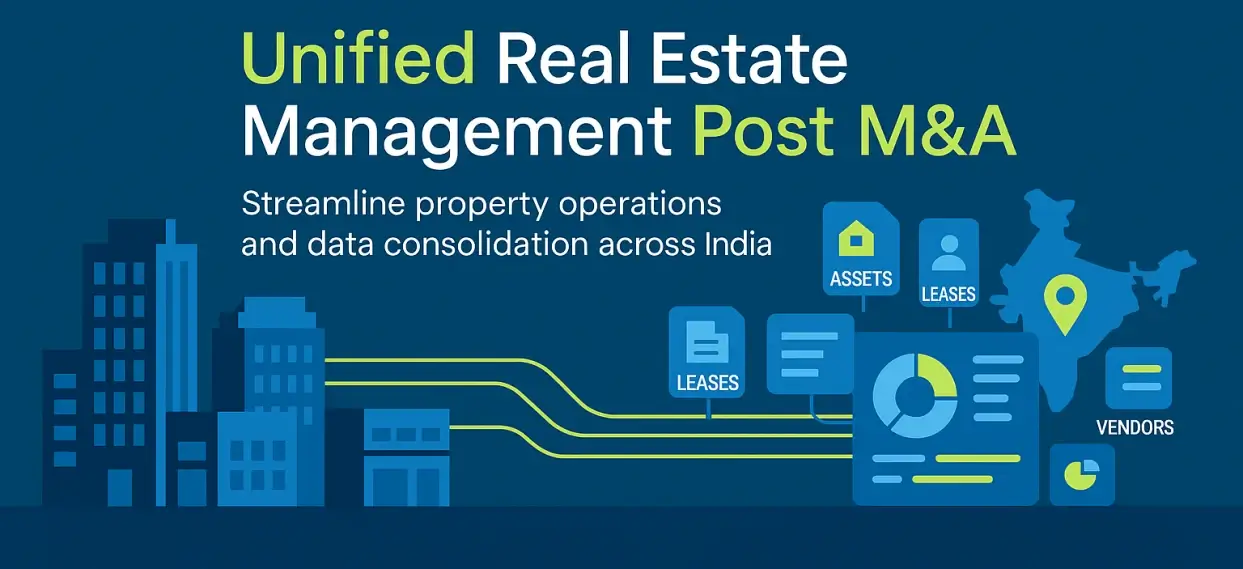
Integrated workplace management software is a centralised platform that helps real estate managers unify property, space, asset, maintenance, lease, vendor and workplace data, providing consistent workflows, reporting and performance controls for a combined portfolio after a merger or acquisition.
The objective is therefore broader than migrating systems. A well-governed platform can create a common operational layer while accommodating legacy applications, different vendor ecosystems and Indian sites at varying levels of operational maturity.
How can integrated workplace management software help real estate managers after an M&A?
Integrated workplace management software consolidates property, space, asset, maintenance, lease and vendor information after an M&A. It gives real estate managers a shared operational environment with consistent workflows, comparable reporting and stronger cost visibility, supporting better decisions about occupancy, maintenance, portfolio consolidation and future real estate requirements across India.
Why integrated workplace management software matters for post-M&A real estate integration in India
Two organisations can describe the same operational reality differently. Building identifiers, asset classifications, preventive-maintenance schedules, lease milestones, service-level agreements (SLAs), cost centres and workplace policies may follow incompatible structures. Simply combining reports does not resolve these differences. Duplicate assets, missing records and inconsistent KPI definitions can distort maintenance costs, utilisation figures and lease exposure.
This is the difference between system consolidation and operating-model consolidation. Moving both organisations onto one application without reconciling classifications, ownership and processes only centralises inconsistent information. For commercial real estate and facility management teams in India, the more useful outcome is governed portfolio data supported by common operating rules.
Where IWMS integration gaps create the greatest risk
Real estate managers should prioritise records that directly affect portfolio decisions. These include property and location master data, critical assets, lease dates, planned and reactive maintenance, occupancy information, vendor SLAs and operational cost allocations.
The quality of these records can influence whether an organisation consolidates offices, renews a lease, changes a service provider or reallocates maintenance expenditure. A duplicated asset register can inflate maintenance budgets, while incomplete lease records can reduce visibility of upcoming expiries and other critical events. Post-M&A integration should therefore prioritise decision-critical information rather than migrate every historical record indiscriminately.
How integrated workplace management software creates one operating model
An integrated workplace management system connects real estate, space, asset, maintenance, service request, vendor and analytics workflows within a common environment. A practical sequence is to standardise master data, establish common approval and service workflows, integrate relevant enterprise applications, and then introduce shared dashboards and KPIs.
For organisations operating across India, existing and acquired locations can consequently be assessed using comparable definitions instead of local reporting conventions. Integrated facility management may remain the service-delivery model, while IWMS software provides the underlying data, workflows and controls used to govern internal teams and outsourced providers.
Decisions IWMS data should improve
Reliable combined data should improve decisions about footprint rationalisation, lease renewals, space allocation, preventive maintenance, vendor management, capital expenditure and operating costs. Relevant indicators include data completeness, SLA adherence, work-order ageing, preventive versus reactive maintenance, space utilisation, cost by site and lease-event visibility.
Connections to ERP or finance platforms, employee directories, occupancy technologies, building systems and vendor ecosystems can further improve operational visibility. However, integrations should be prioritised by business value rather than attempting to connect every legacy system during the first implementation phase.
Implementing integrated workplace management software without carrying legacy problems forward
Implementation should begin with the target operating model, not a bulk data upload. Teams should map both organisations’ property, asset, lease, space, vendor and work-order sources, assign data owners, remove duplicates and standardise classifications. Critical records should be validated before migration, while historical information should be retained or migrated according to operational, reporting and verified retention requirements.
For geographically distributed Indian portfolios, a pilot across selected offices or commercial properties can test taxonomy, mobile workflows, integrations, SLAs and management reporting before wider deployment. Adoption should include facility teams, real estate managers, vendors and relevant business stakeholders. Building operations, safety, privacy, lease and records requirements can vary by asset and jurisdiction within India and should be verified for the specific portfolio.
Governance, scalability and the post-M&A business case
Go-live does not complete integration. Master-data ownership, change controls, role-based access, agreed KPI definitions, integration monitoring and periodic data-quality reviews help prevent individual locations from returning to inconsistent practices.
ROI should be measured against pre-implementation baselines rather than attributing every post-merger saving to the platform. Relevant outcomes include reduced administrative effort, retirement of duplicate systems, improved maintenance planning, better lease visibility, more consistent vendor performance and identification of underused space. For CAFM-focused teams, integrated workplace management software for B2B CAFM can also provide a common framework for governing facility operations as the portfolio changes.
Conclusion
Post-M&A real estate integration in India is a data-governance and operating-model challenge as well as a software project. Integrated workplace management software gives real estate managers a consistent foundation for property, workplace, lease, maintenance, asset and vendor decisions across combined portfolios. Clean master data, high-value workflows, measurable KPIs and phased adoption should precede broader automation.
Key Takeaways
- Integrated workplace management software enables post-M&A portfolio visibility by bringing property, asset, lease, space, maintenance and vendor information into a governed operational environment.
- The platform reduces integration risk by standardising master data, workflows, responsibilities and performance measures across existing and acquired Indian sites.
- This approach strengthens decision-making by connecting IWMS adoption with measurable outcomes in maintenance, utilisation, vendor SLAs, lease visibility, data quality and operating costs.
See how eFACiLiTY can support consistent portfolio data, facility workflows and reporting across a combined Indian estate. Schedule a demo to discuss your post-M&A operating and integration requirements.
FAQ
Q1. What is integrated workplace management software?
Integrated workplace management software is an enterprise platform that centralises real estate, space, asset, maintenance, lease, workplace and facility information. It enables real estate and facility teams to manage buildings through shared data, workflows, reporting and operational controls, particularly across complex, multi-site portfolios created or expanded through mergers and acquisitions.
Q2. What data should be migrated into an IWMS after a merger or acquisition?
Real estate managers should prioritise properties, spaces, critical assets, leases, vendors, maintenance plans, open work orders, service levels and relevant cost references. Historical data should be migrated selectively according to operational, reporting and verified retention requirements, rather than transferring every legacy record and potentially carrying duplicates or obsolete information into the new environment.
Q3. How should real estate managers measure ROI from an integrated workplace management system after M&A?
Real estate managers should establish pre-implementation baselines for maintenance costs, work-order ageing, SLA compliance, space utilisation, data quality, vendor performance, lease visibility and administrative effort. ROI can then be assessed against measurable improvements, including retired systems, better maintenance planning and reduced underutilisation, without attributing unrelated post-merger savings to the IWMS.