Introduction
India’s expanding airport terminals create a facilities-management challenge alongside the capacity challenge. Airport directors must accommodate higher passenger volumes and larger asset estates without allowing added complexity to undermine uptime, safety, passenger experience or operating costs. Gates, passenger areas, MEP infrastructure, maintenance teams, contractors, utilities and terminal spaces increasingly need to be managed as interconnected parts of airport performance.
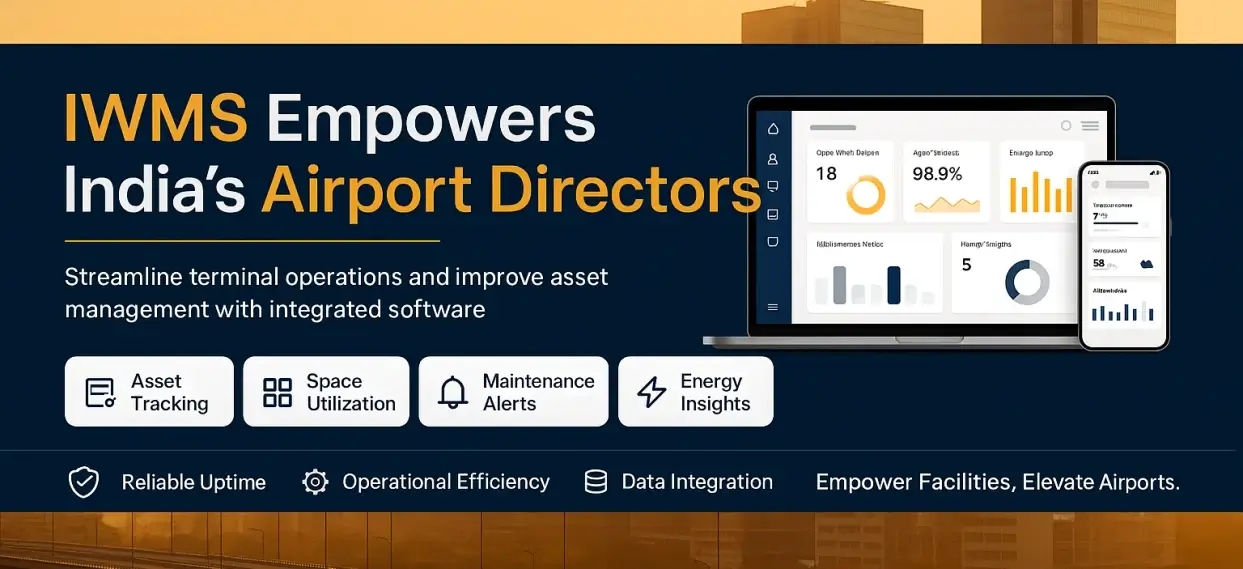
IWMS India is an integrated digital approach that helps Indian airport operators manage facilities, assets, space, maintenance, energy and operational data across expanding terminals through a coordinated workplace management platform.
An integrated workplace management system (IWMS) connects day-to-day facilities execution with longer-term terminal planning. This gives airport leadership a consistent evidence base for operational decisions, lifecycle management and capital investment.
How can IWMS India help airport directors manage expanding terminals?
IWMS India helps airport directors coordinate terminal space, critical assets, maintenance, energy, contractors and facilities data within one management environment. By connecting workflows with real-time and historical information, an integrated workplace management system can improve asset availability, maintenance visibility, capacity decisions and lifecycle planning as airport infrastructure expands across India.
Why Expanding Indian Airport Terminals Need Connected IWMS Operations
IWMS India Reduces Risks Created by Fragmented Facilities Data
Terminal expansion magnifies weaknesses in fragmented facilities information. Asset registers may sit in spreadsheets, drawings in separate repositories and service records with contractors or individual departments. When an HVAC unit, baggage-area facility asset, escalator, lift, electrical system or passenger amenity fails, incomplete information can delay diagnosis and obscure maintenance responsibility.
An IWMS establishes a governance layer across these records without replacing specialised aviation, passenger-processing or security systems. Airport directors can relate equipment to terminal locations, work orders, maintenance histories, costs and contractors. This makes recurring failures, overdue maintenance and service-level exposure easier to identify.
For Indian airports operating busy terminals for extended hours, asset criticality also matters. A maintenance backlog should not be prioritised solely by work-order age. Equipment supporting passenger circulation, essential utilities or operationally sensitive terminal areas may require faster intervention because the consequence of failure is greater.
Terminal Capacity Depends on Usable, Resilient Space
More floor area does not automatically produce more effective capacity. Lounges, retail and service areas, passenger circulation zones, maintenance rooms and back-of-house spaces have different constraints. Space management helps airport leadership evaluate utilisation alongside passenger movement, accessibility, maintenance access and operational resilience.
This becomes particularly useful during seasonal peaks, terminal refurbishment and phased expansion. High utilisation alone is not necessarily desirable: airports may need spare capacity for disruption management, queue changes, maintenance access or future reconfiguration. Linking spatial and facilities data helps directors understand whether existing space can be used differently before committing to additional construction.
How IWMS India connects airport assets, maintenance, space and energy
Connecting terminal data across the asset lifecycle with IWMS India
Integrated workplace management software can maintain a structured asset register that connects equipment with locations, inspections, preventive maintenance, warranties, technicians, contractors, work orders and lifecycle costs. Mobile workflows can route faults to accountable teams and escalate overdue tasks, while dashboards provide visibility into uptime, maintenance backlog, response times, recurring failures and contractor SLA performance.
This enterprise facilities-management view becomes more valuable during airport expansion because spatial records can connect rooms and operational zones with their assets, energy consumption and maintenance demand. Airport directors in India can identify where costs are increasing, whether back-of-house areas could be repurposed and what facilities consequences could follow from modifying passenger-facing areas.
Where reliable BIM or CAD information exists, it can add spatial context to asset and maintenance records. This creates stronger evidence for capital planning than floor plans viewed in isolation. Leadership can assess whether existing terminal space should be reconfigured while understanding the associated asset, utility and maintenance implications.
Integrating IWMS India with airport building and enterprise systems
An IWMS can exchange authorised information with building management systems (BMS), IoT sensors, utility meters, ERP or procurement applications, and BIM/CAD environments. It should complement rather than attempt to replace specialised airport operational, passenger-processing and security technologies.
Integration therefore requires deliberate governance. Indian airport operators should assess API capabilities, master-data ownership, cybersecurity controls, role-based permissions and data consistency before connecting systems. Sensor information, for example, has limited management value if readings cannot be mapped reliably to the correct asset, terminal location and accountable maintenance workflow.
Energy information can also become more actionable when connected to assets and locations. Instead of reviewing consumption only at terminal level, facilities teams can investigate abnormal usage alongside equipment condition, operating schedules and maintenance history, helping distinguish operational demand from avoidable inefficiency.
Implementing IWMS India without disrupting live airport operations
Start with airport outcomes, data quality and a bounded IWMS pilot
An airport in India should begin with specific operational outcomes rather than attempting to digitise every facilities process simultaneously. Measures might include critical-asset uptime, preventive-maintenance completion, work-order response times, contractor SLA performance, energy intensity, space utilisation and asset lifecycle cost.
Reliable asset hierarchies, location structures, equipment criticality and ownership should precede extensive workflow automation. Poor master data merely allows inconsistent decisions to move faster.
A bounded pilot, such as one terminal area, critical asset class or maintenance workflow, gives an airport a practical way to validate data, roles, mobile processes and integrations without introducing airport-wide change at once. After validation, operators can extend priority integrations, train facilities teams and contractors, measure adoption and progressively expand the IWMS deployment.
Governance should define corporate facilities-management responsibilities, role-based access, contractor accountability and dashboard ownership. Applicable Indian aviation, building, fire-safety, accessibility, environmental and data requirements should be verified for each airport and deployment. An IWMS can support auditable records and controlled workflows, but software does not establish regulatory compliance by itself.
ROI should extend beyond software savings. Avoided downtime, maintenance productivity, energy performance, stronger SLA control, better asset-life decisions and better-targeted or deferred capital expenditure provide more meaningful measures when credible pre-deployment baselines exist.
Conclusion
Terminal expansion makes a coherent digital view of assets, spaces, maintenance and resource consumption increasingly valuable for airport directors in India. IWMS India can connect facilities execution with capacity, energy and lifecycle planning while preserving the role of specialist airport systems. Its value depends on trustworthy data, selective integrations, measurable outcomes and phased adoption that protects continuity across live terminal operations.
Key Takeaways
- IWMS India enables airport directors to coordinate terminal assets, space, maintenance, contractors and energy through a connected facilities-management operating model.
- The platform improves operational visibility by linking asset data, work orders, service levels, locations and lifecycle costs within consistent governance.
- A phased IWMS approach reduces deployment risk by combining defined airport outcomes, reliable master data and priority integrations before extending workflows across terminals.
See how eFACiLiTY can connect airport assets, maintenance workflows, spatial information and management reporting as terminals expand across India. Schedule a demo to discuss your airport’s operational requirements.
FAQ
Q1. What is IWMS India?
IWMS India refers to integrated workplace management system software used by Indian organisations to coordinate facilities, assets, maintenance, space, energy and related operational data. For airport directors, it creates a common management environment for terminal facilities operations and long-term planning while supporting controlled integration with authorised building and enterprise systems.
Q2. Can an IWMS integrate with existing airport facilities systems?
Modern IWMS platforms can integrate with relevant BMS, IoT, utility metering, ERP and BIM/CAD environments through suitable interfaces. The appropriate scope depends on the airport’s architecture, cybersecurity requirements, operational criticality and data ownership. Specialist aviation, security and passenger-processing platforms can remain separate while exchanging approved facilities-related information where required.
Q3. How should an Indian airport measure ROI from IWMS software?
Indian airports can measure IWMS ROI through changes in critical-asset downtime, preventive-maintenance completion, work-order response, energy performance, contractor SLA results, space utilisation and lifecycle costs. Airport directors should establish credible baselines before deployment so improvements can be measured consistently and used to prioritise subsequent phases of the IWMS programme.