Introduction
For a JSE-listed real estate group in South Africa, managing offices, retail centres, industrial properties and logistics assets can become a finance challenge when lease, occupancy, maintenance, utility, asset and capital-project data sit in separate systems. Fragmentation makes cost movements harder to explain, expenditure more difficult to forecast and portfolio performance less consistent to compare.
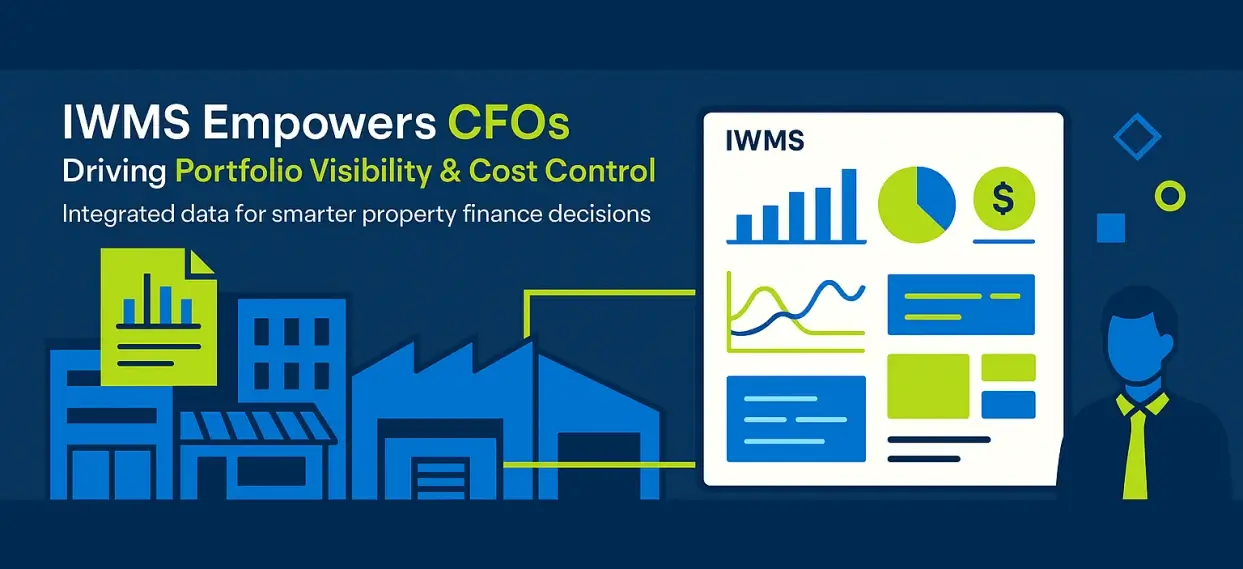
IWMS is an integrated workplace management system that gives property and finance leaders a shared view of facilities, assets, space, occupancy, maintenance and portfolio costs, supporting more disciplined operational and investment decisions.
For South African CFOs, the value extends beyond facilities efficiency. Connecting operational property activity with finance-ready information can improve budgeting, capital allocation, portfolio analysis and management reporting while providing clearer evidence of how physical assets consume operating expenditure and capital.
How can IWMS help CFOs control property portfolio costs?
IWMS helps CFOs control property portfolio costs by connecting occupancy, space, maintenance, asset, lease and project information in one governed environment. For South African real estate groups, this can expose underused capacity, recurring maintenance expenditure and capital priorities while improving forecasting, variance analysis and portfolio-level financial visibility across diverse property types.
The important distinction is traceability. A portfolio-level operating-cost variance has limited decision value if finance cannot trace it to a property, asset, work order, supplier or cost centre. Connecting these records allows management to investigate exceptions rather than relying solely on aggregated totals.
For example, higher maintenance expenditure at a retail centre may reflect repeated reactive work on a particular asset rather than a general rise in facilities costs. That distinction matters when deciding whether to continue repairing the asset, revise preventive maintenance or consider replacement.
Why Fragmented Property Data Creates an IWMS Business Case
Separate spreadsheets, contractor applications, property records and facilities management software can create competing versions of portfolio performance. Reconciliation then becomes a recurring administrative task, while budgets and forecasts depend on information captured at different times and levels of detail.
A workplace management system becomes financially useful when operational records are mapped consistently to properties, assets, budgets and cost centres. Work orders can reveal repeated failures, planned-maintenance records can inform expenditure forecasts, utility information can highlight unusual consumption, and space data can expose occupancy inefficiencies across South African properties.
From Facilities Activity to Finance-Ready IWMS Evidence
An IWMS should preserve sufficient granularity for finance teams to investigate why expenditure changed. Instead of seeing only an increase in maintenance spend, management can identify which assets generated reactive work, which suppliers performed it and how those costs compare with maintenance history and asset condition.
This evidence also supports more disciplined asset lifecycle planning. It can help distinguish recurring operating expenditure from potential capital requirements without assuming that reduced maintenance activity automatically translates into cashable savings.
Which IWMS capabilities matter most to a real estate CFO?
An integrated workplace management software investment should be judged by the decisions it improves rather than the length of its feature list. For CFOs overseeing South African property portfolios, the most relevant capabilities usually include consolidated portfolio visibility, occupancy analytics, preventive maintenance, asset lifecycle records, supplier information, capital-project tracking and executive reporting.
These capabilities create more value when they operate from consistent data. An asset with repeated reactive expenditure, for example, can be viewed alongside its condition, work history and associated costs. Finance and property teams can then make a better-informed repair-versus-replacement decision and identify similar cost patterns across the portfolio.
IWMS integration and data governance determine financial usefulness
Integration with ERP and finance systems, procurement platforms, property and lease records, and relevant building-management or IoT data is critical. Common property, asset and cost identifiers are equally important because inconsistent identifiers can undermine reconciliation even when systems are technically connected.
Legacy computer-aided facility management system records may require mapping, deduplication and cleansing before migration. CFOs assessing computer-aided facility management software alongside a broader IWMS should therefore consider data ownership, master-data standards, reporting definitions and responsibility for correcting incomplete records.
How CFOs should build an IWMS ROI case
An IWMS ROI case should begin with an auditable baseline covering relevant occupancy costs, maintenance expenditure, planned and reactive work, contractor spending, unused space, asset downtime and administrative effort. Proposed benefits should then have a defined baseline, target, data source, accountable owner and measurement period.
Finance should distinguish between cashable savings, avoided expenditure, productivity improvements and benefits related to risk or decision quality. Treating these categories separately reduces the risk of overstating the investment case.
Measure IWMS ROI against South African portfolio economics
For a JSE-listed South African property group, the ROI assessment should consider whether occupancy decisions, maintenance planning, asset life and capital allocation measurably improve after implementation. A representative portfolio pilot can test data quality, integrations and reconciliation with finance records before wider deployment.
An occupancy-cost lens can also connect utilisation information with lease and property costs, helping finance identify where space is materially underused. After go-live, recurring benefit reviews should compare realised outcomes with the original baseline so that IWMS ROI remains measurable rather than becoming a one-off implementation forecast.
Conclusion
For JSE-listed South African real estate groups, the CFO case for IWMS is not simply about replacing facilities management software. It is about connecting property activity with credible, traceable financial evidence.
A well-governed IWMS can strengthen cost visibility, capital prioritisation, forecasting and long-term portfolio performance when integration, data integrity, adoption and benefit measurement are managed as finance priorities. Any decisions involving South African statutory, accounting, sustainability, governance or listing obligations should be assessed against current authoritative requirements.
Key Takeaways
- IWMS connects occupancy, maintenance, asset, space and cost information to strengthen portfolio-level financial visibility.
- The platform exposes underutilisation, recurring maintenance expenditure and asset lifecycle decision points that can inform cost and capital decisions.
- An IWMS ROI framework separates cashable savings, avoided expenditure and other benefits using agreed baselines, accountable owners and finance-reconciled measurements.
Explore how eFACiLiTY can consolidate facilities and portfolio information around financially significant use cases for your South African property portfolio. Contact us to discuss your priorities.
FAQ
Q1. What is IWMS?
IWMS, or integrated workplace management system, is software that unifies property, space, asset, maintenance, occupancy and related operational information. For real estate groups, it gives facilities, property and finance teams a shared environment for managing buildings and analysing costs, utilisation, maintenance requirements and asset lifecycle needs across a portfolio.
Q2. How should a CFO calculate ROI from an IWMS?
A CFO should establish auditable baseline costs before implementation and measure verified changes in occupancy, maintenance, contractor expenditure, downtime and administrative effort. The ROI model should separate cashable savings from avoided costs, productivity and risk benefits, then compare realised value with implementation, integration, subscription and ongoing support costs over an appropriate period.
Q3. What should a South African real estate group assess before implementing IWMS?
A South African real estate group should define the financial and operational decisions the IWMS must improve, then assess data quality, portfolio identifiers, integrations, reporting ownership and user adoption. Finance, facilities, property, procurement and IT should also agree baseline measures and governance responsibilities before rollout to avoid creating another disconnected property-data silo.