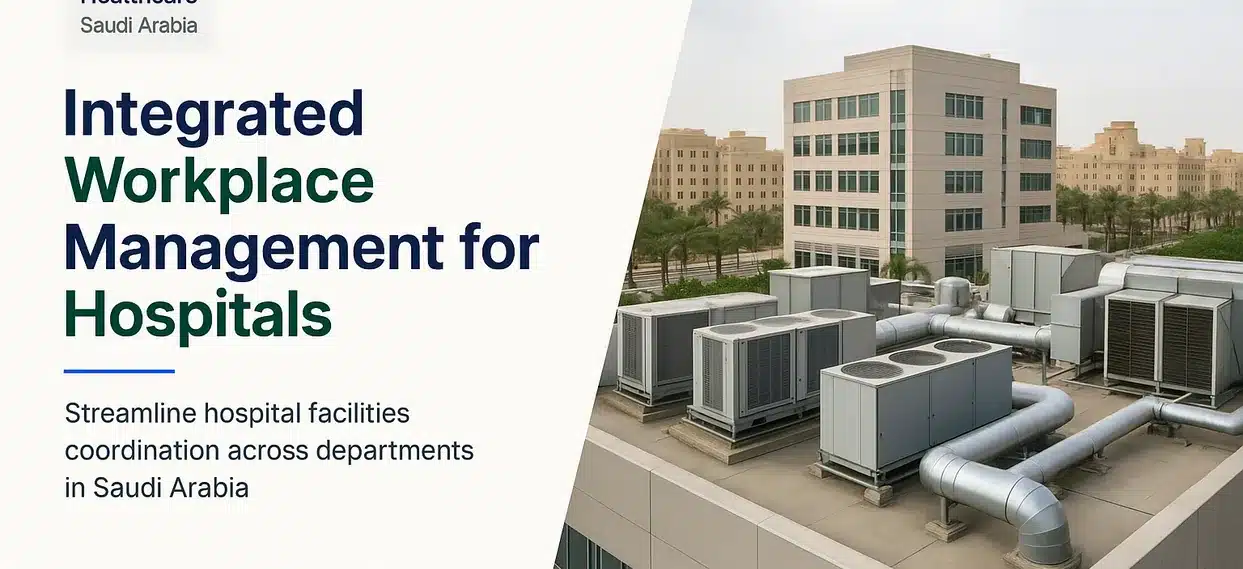
Saudi Arabian hospitals operate within a uniquely complex environment, where multiple departments must compete and collaborate for finite facility resources, all while complying with rigorous health, safety, and regulatory standards. Manual processes and fragmented systems often undermine operational efficiency, leading to increased costs and, ultimately, impacting patient care and safety.
An integrated workplace management system is a digital platform that unifies and streamlines hospital facility coordination across all departments, enhancing efficiency and compliance for healthcare providers.
What is an integrated workplace management system for hospitals?
An integrated workplace management system (IWMS) for hospitals is purpose-built software that centralises all facility management tasks, resources, and data across the organisation. It enables coordinated scheduling, preventive maintenance, asset tracking, and compliance documentation for every department, supporting facility managers in optimising operations and creating safer patient environments.
Why Saudi Arabian Hospitals Need Integrated Facility Coordination
Key Operational Challenges in Hospital Departmental Facilities
Saudi Arabian hospitals face distinct operational and regulatory demands, including stringent infection control protocols, climate-specific energy management, and robust emergency preparedness. Departments often function in silos, which can lead to duplicate work orders, missed maintenance windows, and resource conflicts—directly threatening efficiency and patient safety.
- Strict compliance with Ministry of Health and local regulatory standards
- Increased pressure on HVAC and critical systems due to extreme climate
- Risks of duplicated work and missed maintenance without unified coordination
- Potential for higher costs and patient care interruptions from disconnected workflows
Core Capabilities of Healthcare IWMS for Departmental Coordination
Digital Workflows, Computer Aided Facility Management Software, and Real-Time Visibility
Healthcare IWMS platforms in Saudi hospitals provide a unified solution for preventive maintenance, asset management, space utilisation, and compliance across all departments. Modules for computer aided facility management automate scheduling and resource allocation, significantly reducing manual errors and operational downtime.
- Unified dashboards for real-time monitoring of departmental facility operations
- Automated work order management and asset tracking across all hospital areas
- Integration with building management systems for improved energy efficiency
- Centralised compliance documentation supporting regulatory readiness
- Shared data and processes for seamless collaboration between departments
Implementing an IWMS in Saudi Hospitals: Steps for Success
Stakeholder Engagement, Data Migration, and Change Management
A successful IWMS implementation in Saudi hospitals starts with detailed mapping of current departmental workflows and defining cross-functional KPIs that align with the hospital’s objectives. Early engagement with stakeholders—including department heads, IT, facilities, and compliance teams—is critical to breaking down silos and establishing shared priorities.
- Map existing departmental processes and identify integration opportunities
- Engage key stakeholders for buy-in and input throughout deployment
- Plan and validate data migration, ensuring regulatory compliance
- Deliver comprehensive training and support change management programmes
- Establish ongoing review and feedback to refine workflows post-implementation
Measuring ROI: Cost Reduction and Uptime Gains in Hospital Facilities
Facilities Management Software for Hospitals: Cut Costs and Improve Uptime
Integrated workplace management systems deliver clear, measurable ROI for Saudi hospitals by reducing maintenance costs, minimising unplanned downtime, and optimising resource allocation between departments. Automated reporting simplifies compliance audits and provides the data required for strategic financial planning.
- Reduced maintenance spend through automated scheduling and preventive maintenance
- Lower unplanned facility downtime, supporting continuous patient care
- Improved resource allocation and utilisation across departments
- Enhanced compliance audit readiness and strategic reporting
- Demonstrable gains in operational efficiency and regulatory adherence
Conclusion
Integrated workplace management systems empower Saudi Arabian hospitals to move beyond fragmented facility management, unlocking new levels of operational efficiency, regulatory compliance, and cost control. By embracing advanced healthcare facility management software, hospital facility managers can transform workflows, reduce risk, and deliver safer, more reliable patient environments. Strategic IWMS implementation positions hospitals for ongoing success as regulations and operational challenges evolve.
Key Takeaways
- Integrated workplace management systems enable seamless coordination of hospital facilities, improving patient safety and supporting compliance in Saudi Arabia.
- Healthcare IWMS delivers cost savings and increased uptime by automating maintenance and resource scheduling across all hospital departments.
- Computer aided facility management software allows Saudi hospitals to meet local regulatory requirements and address operational challenges unique to the region.
See how an integrated workplace management system can elevate your hospital’s facility operations and compliance in Saudi Arabia. Schedule a demo with eFACiLiTY to get started.
FAQ
Q1. What is an integrated workplace management system?
An integrated workplace management system (IWMS) is software that consolidates and streamlines facility management processes, enabling hospitals to coordinate maintenance, compliance, and resources across departments for improved efficiency and patient care.
Q2. How does a healthcare IWMS improve hospital facility coordination?
Healthcare IWMS platforms automate work order management, track assets, and integrate data from all departments. This reduces manual effort, prevents duplication, ensures timely maintenance, and supports compliance with Saudi Arabian healthcare regulations.
Q3. What should Saudi hospitals consider when implementing an IWMS?
Hospitals should assess departmental workflows, ensure data accuracy, engage all stakeholders, and align the system with Ministry of Health regulations. Training and change management are key to successful adoption and maximising operational benefits.