Introduction
Kenyan FM service providers often coordinate office portfolios, retail locations, banking sites, telecommunications infrastructure and healthcare facilities through one operations function. Multiple technicians, subcontractors, SLAs, preventive maintenance schedules and asset registers create control challenges when service requests are divided between spreadsheets, messaging applications and standalone maintenance tools.
Facilities management software is a digital platform that helps FM service providers coordinate assets, work orders, technicians, preventive maintenance, SLAs and client reporting across multiple sites through a central operational system.
How does facilities management software help FM service providers in Kenya?
Facilities management software helps Kenyan FM service providers coordinate work orders, assets, technicians, subcontractors, preventive maintenance and SLAs across multiple client locations. It gives operations directors central visibility into service performance, strengthens field-team accountability and supports consistent reporting, while providing operational data for controlling costs, compliance responsibilities and contract performance.
Why FM service provider operations become difficult to scale without facilities management software
Outsourced FM creates a more complex control environment than managing a single corporate estate. Each client may have different sites, assets, maintenance frequencies, response and resolution targets, escalation rules and reporting expectations. Fragmented request intake can therefore cause duplicate jobs, delayed assignments and incomplete evidence that contractual service levels were achieved.
The challenge becomes more pronounced when technicians and subcontractors cover geographically dispersed Kenyan properties. Mobile connectivity can also vary between sites. Managers need dependable timestamps, job status updates and field evidence without making service continuity dependent on informal messages or constant connectivity.
Facilities management software can establish a common operational record while preserving contract-specific workflows and permissions. Service desks can see outstanding requests, supervisors can monitor SLA risks, and field teams can capture job information against the correct client and asset.
Better data also helps operations directors distinguish isolated faults from recurring asset problems. Without reliable histories, repeated breakdowns can inflate reactive maintenance expenditure, distort technician utilisation and make contract profitability harder to assess. A structured facility management platform provides the evidence needed to review these patterns across individual contracts and the wider portfolio.
How facilities management software controls multi-client service delivery
A well-configured facilities management system creates a traceable workflow from request to verified closure. A service request is captured, categorised and prioritised; the relevant SLA is applied; and an appropriate technician or subcontractor is assigned. Field users can then record attendance, work completed, materials consumed, photographs or other supporting evidence and completion status.
Supervisors can review this information before closing the job. The resulting service record can feed operational dashboards and client reports, reducing the effort required to reconstruct performance from emails, spreadsheets and messaging histories.
Asset histories and preventive maintenance schedules provide another level of control. Operations teams can identify repeat failures, overdue maintenance and assets with rising service costs. That evidence supports more informed decisions about repair, replacement and planned maintenance rather than treating every failure as an unrelated incident.
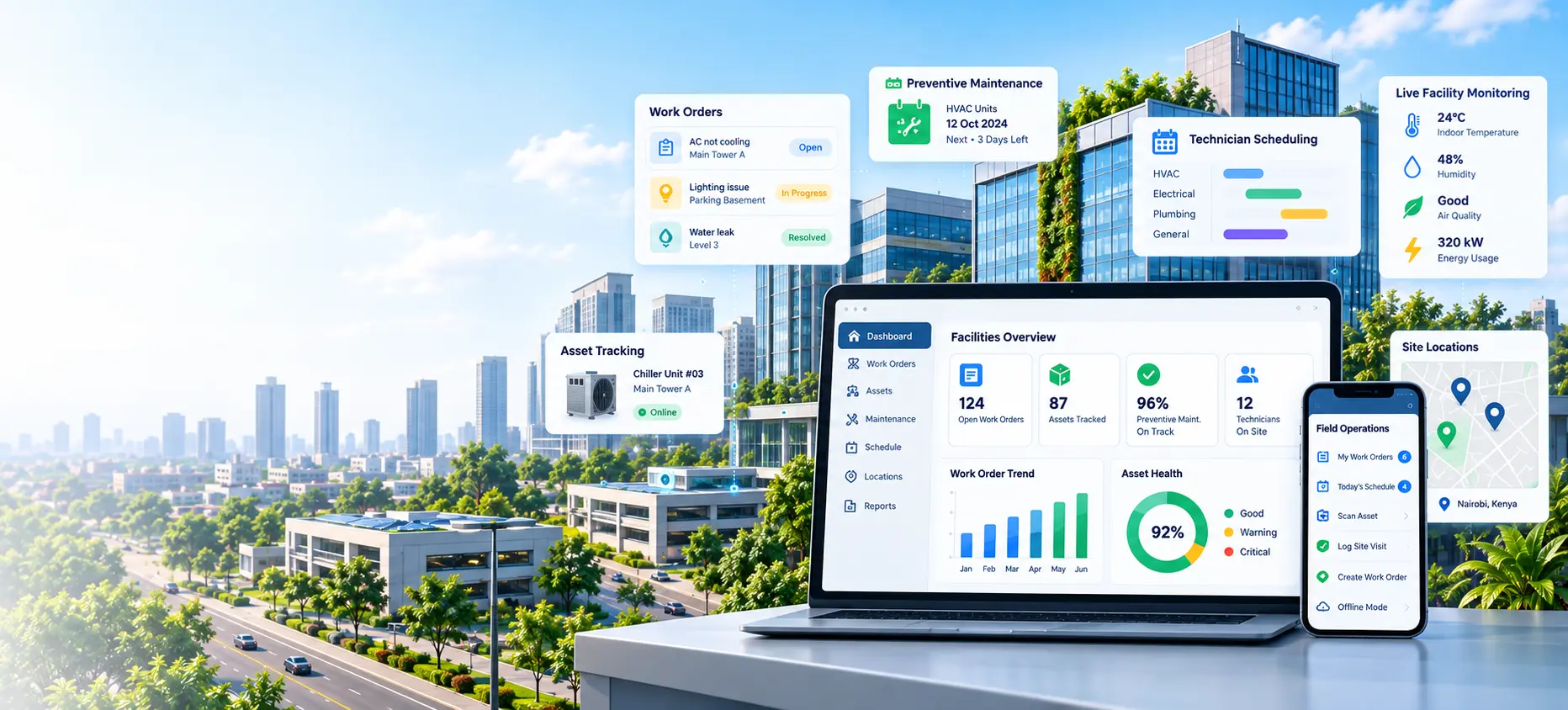
Client-specific dashboards can track indicators such as open work orders, SLA attainment, preventive maintenance completion, repeat faults and technician or contractor performance. Access controls are particularly important for outsourced FM because each customer should see relevant information without exposing another client’s operational data.
Terms such as computer aided facility management system (CAFM), integrated workplace management system (IWMS) and integrated facility management software can describe overlapping capabilities. For Kenyan service providers, the product label matters less than whether the platform supports contract-centric workflows, mobile field execution and multi-client governance. The same principle applies to facilities management software for telecom operations, where dispersed infrastructure can generate substantial volumes of geographically distributed maintenance work.
How to implement facilities management software across Kenyan FM contracts
Implementation should begin with operational data and contract logic rather than reproducing every existing process digitally. Establish clear client, site, asset, contract and user hierarchies first. Asset registers, service categories, technician skills and contract scope should be validated before SLA clocks, maintenance frequencies, escalation paths and approval responsibilities are configured.
A controlled group of client sites provides a practical starting point. Operations directors can test request logging, dispatch rules, technician mobile usability, offline or low-connectivity processes, supervisor approvals and client reporting before extending the facilities management software across the Kenyan portfolio.
Integrations with finance or ERP systems, identity services, building systems and IoT monitoring should each have a defined operational purpose. Kenyan requirements concerning personal data, workplace safety, record keeping, tax processes and sector-specific operations should also be checked against current authoritative requirements during implementation rather than assumed to be covered automatically by software.
Performance should be baselined before rollout. Useful measures include response and resolution times, SLA attainment, first-time fix rate, preventive maintenance completion, repeat incidents and work-order backlog. A workplace management system is delivering operational value when these indicators show stronger contract control and service evidence, not merely when user login volumes increase.
Conclusion
For Kenyan FM service providers, facilities management software creates the greatest value when contractual requirements connect directly to daily field execution and measurable client outcomes. Central visibility, stronger SLA control, preventive maintenance discipline, traceable field activity and consistent reporting can make multi-client operations easier to govern and scale.
Operations directors should therefore evaluate platforms against actual Kenyan service-delivery conditions, client workflows, connectivity needs and reporting requirements rather than feature volume alone.
Key Takeaways
- Facilities management software enables multi-client operational control by connecting service requests, assets, field teams, SLAs and reporting in one environment.
- The facility management platform reduces service-delivery blind spots by creating traceable workflows from request capture through field execution to verified closure.
- This approach strengthens implementation outcomes by combining reliable contract data, controlled rollout and measurable operational performance.
See how eFACiLiTY can support Kenyan FM service providers managing multi-site contracts, SLA performance, mobile field execution and client reporting. Schedule a demo to explore the platform against your operational workflows.
FAQ
Q1. What is facilities management software?
Facilities management software is a digital system for coordinating assets, maintenance, work orders, service requests, technicians and contractors. For FM service providers, it creates a central operational environment for managing multiple client sites, monitoring SLAs, maintaining service records and producing consistent performance information for operational teams and customers.
Q2. What should Kenyan FM service providers look for when selecting facility management software?
Kenyan FM service providers should prioritise multi-client data structures, configurable SLA workflows, mobile technician tools, preventive maintenance, asset histories, subcontractor controls and client-specific reporting. They should also assess connectivity, security, scalability and integrations, particularly whether the platform can accommodate distinct contractual requirements across different customer portfolios.
Q3. How should an FM service provider roll out integrated workplace management software?
Start with validated client, site, asset, contract and SLA data, then configure workflows around a controlled portfolio. Test request capture, dispatch, mobile execution, escalation and reporting with actual users before expansion. Baseline operational KPIs beforehand so management can measure changes in response times, SLA attainment and maintenance completion.