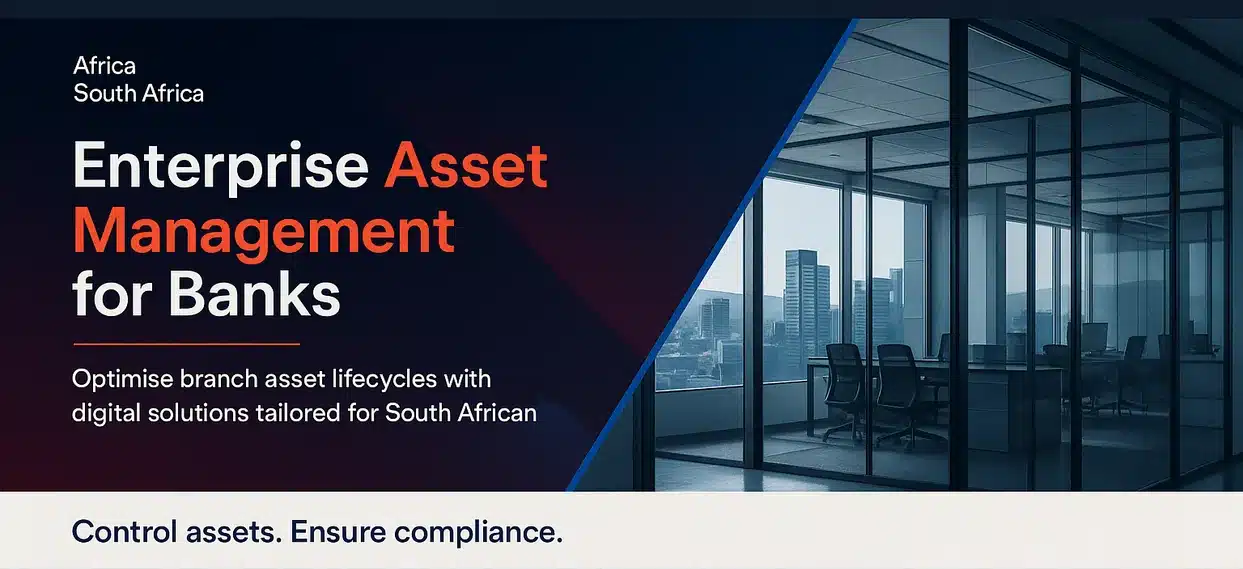
Managing physical assets across South Africa’s extensive banking networks has never been more complex. With hundreds of branches dispersed across cities and rural areas, each with its own unique operational risks and compliance demands, facility and asset managers face mounting pressure to optimise asset lifecycles. Manual tracking is no longer sufficient—errors, lapses in maintenance, and compliance failures can quickly escalate costs and operational disruption.
Enterprise asset management is the systematic process of tracking, maintaining, and optimising assets throughout their lifecycle to maximise value and compliance for organisations such as South African banks.
What is enterprise asset management in banking?
Enterprise asset management in banking refers to the integrated set of processes and digital tools that enable financial institutions to efficiently acquire, track, maintain, and renew physical assets—such as ATMs, IT infrastructure, and branch equipment—across multiple locations. This approach ensures regulatory compliance, reduces operational risk, and supports cost control, which are all critical in South Africa’s banking sector.
Why South African Banks Need End-to-End Control of the Branch Asset Lifecycle
South African banks operate across a vast geography, with assets distributed between metropolitan centres and remote rural branches. This diversity introduces a range of operational risks—variable climate conditions, heightened security needs, and frequent load-shedding events all impact asset reliability and maintenance schedules. Regulatory frameworks in South Africa’s banking industry require institutions to maintain comprehensive documentation and audit trails for all physical assets, from point-of-sale terminals to essential infrastructure.
Manual asset tracking—still prevalent in some banks—often leads to outdated records, missed maintenance activities, and uncontrolled costs. The increasing shift towards digital banking has not diminished the importance of physical touchpoints; ATMs and branch technologies remain vital for customer service and brand reputation. Any asset downtime or failure can directly affect customer satisfaction and result in compliance breaches.
Furthermore, banks are under growing pressure to demonstrate transparency and accountability in asset management to satisfy auditors and regulators. Without full lifecycle visibility, the risks of non-compliance, unnecessary capital expenditure, and reputational harm are significantly increased.
Core Capabilities of Enterprise Asset Management for Branch Asset Lifecycle Optimisation
Digital Asset Acquisition, Maintenance, and Renewal Processes
EAM platforms provide South African banks with a centralised system to manage assets throughout their lifecycle. At the acquisition stage, all asset data—such as purchase information, warranties, and supplier agreements—are captured digitally, reducing paperwork and improving traceability. During operational use, integrated computerised maintenance management system (CMMS) features automate preventive maintenance scheduling, notify managers of warranty expiries, and offer real-time insights into asset condition.
- Digital capture of acquisition, warranty, and supplier data for every asset
- Automated preventive maintenance scheduling and warranty alerts via integrated CMMS
- Real-time access to asset performance and service histories for high-usage equipment
- Seamless integration with procurement and financial systems for planned renewals
- Compliance documentation and audit readiness for regulatory inspections
These EAM workflows are designed to support South African banking compliance requirements by providing the documentation, reporting, and audit readiness essential for regulatory inspections. Notably, best practices from EAM and CMMS implementations in other heavily regulated sectors—such as metro station management—can be effectively adapted to the banking context, streamlining operations across diverse branch portfolios.
Implementing Enterprise Asset Management in South African Banks: A Practical Roadmap
Steps to Achieve Lifecycle Visibility and Control
A successful EAM deployment in South African banks begins with a comprehensive asset inventory. Increasingly, banks are utilising barcoding or RFID tagging to digitise this process, ensuring every asset is uniquely identified and easily auditable. The next step is selecting an EAM or CMMS platform tailored to the banking sector, with robust support for South African compliance mandates and the ability to generate detailed, branch-level reports.
- Conduct a complete asset inventory using digitised tagging methods
- Select and configure an EAM or CMMS platform suited for South African banking requirements
- Provide thorough training to facility and asset managers on digital asset workflows
- Establish regular performance reviews and compliance audits with automated reporting
- Implement a phased rollout, starting with pilot branches, to manage change and minimise risk
Phased implementation is a proven approach for minimising risk. South African banks often begin with pilot projects in high-profile metropolitan branches, refining processes before rolling out the EAM platform across their entire branch network. This strategy fosters effective change management and delivers measurable improvements in risk reduction and cost control early in the process.
Conclusion
For South African banks, enterprise asset management is a strategic imperative for mitigating risk, ensuring compliance, and maximising the value of branch assets. Digital EAM platforms, especially those with integrated CMMS capabilities, provide the transparency, efficiency, and audit readiness that are essential in today’s banking landscape. By managing the entire asset lifecycle digitally, banks can reduce costs, avoid compliance failures, and deliver consistent service quality to customers nationwide.
Key Takeaways
- Enterprise asset management empowers South African banks to control branch asset lifecycles by digitising acquisition, maintenance, and renewal workflows for improved oversight and compliance.
- Integrated EAM and CMMS capabilities deliver regulatory compliance, audit readiness, and operational efficiency across distributed banking networks in South Africa.
- EAM implementation provides asset managers with the visibility and tools required to reduce costs, extend asset lifespan, and meet regulatory obligations consistently.
Ready to bring your bank’s asset management into the digital era? See how eFACiLiTY can help South African banks achieve compliance and efficiency—schedule a demo today.
FAQ
Q1. What is enterprise asset management?
Enterprise asset management is the coordinated process of acquiring, maintaining, and renewing assets throughout an organisation’s lifecycle, using digital platforms to enhance efficiency, compliance, and return on investment. For South African banks, it is fundamental for managing assets across multiple branch locations.
Q2. How does enterprise asset management support compliance for South African banks?
Enterprise asset management systems automate recordkeeping, schedule preventive maintenance, and generate audit trails for all asset activities. This enables South African banks to meet regulatory requirements, reduce the risk of non-compliance, and ensure smooth audit processes with accurate, real-time data.
Q3. What are the main benefits of integrating a computerised maintenance management system with EAM for banks?
Integration provides real-time asset tracking, centralised maintenance scheduling, predictive renewal planning, and enhanced reporting capabilities. For South African banks, this results in reduced downtime, improved cost management, and stronger compliance across the entire branch network.