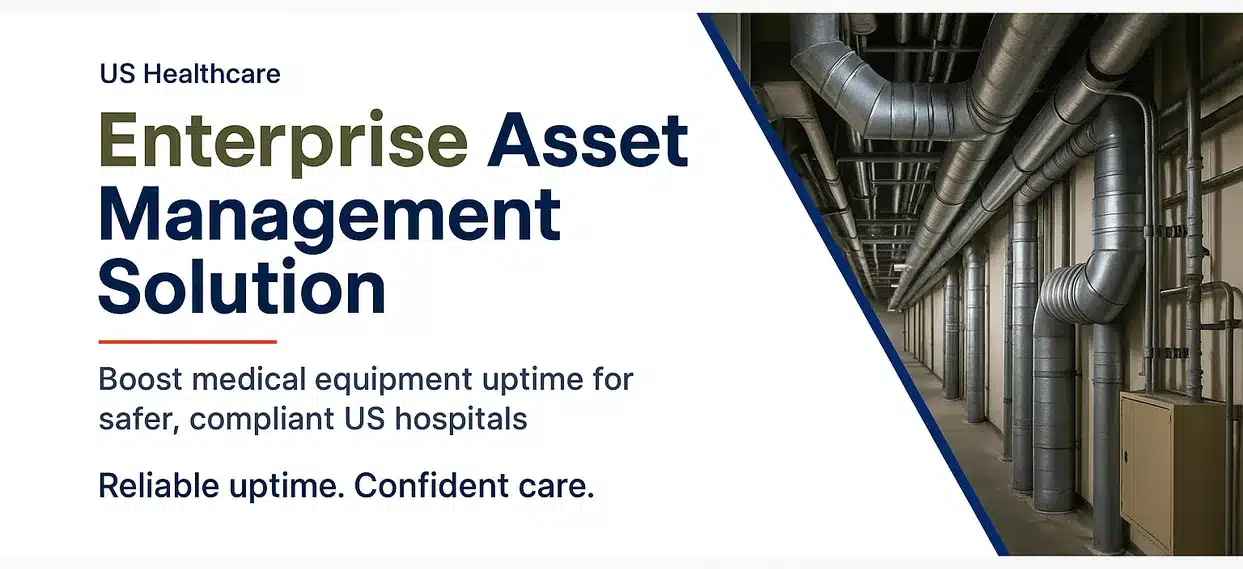
Unexpected downtime of medical equipment is a critical pain point for US hospitals, directly impacting patient care, compliance, and operational costs. Clinical engineering and asset management teams must constantly balance the need for high equipment uptime with regulatory requirements and tight budgets. As the complexity of healthcare facilities and the volume of medical assets increase, robust hospital asset management is no longer optional—it is mission-critical for safe, efficient, and compliant operations.
An enterprise asset management solution is a comprehensive software platform that enables hospitals to manage, maintain, and optimise medical equipment uptime for improved patient safety and operational efficiency.
What is an enterprise asset management solution for hospitals?
An enterprise asset management solution for hospitals is a software system designed to track, maintain, and optimise all medical equipment assets, supporting compliance, reducing downtime, and improving care delivery for US healthcare facilities.
Why do US hospitals need an enterprise asset management solution for medical equipment uptime?
US hospitals need enterprise asset management solutions to ensure maximum equipment uptime, maintain compliance with The Joint Commission and CMS, and reduce operational costs. Centralising asset data and automating maintenance enhance visibility, minimise failures, and enable hospitals to deliver safe, efficient patient care while meeting regulatory demands.
Key Operational Challenges Impacting Equipment Availability
Clinical-Area Pressures and Regulatory Demands
US hospitals rely on a vast range of diagnostic, therapeutic, and support equipment—assets that are heavily utilised and integral to patient care. High utilisation rates, especially in critical areas such as the ICU and OR, increase the risk of unplanned failures and service disruptions. Meeting The Joint Commission, CMS standards, and other regulatory requirements further intensifies the pressure, requiring meticulous record-keeping and regular audits.
- Hospitals operate with high equipment utilisation in clinical environments
- Asset managers face stringent regulatory compliance and audit requirements
- Manual processes and fragmented systems create data visibility challenges
- Budget constraints demand maximising asset value and mitigating downtime
Core Capabilities of Enterprise Asset Management Solutions for Hospitals
From Preventive Maintenance to Predictive Analytics
Modern enterprise asset management solutions equip US hospitals to automate maintenance workflows and centralise asset data. Automated work order scheduling ensures preventive maintenance is always completed on time. Integration with computerized maintenance management systems (CMMS) delivers unified maintenance oversight for informed decision-making.
- Mobile functionality enables service logging and inspection from anywhere
- Asset tracking tools provide real-time location and lifecycle data
- Advanced analytics enable predictive maintenance strategies
- Compliance dashboards streamline audit preparation and inspection readiness
Hospital Asset Management Use Cases: Improving Uptime, Compliance, and Cost Control
Real-World Scenarios for Clinical Engineering Teams
In high-acuity hospital settings such as the ICU or OR, rapid response to equipment failures is essential for patient safety and operational continuity. Enterprise asset management streamlines workflows, helping teams quickly identify, locate, and service critical devices. Scheduled preventive maintenance minimises sudden breakdowns and lowers repair costs.
- Clinical engineering teams rapidly respond to critical equipment failures
- Preventive maintenance reduces last-minute repairs and clinical disruptions
- Facility management gains audit-ready compliance documentation
- Data-driven insights highlight underutilised assets for strategic decisions
Integrating Enterprise Asset Management with Existing Hospital Systems
Seamless Workflows and Data Flow
For US hospitals, successful enterprise asset management depends on integration with existing technology platforms. Seamless connectivity with Electronic Health Records (EHR), CMMS, and procurement systems unifies data, maintenance, and purchasing workflows. This allows healthcare facility management software to cut costs and improve uptime by eliminating silos and reducing manual entry.
- Integrated systems create a single source of truth for asset data
- Secure interoperability ensures HIPAA-compliant data sharing
- Real-time insights support cross-departmental collaboration
- Automated workflows reduce administrative burden and errors
ROI and Business Case for Hospital Asset Management Solutions
Quantifying Uptime Gains and Cost Savings
Investing in enterprise asset management delivers measurable returns for US hospitals. Reduced downtime allows for increased patient throughput and improved care quality. Automated, predictive maintenance lowers repair costs and extends asset life. Robust compliance tracking minimises regulatory penalties, safeguarding hospital reputation and finances.
- Equipment uptime increases patient capacity and throughput
- Predictive maintenance lowers total cost of ownership
- Compliance management reduces audit risk and penalties
- Staff productivity rises through streamlined automation
Implementation Roadmap: Deploying an Enterprise Asset Management Solution in US Hospitals
Best Practices for Rollout and Change Management
Effective implementation starts with reviewing current processes and identifying key operational challenges. Data migration and system integration planning are crucial to maintaining records. Early staff engagement and training build buy-in. Most US hospitals achieve success with a phased rollout, starting with a pilot in a high-impact department before scaling enterprise-wide.
- Assess existing asset management workflows and challenges
- Plan data migration and technology integration
- Train clinical engineering and asset management teams
- Roll out in phases, expanding from pilot departments
- Maintain continuous support and process improvement
[Product] Compared to Traditional Hospital Asset Management Approaches
Enterprise Asset Management vs. Legacy Methods
| Dimension | Enterprise Asset Management Solution | Legacy Approach |
|---|---|---|
| Asset records | Centralised, digital, real-time | Manual spreadsheets and paper |
| Maintenance scheduling | Automated, rules-based, proactive | Reactive and ad hoc |
| Analytics and reporting | Real-time, actionable insights | Periodic, manual reviews |
| Compliance management | Integrated dashboards and documentation | Siloed, manual preparation |
| System integration | Seamless with EHR, CMMS, procurement | Disconnected, fragmented systems |
Feature Highlights: What Sets [Product] Apart for US Hospitals
Capabilities for Modern Hospital Requirements
- Digital asset lifecycle tracking reduces data fragmentation
- Automated and analytics-driven maintenance minimises downtime
- Built-in, audit-ready compliance management simplifies inspections
- Mobile and cloud access support operations from any location
- Seamless IT integration, including EHR, CMMS, and procurement
- Customisable, real-time reporting delivers actionable insights
Conclusion
Deploying an enterprise asset management solution positions US hospitals to maximise medical equipment uptime, reinforce compliance, and enhance operational efficiency. These systems equip clinical engineering teams to support patient care, meet regulatory demands, and control costs. Hospitals that invest in integrated, healthcare-specific asset management solutions will realise lasting improvements in quality, safety, and financial performance.
Key Takeaways
- Enterprise asset management solutions empower US hospitals to maximise equipment uptime by automating maintenance and centralising asset data.
- Hospital asset management platforms reduce compliance risk and support audit readiness through integrated documentation and analytics.
- Healthcare facility management software delivers measurable ROI by lowering costs, boosting staff productivity, and supporting regulatory requirements.
Discover how your hospital can increase equipment uptime and ensure compliance with a healthcare-specific asset management solution. Schedule a demo with our team today.
FAQ
Q1. What is an enterprise asset management solution?
An enterprise asset management solution is a software platform that enables hospitals to manage, maintain, and optimise their medical equipment, reducing downtime and supporting compliance for clinical engineering and asset management teams.
Q2. How does an enterprise asset management solution improve medical equipment uptime in US hospitals?
It automates maintenance scheduling, centralises asset data, and enables predictive analytics—allowing US hospitals to proactively address issues, minimise unplanned downtime, and streamline compliance with healthcare regulations.
Q3. What should US hospitals look for when selecting hospital asset management software?
Key factors include seamless integration with existing systems (EHR, CMMS), robust compliance support, mobile access, advanced reporting capabilities, scalability, and a track record of success within the US healthcare sector.