Introduction
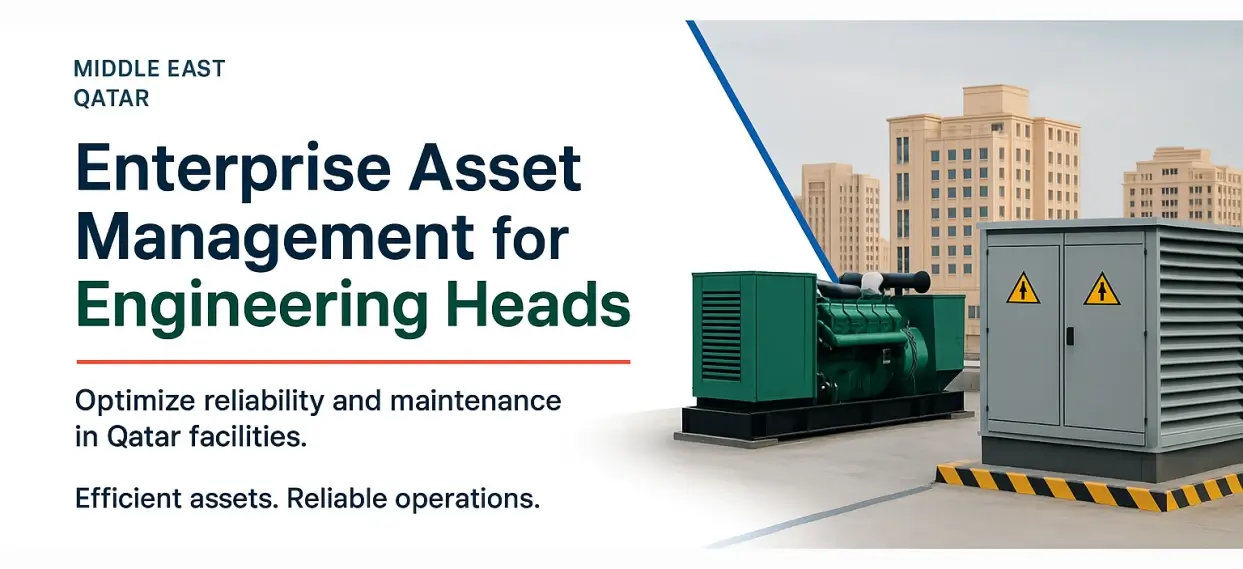
Engineering heads in Qatar operate assets under demanding conditions, including sustained cooling loads, high temperatures, humidity, dust exposure and intensive equipment utilisation. Across commercial complexes, healthcare facilities, airports, campuses, hospitality properties and mixed-use estates, fragmented maintenance records can make recurring failures and repair-versus-replace decisions difficult to assess. Bringing engineering activity and reliable asset data together provides a clearer basis for reliability, lifecycle planning and business continuity.
An enterprise asset management solution is a digital platform that helps engineering teams manage physical assets, maintenance, work orders, condition data, costs, spares and lifecycle performance within a unified operational environment.
How can an enterprise asset management solution help engineering heads in Qatar?
An enterprise asset management solution helps engineering heads in Qatar centralise asset data, maintenance schedules, work orders, spare parts, inspections and performance reporting. It strengthens lifecycle visibility and helps teams prioritise maintenance across complex facilities exposed to demanding climate conditions, sustained cooling requirements and operationally critical equipment.
Why Engineering Heads in Qatar Need an Enterprise Asset Management Solution
Qatar’s operating environment can place significant demands on chillers, air-handling units, pumps, electrical infrastructure and control systems. High cooling requirements, heat, humidity and airborne dust make visibility into equipment condition, maintenance intervals and failure patterns particularly valuable. Engineering heads can use measures such as mean time between failures (MTBF), mean time to repair (MTTR), downtime, service levels and maintenance backlog alongside asset criticality to understand operational risk.
The challenge becomes greater when asset registers, technician records, contractor activities, warranties, inventories and service histories remain disconnected. Incomplete histories weaken lifecycle cost analysis and make repair, refurbishment and replacement decisions harder to justify. Consistent asset hierarchies and maintenance KPIs create a stronger basis for multi-site reporting, budgeting and capital planning while supporting records required for applicable local compliance, safety and building requirements.
Moving from Reactive Maintenance to Risk-Based EAM Priorities
Not every overdue work order creates the same operational exposure. Engineering teams can prioritise work according to asset criticality, condition, failure history, operational consequences and backlog age.
Preventive maintenance follows predefined intervals, while condition-based maintenance responds to measured or observed equipment condition. Predictive maintenance can use historical and condition data to identify emerging failure risks. In Qatar facilities, these approaches can help engineering teams focus attention on equipment where loss of cooling, power or other critical services could materially disrupt operations.
How an Enterprise Asset Management Solution Connects Engineering Data
A structured asset register provides the basis for planned maintenance and lifecycle analysis. Technicians receive work orders and record labour, materials, meter readings, faults and completion details against individual assets. Engineering managers can then analyse recurring failures, downtime, preventive maintenance compliance, maintenance costs and spare usage when assessing reliability or replacement priorities.
EAM extends the maintenance execution functions commonly associated with a computerised maintenance management system (CMMS) by connecting maintenance histories with inventory, warranties, contracts, costs and procurement information. Mobile workflows, automated notifications and meter readings can improve the timeliness and consistency of operational data.
IoT sensors and building management systems can add condition information, but technology alone does not create reliable predictive maintenance. Useful predictions depend on appropriate sensing, sufficient historical records, meaningful failure data and analytical maturity.
Maintenance Management Capabilities That Matter in Qatar
For facilities in Qatar, useful capabilities include work-order control, planned maintenance, inspections, technician mobility, spare-parts consumption, escalation workflows and complete service histories. Role-based access can also help organisations control how internal teams and contractors create, update and approve engineering records.
Data quality remains critical. Standardised asset names, failure codes, maintenance procedures and completion requirements help turn operational records into decision-grade information. Reliable histories can then support warranty recovery, root-cause analysis, budgeting and capital expenditure planning by showing how failure frequency, downtime and cumulative maintenance costs affect lifecycle economics.
Implementing an Enterprise Asset Management Solution Across Qatar Facilities
Implementation should begin with dependable asset data rather than an attempt to migrate every historical record. Engineering teams should first define asset hierarchy, naming conventions, locations, ownership, criticality, maintenance strategies and mandatory data fields. A phased deployment can then prioritise high-value and operationally critical assets across Qatar facilities.
Integration requirements should also be established early. Building management systems, IoT platforms, ERP and procurement processes, inventory, finance and enterprise facility management workflows may each hold information required for a complete asset view. API capability, cybersecurity, data ownership, scalability and role-based permissions should therefore form part of EAM evaluation criteria.
A Practical EAM Adoption Framework for Engineering Heads
A controlled enterprise asset management rollout can follow four practical stages:
- Establish the asset baseline, hierarchy and criticality model.
- Configure maintenance workflows, data standards and user responsibilities.
- Pilot the solution against defined reliability and maintenance KPIs.
- Scale across further assets or sites after validating data quality and user adoption.
Engineering leaders should measure results beyond work-order volumes. Reduced unplanned downtime and emergency maintenance, improved preventive maintenance compliance, better inventory control, longer useful asset life and higher engineering productivity offer stronger indicators of operational value. Baseline measurements are important so improvements can be attributed and assessed consistently.
Conclusion
Qatar’s demanding facility environment makes dependable maintenance data and lifecycle visibility strategically important. An enterprise asset management solution can connect asset history, maintenance execution, condition information, spares and performance metrics, giving engineering heads a stronger evidence base for reliability, maintenance and investment decisions.
Evaluation should therefore focus on critical-asset reliability, data governance, integration capability, user adoption, scalability and measurable operational outcomes rather than feature quantity alone.
Key Takeaways for Enterprise Asset Management
- An enterprise asset management solution strengthens asset reliability by connecting maintenance execution, condition information, failure history and lifecycle data.
- The EAM platform reduces reactive decision-making by providing structured asset histories, criticality-based priorities, maintenance KPIs and visibility into recurring failures.
- A phased EAM implementation improves operational value by establishing reliable asset data, practical workflows, integrations and measurable performance baselines before wider deployment.
Engineering heads assessing maintenance digitisation in Qatar can explore how eFACiLiTY supports a structured EAM strategy for complex facilities. Contact us to discuss your asset-management priorities.
FAQ
Q1. What is an enterprise asset management solution?
An enterprise asset management solution is software that centralises information and processes for physical assets throughout their operational lifecycle. It enables engineering teams to manage asset registers, work orders, preventive maintenance, inspections, spare parts, costs and condition information, supporting reliability, maintenance control and lifecycle planning across complex facilities.
Q2. How should engineering heads select EAM software for facilities in Qatar?
Engineering heads should assess EAM software against asset complexity, maintenance workflows, mobile usability, integrations, reporting, scalability, cybersecurity and data governance. For Qatar facilities, selection should also consider intensive cooling operations, environmental conditions, contractor workflows and the ability to monitor critical-asset reliability consistently across multiple buildings or sites.
Q3. What should be completed before implementing an enterprise asset management system?
Before implementation, teams should establish a reliable asset hierarchy, identify critical equipment, clean essential records, define maintenance workflows, set KPI baselines and confirm integration requirements. Engineering and maintenance users should participate in configuration and testing, while a controlled pilot validates data quality, mobile execution, training and reporting before wider deployment.