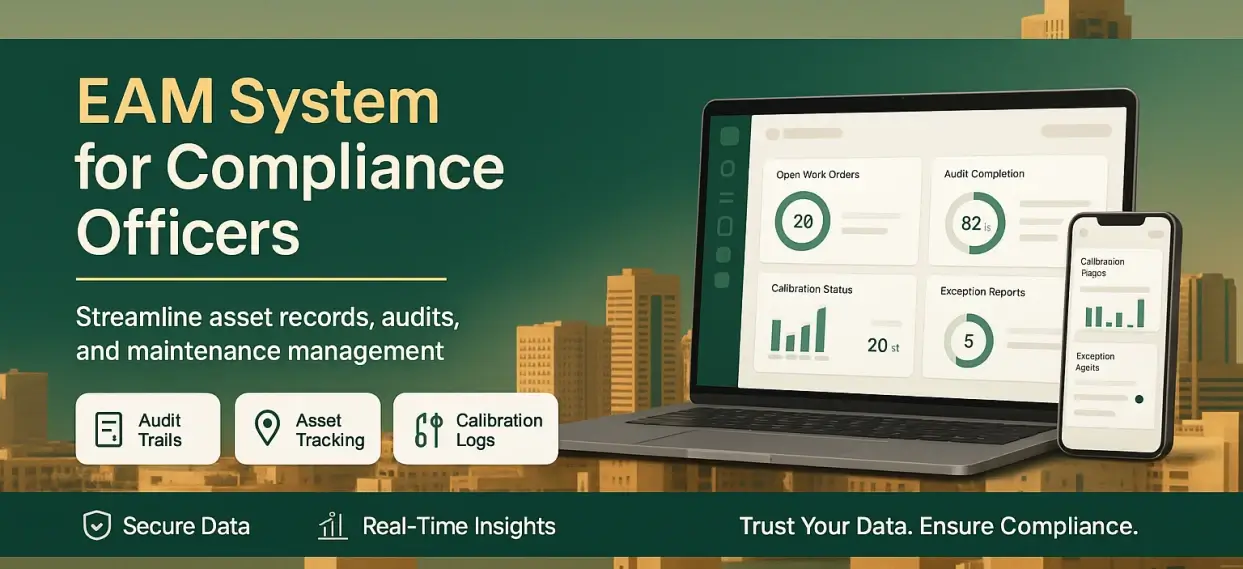
For pharmaceutical exporters in Jordan, production equipment, laboratory instruments, storage assets, utilities and controlled environments can generate maintenance, calibration, inspection and corrective-action evidence across disconnected systems. Compliance officers need to establish what happened to an asset, when work occurred, who performed it, what evidence was produced and whether exceptions were resolved.
An EAM system is enterprise asset management software that helps pharmaceutical compliance and facilities teams control asset records, maintenance, calibration, inspections, documentation and audit evidence throughout the operational life cycle.
How does an EAM system help pharmaceutical exporters in Jordan maintain compliance?
An EAM system helps pharmaceutical exporters in Jordan maintain compliance by centralising asset histories, maintenance schedules, calibration records, inspections, work orders, approvals and audit trails. Compliance officers can verify critical equipment controls, identify overdue activities, investigate exceptions and retrieve supporting evidence efficiently for internal reviews, customer audits and applicable destination-market requirements.
Why an EAM system strengthens audit readiness for pharmaceutical exporters
When calibration certificates sit in shared folders, maintenance histories remain in spreadsheets and corrective actions reside in separate quality workflows, reconstructing an equipment history becomes difficult. An EAM system can establish a controlled evidence chain from asset identity and scheduled requirements through authorised work, execution details, approvals, attachments and resulting exceptions.
For Jordanian pharmaceutical exporters serving regional and international markets, this traceability can improve confidence that evidence is available when requested. Relevant assets may include production machinery, laboratory instruments, HVAC equipment supporting controlled environments, cold-storage assets, backup power systems and critical utilities.
Timestamps, role-based permissions and change histories make this evidence chain more useful. A properly configured audit trail can record relevant actions and changes in a way that supports reconstruction of events. Configuration should reflect the organisation’s approved procedures and verified local and destination-market requirements rather than assuming the software itself creates compliance.
From EAM maintenance records to retrievable compliance evidence
Compliance officers should be able to retrieve records by asset, location, work order, date, technician, calibration status or exception. This enables reviewers to move from a specific piece of equipment to its maintenance history and supporting documentation without manually reconciling several sources.
Incomplete histories create more than an administrative problem. Missing approvals, inconsistent asset identifiers or unresolved exceptions can make it harder to demonstrate that maintenance controls have operated consistently. A related microblog, "cafm system audit trails for pharma compliance", provides additional facility-level context without making those records a substitute for the EAM system of record.
How EAM and facility workflows work together without fragmenting compliance records
An EAM system should provide an authoritative environment for asset condition, maintenance, inspections, calibration-related workflows and work history. Reservation technologies address different operational requirements. A workspace reservation system or desk booking system manages workspace use, while meeting room booking, room reservation and facility booking tools coordinate reservable spaces.
These platforms should not become parallel repositories for controlled maintenance evidence. Where facility access, room availability or planned maintenance windows affect pharmaceutical operations in Jordan, governed integrations can provide useful context while maintaining clear system-of-record boundaries. Data ownership, integration scope and exchange rules should be documented and tested.
Where a meeting room management system fits
A meeting room management system can schedule audit interviews, quality reviews, employee training, supplier discussions or rooms required during an inspection. It supports coordination, but maintenance and calibration evidence should remain within the relevant controlled asset-management environment.
This distinction helps compliance officers avoid treating booking information as controlled equipment history. It also allows facilities teams to coordinate maintenance windows and access requirements without duplicating regulated or compliance-relevant records across unrelated systems.
How to implement an EAM system around pharmaceutical compliance controls
Implementation should begin with compliance-critical assets rather than an indiscriminate migration of every facilities record. For pharmaceutical exporters in Jordan, teams should first establish which equipment can affect production, laboratory operations, controlled storage, utilities or other critical conditions.
A practical EAM implementation sequence is to:
- Identify critical assets, locations and accountable owners.
- Define required maintenance, inspection, calibration evidence, approvals and exception paths.
- Clean asset master data and migrate only reviewed, appropriately controlled records.
- Configure permissions, audit trails, alerts and escalation rules, then test evidence retrieval.
Master-data quality is a significant control point. Duplicate asset IDs, incomplete location hierarchies, inconsistent equipment names or missing maintenance frequencies can weaken reporting even when the EAM system functions correctly. Integrations with ERP, document management, quality workflows, building systems or reservation platforms should therefore have defined ownership and tested data flows.
EAM compliance metrics that reveal control gaps
Useful indicators include overdue preventive maintenance and calibration-related activities, open critical work orders, recurring failures, unresolved exceptions, downtime and evidence-retrieval time. Metrics should be interpreted according to asset criticality. An overdue activity affecting controlled pharmaceutical storage, for example, may require different investigation and escalation from work on a low-risk office asset.
Trend reporting can also reveal repeated failures, recurring late work and persistent documentation gaps before an audit begins. This turns EAM reporting into an ongoing governance mechanism rather than simply a method for assembling evidence after an auditor requests it.
Conclusion: EAM System Audit Readiness for Pharmaceutical Exporters in Jordan
For pharmaceutical exporters in Jordan, an EAM system can create a clearer connection between physical assets, completed maintenance, supporting evidence and unresolved exceptions. Audit readiness still depends on reliable master data, controlled workflows, appropriate permissions and requirements verified for relevant markets rather than software deployment alone.
Compliance and facilities teams should regularly test whether critical asset histories can be retrieved quickly, traced to supporting evidence and explained coherently during an internal review, customer audit or other applicable assessment.
EAM System Key Takeaways for Pharmaceutical Compliance
- An EAM system strengthens audit readiness by connecting pharmaceutical assets with maintenance, inspections, calibration-related records, approvals and historical evidence.
- The platform reduces compliance blind spots through consistent asset identities, responsibilities, permissions, exception handling and evidence workflows.
- A compliance-focused EAM approach improves control by prioritising critical assets, reliable master data, retrievable audit trails and meaningful exception metrics.
Explore how eFACiLiTY can support structured asset and facility compliance workflows for pharmaceutical operations in Jordan. Schedule a demo to assess how stronger maintenance visibility could support your audit-readiness programme.
FAQ
Q1. What is an EAM system?
An EAM system is enterprise asset management software used to manage physical assets throughout their operational life cycle. It centralises asset information, preventive maintenance, work orders, inspections, documentation and performance history, helping pharmaceutical compliance and facilities teams maintain controlled records, manage critical equipment and retrieve evidence efficiently when required.
Q2. What EAM records should pharmaceutical compliance officers retrieve during an audit?
Compliance officers should be able to retrieve asset histories, scheduled and completed maintenance, calibration-related records, inspections, work orders, approvals, technician details, supporting documents, exceptions and related corrective actions. Exact evidence requirements should follow controlled organisational procedures and the verified local and destination-market obligations applicable to the Jordanian pharmaceutical exporter.
Q3. How should a pharmaceutical exporter implement an EAM system for compliance?
A pharmaceutical exporter should identify compliance-critical assets, clean master data, map maintenance and calibration evidence, define roles and approvals, and configure traceable workflows. Before wider rollout, the organisation should verify applicable requirements, test record retrieval and exception handling, train responsible users, and establish monitoring for overdue, incomplete or unresolved activities.