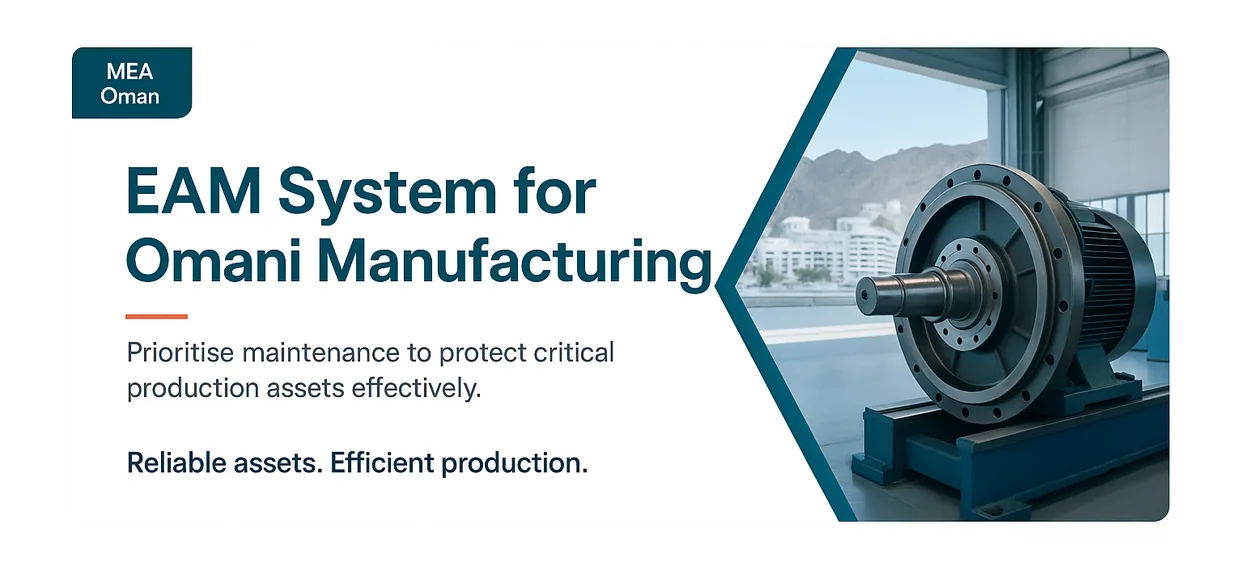
In Oman’s rapidly advancing manufacturing sector, unplanned equipment downtime poses a significant threat to production continuity and profitability. With critical assets forming the backbone of Omani factories, even short interruptions can lead to major financial losses and missed delivery commitments. The operational environment in Oman—characterised by extreme heat, dust, and humidity—amplifies the risk of asset failure, making proactive maintenance more challenging yet more vital than ever.
An EAM system is a centralised platform that helps Omani manufacturers manage, monitor, and prioritise maintenance for critical production assets, ensuring optimal reliability and compliance.
How does an EAM system help prioritise maintenance for critical assets?
An EAM system enables Omani manufacturing facilities to identify, rank, and schedule maintenance for their most critical assets using risk-based assessments, real-time condition monitoring, and automated work order management. This ensures that resources are focused where downtime would have the highest operational and financial impact.
Why Manufacturing Facilities in Oman Need Data-Driven Maintenance Prioritisation
Key Operational Challenges Facing Omani Manufacturers
Manufacturing operations across Oman encounter a unique blend of environmental and operational challenges that directly affect asset reliability. The region’s high temperatures, persistent dust, and elevated humidity accelerate asset wear and increase the likelihood of unexpected failures. Without a structured approach to maintenance, many Omani factories rely on reactive strategies—addressing issues only after breakdowns occur. This approach frequently results in costly unscheduled downtime, missed production targets, and potential regulatory penalties for not meeting local safety or environmental requirements.
Manufacturing facility management software is instrumental in overcoming these challenges. By centralising maintenance data and providing actionable insights, such software enables maintenance teams to move from reactive to proactive, data-driven decision-making. The outcome is more effective resource allocation, improved asset reliability, and reduced exposure to operational risks, all tailored to the realities of manufacturing in Oman.
Core Capabilities of an EAM System for Manufacturing Maintenance
Using an EAM System to Identify and Protect Critical Assets
A modern EAM system enables Omani manufacturers to systematically identify, rank, and protect their most valuable production assets. Through asset criticality ranking, the system assesses which machines or infrastructure components are most vital to production continuity, safety, and regulatory compliance. By tracking failure modes and monitoring real-time asset health, maintenance teams can anticipate potential breakdowns before they disrupt operations.
Integration with computerised maintenance management system (CMMS) features further enhances this capability, enabling automated work order creation, mobile task execution, and immediate updates from the factory floor. These features are crucial for improving production reliability with maintenance software, ensuring that the right resources are deployed to the right assets at the right time.
- EAM systems facilitate systematic identification and ranking of critical production assets in Omani factories.
- Asset health monitoring and failure mode tracking help predict and prevent costly breakdowns.
- Integration with CMMS automates work orders and supports real-time communication across the factory floor.
Best practices involve linking asset risk profiles—such as age, usage intensity, and failure history—to automated maintenance prioritisation. This ensures that critical assets receive timely interventions, while less vital equipment is maintained according to its actual operational risk. Such an approach optimises both uptime and maintenance expenditure, directly supporting the resilience of Omani manufacturing operations.
Implementing an EAM System in Omani Manufacturing: Roadmap and Best Practices
Steps for Successful Maintenance Prioritisation Adoption
A successful EAM system implementation in Omani manufacturing begins with a focused pilot project targeting a subset of critical assets. This pilot stage enables teams to validate workflows, collect operational feedback, and demonstrate early benefits before expanding system adoption across the entire facility.
- Pilot Project: Select high-impact production lines or assets for initial rollout.
- User Training: Provide maintenance managers and technicians with tailored, hands-on training relevant to Omani operational conditions.
- Customisation: Configure the system to address local compliance requirements and respond to specific environmental challenges, such as integrating alerts for heat-induced asset stress.
- Stakeholder Engagement: Involve asset managers, production leaders, and compliance officers from the outset to build buy-in and ensure the solution aligns with organisational objectives.
- Scaling and Continuous Improvement: Leverage insights from the pilot to guide phased expansion, optimise workflows, and track ROI using KPIs such as reduced downtime, maintenance cost savings, and improved regulatory compliance.
By following this structured approach, Omani manufacturers can embed maintenance prioritisation into daily operations, resulting in measurable improvements in production reliability and asset longevity.
Conclusion
For Omani manufacturing organisations, leveraging an EAM system to prioritise maintenance for critical production assets delivers a substantial strategic advantage. By shifting from reactive to data-driven, risk-based maintenance, factories benefit from greater uptime, extended asset life, and stronger alignment with local compliance requirements. Ultimately, an EAM system empowers Omani manufacturers to allocate resources where they matter most—ensuring continuous and reliable production.
Key Takeaways
- EAM systems provide Omani manufacturers with the ability to prioritise maintenance for critical assets by automating risk-based scheduling and condition monitoring.
- Critical asset management through an EAM system minimises unplanned downtime and reinforces compliance within Oman’s manufacturing sector.
- The adoption of manufacturing facility management software leads to measurable gains in production reliability and operational efficiency.
Looking to boost your asset reliability and reduce downtime in your Omani manufacturing facility? See how an EAM system can transform your maintenance strategy—schedule a demo today.
FAQ
Q1. What is an EAM system?
An EAM system, or Enterprise Asset Management system, is a platform that enables manufacturing organisations in Oman to manage, monitor, and optimise maintenance for critical assets. It centralises asset information, schedules maintenance, and enhances production reliability for asset-intensive environments.
Q2. How does an EAM system support maintenance prioritisation in manufacturing?
EAM systems employ asset criticality ranking, real-time monitoring, and automated work order management to help manufacturing facilities in Oman focus maintenance resources on the most vital production assets. This approach reduces downtime and increases operational efficiency.
Q3. What is the difference between an EAM system and a computerised maintenance management system?
An EAM system provides comprehensive asset lifecycle management, including asset tracking, planning, and compliance for Omani manufacturers. In contrast, a computerised maintenance management system primarily focuses on work order management and maintenance scheduling within the facility.