Introduction
Ghana’s power utilities must keep generation assets, transmission and distribution networks, substations, transformers, switchgear, vehicles and supporting facilities dependable while managing equipment of varying ages and constrained maintenance resources. Fragmented records, reactive maintenance and incomplete work histories can make maintenance priorities and capital requests difficult to assess and defend.
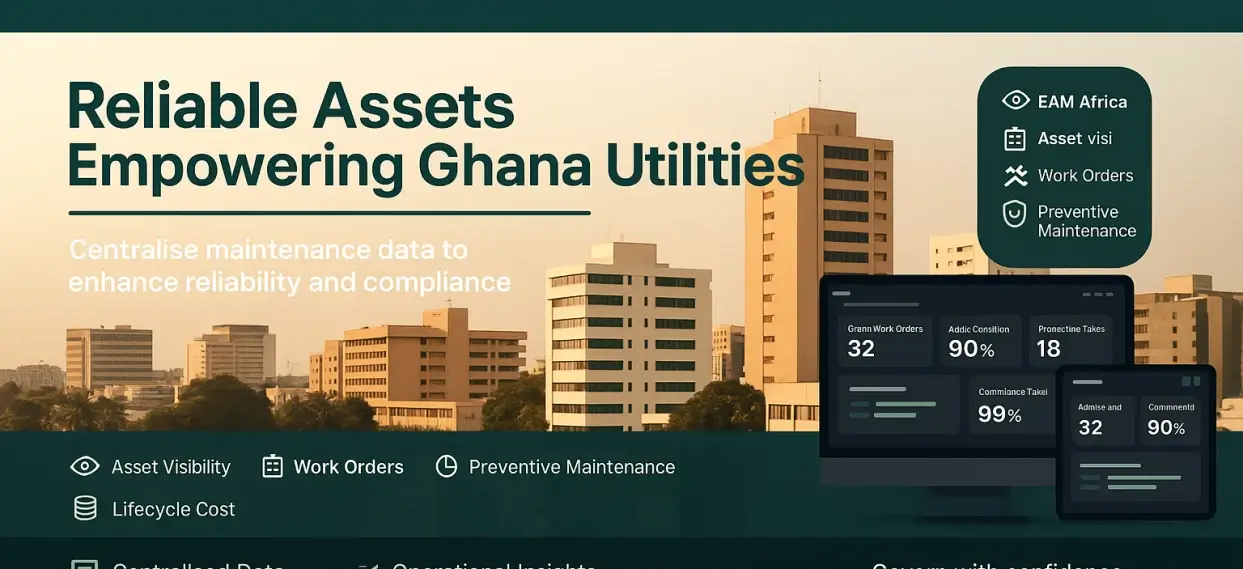
An EAM Solution is enterprise software that helps Ghana’s power utilities manage physical assets, maintenance, work orders, costs, risks and lifecycle information in one governed system, giving government officials clearer evidence for reliability planning, operational oversight and infrastructure investment decisions.
How can an EAM Solution improve Ghana’s power utility asset management?
An EAM Solution can help Ghana’s power utilities centralise asset records, schedule preventive maintenance, prioritise critical equipment, control work orders and monitor lifecycle costs. For government officials, it provides visibility into asset condition, maintenance performance, operational risk and investment needs, supporting service reliability, accountability and evidence-based infrastructure planning across generation, transmission and distribution assets.
Why Ghana’s Power Utilities Need Better EAM Solution Asset Visibility
Power infrastructure is geographically dispersed, and its maintenance information can be equally fragmented. Spreadsheets, paper records and isolated maintenance systems may leave planners without a complete history of inspections, faults, repairs, parts consumption and expenditure. That makes it harder to distinguish an isolated equipment problem from a recurring reliability issue requiring wider intervention.
Ghana’s operating conditions also matter. Heat, humidity, seasonal heavy rainfall, dust exposure and difficult access to some field locations can influence inspection requirements, deterioration and maintenance planning. Utilities therefore need asset information that reflects both equipment condition and the environment in which equipment operates.
An enterprise asset management system creates a consistent asset hierarchy linking equipment with locations, condition assessments, failure records, spare parts, maintenance expenditure and criticality. Asset maintenance software can give technicians, engineers and planners a common operational record rather than competing versions of asset history.
For government oversight, that consistency improves traceability. Officials can assess whether maintenance expenditure is directed towards critical assets, whether recurring faults are being addressed and whether proposed replacement programmes are supported by condition and performance evidence.
How an EAM Solution Turns Maintenance Data Into Utility Decisions
Effective EAM connects individual maintenance activities to wider reliability and lifecycle decisions. Instead of treating a completed work order as the end of a process, utilities can use the resulting data to identify failure patterns, assess maintenance effectiveness and inform repair, refurbishment or replacement choices.
Asset Criticality, Preventive Maintenance and Work Control
A practical workflow begins with a verified asset register. Transformers, substations, switchgear, protection equipment and other utility assets can be organised into defined hierarchies and assigned criticality using service consequences, safety exposure, condition, failure history and replacement lead time.
Preventive and condition-based tasks can then be scheduled against those assets, with inspection findings and completed work returned to the same record. A computerised maintenance management system supports work-order control and maintenance execution, while broader enterprise asset management connects these activities with risk, lifecycle cost, inventory and management reporting.
For example, repeated defects on a high-criticality transformer can trigger more than another corrective work order. Its failure history, maintenance costs, condition and operational consequences can provide evidence for engineering review and repair-versus-replacement planning.
From Field Records to Management-Level EAM Evidence
Governed maintenance data can be consolidated into indicators such as planned-versus-reactive maintenance, repeat failures, equipment availability, backlog, mean time between failures and mean time to repair. Labour, material usage and contractor activity can also be associated with the relevant assets and work.
An EAM software guide to prioritise critical power assets can help Ghanaian utility teams establish consistent criticality criteria before configuring workflows. The objective is not simply to collect more information. It is to make asset risk, maintenance performance and expenditure sufficiently traceable to support defensible operational and capital decisions.
Implementing an EAM Solution and Measuring Public Value in Ghana
Implementation should begin with clear operational outcomes and information ownership rather than software configuration alone. For a Ghanaian power utility, an initial deployment could focus on a defined population of high-criticality transformers or substation assets where maintenance histories can be validated and performance baselines established.
Start With Governance, a Pilot and Reliable EAM Asset Data
Asset naming conventions, hierarchy rules, duplicate management, condition codes, maintenance standards, master-data ownership and role-based permissions should be agreed early. Poor source data can undermine even capable enterprise asset management software, particularly when duplicate assets or inconsistent identifiers prevent reliable reporting.
Scaling should follow evidence that pilot workflows are practical and records are being maintained consistently. Relevant integrations may include finance or ERP, inventory and spares, procurement, GIS, document repositories and approved condition-monitoring systems.
Connect EAM Field Execution With Enterprise Oversight
Mobile work execution can support technicians working at substations and distributed locations, while offline capability and later synchronisation may be important where field connectivity is unreliable. Adoption should include technicians, engineers, planners, contractors, managers and oversight stakeholders rather than focusing only on system administrators.
Cybersecurity, access control, audit trails and integration governance also require deliberate design in a critical utility environment. Public value should then be measured against a verified baseline, including emergency work, repeat failures, backlog control, labour and spares usage, lifecycle expenditure and changes in asset condition.
EAM software cannot by itself prevent outages. Its governance value lies in providing stronger evidence about where asset risk, maintenance effort and expenditure are concentrated, helping Ghanaian utility stakeholders develop more credible multi-year maintenance, replacement and infrastructure investment plans.
Conclusion: EAM Solution for Ghana’s Power Utilities
For Ghana’s power-utility stakeholders, an EAM Solution creates a structured connection between equipment condition, maintenance work, operational risk, expenditure and lifecycle decisions. Sustainable value depends on trusted asset data, criticality-based maintenance, appropriate integrations, field adoption and measurable baselines rather than software deployment alone. These foundations give government officials stronger evidence for accountable infrastructure stewardship and long-term power-system asset planning.
Key Takeaways: EAM Solution for Utility Asset Governance
- An EAM Solution strengthens utility asset governance by connecting condition, maintenance history, work execution, risk and lifecycle costs in a governed information environment.
- The platform supports risk-based maintenance decisions by relating asset criticality and condition to operational consequences and verified performance evidence.
- This approach improves government oversight by combining reliable asset data, measurable KPIs, field workflows, enterprise integrations and clear information ownership.
See how eFACiLiTY can support Ghanaian utility stakeholders evaluating maintenance visibility, critical-asset prioritisation and lifecycle planning. Contact us to explore an enterprise EAM approach.
FAQ
Q1. What is an EAM Solution?
An EAM Solution is enterprise software for managing physical assets throughout their operational lifecycle. It combines asset registers, maintenance planning, work orders, condition, risk and cost information. For Ghana’s power utilities, it creates a governed view of asset performance and maintenance requirements to support reliability, oversight and infrastructure investment decisions.
Q2. How should Ghana’s power utilities begin implementing enterprise asset management?
Ghana’s power utilities should begin with defined operational objectives, a governed asset hierarchy, verified equipment records and consistent criticality rules. They can then pilot workflows on selected critical assets, establish baseline performance indicators, connect relevant enterprise and field systems, address user adoption and expand after validating data quality and processes.
Q3. Which power-utility assets should be prioritised in an EAM system?
Prioritisation should consider consequence of failure, equipment condition, failure history, safety implications, service impact, replacement lead time and maintenance cost. Rather than ranking Ghana’s utility assets by age alone, consistent criticality criteria can identify where inspections, preventive maintenance, spares planning and capital intervention are likely to deliver greater operational value.