Introduction
Saudi Arabia’s giga-projects can bring together extensive asset portfolios, multiple delivery packages, contractors, commissioning records, warranties and future operational stakeholders. For project managers, completing construction is only part of the task. Construction facility handover must also provide operators with structured asset registers and reliable lifecycle information they can use from day one.
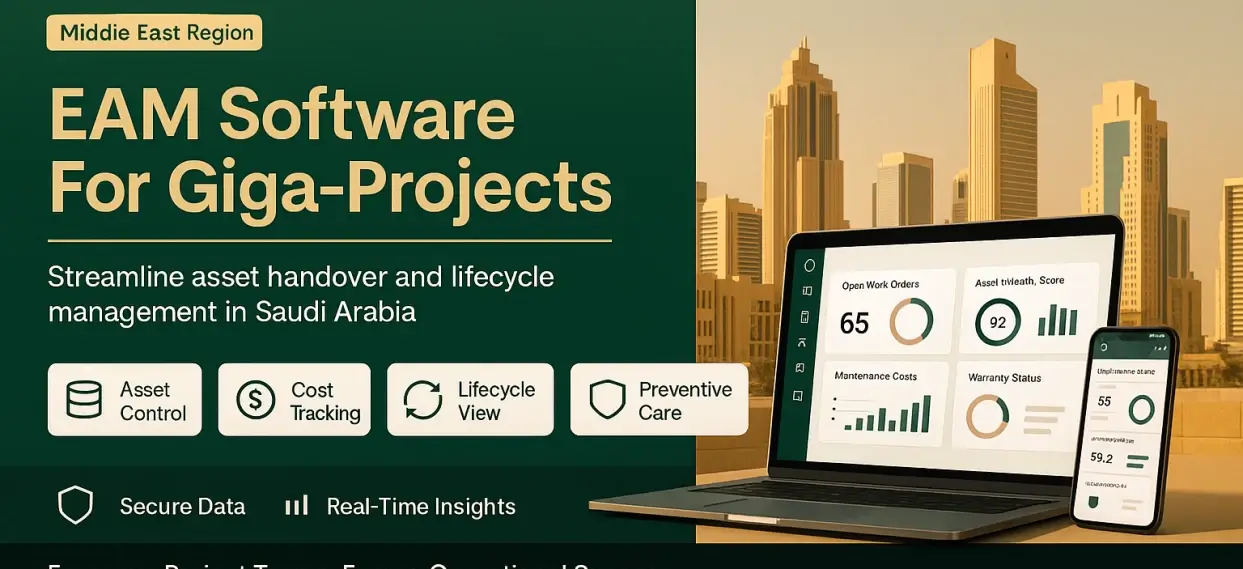
EAM Software is an enterprise asset management platform that helps project and asset teams structure asset data, maintenance requirements, lifecycle costs, work processes and operational records so physical assets can be managed effectively from commissioning through long-term operation.
How does EAM Software help project managers on Saudi Arabia’s giga-projects?
EAM Software helps project managers on Saudi Arabia’s giga-projects establish structured asset records, connect commissioning and handover information, prepare lifecycle maintenance and improve visibility of asset costs and operational readiness. Introducing EAM before handover can reduce information gaps between construction teams, contractors, facility operators, maintenance teams and long-term asset owners.
Why EAM Software matters before construction handover
Asset information across a Saudi giga-project may be distributed between BIM or common data environments (CDEs), spreadsheets, contractor submissions, document repositories, commissioning platforms and project planning software. Having these files does not necessarily provide operations teams with a usable asset register.
Before handover, project teams should establish consistent asset hierarchies, identifiers and ownership alongside criticality classifications, warranty information, commissioning status, operations and maintenance manuals, maintainability requirements and preventive maintenance data. These requirements should be incorporated into contractor deliverables rather than treated as a final data exercise at practical completion.
Turning project information into operations-ready EAM data
The practical test is whether transferred information supports real operational workflows. A maintainable asset should be identifiable when operators create work orders, schedule preventive maintenance, perform inspections, manage spare parts, administer warranties or assess lifecycle requirements.
This makes asset data governance a project-delivery responsibility involving owners, project managers, contractors, consultants and future operators. Where BIM and EAM Software are integrated, information should transfer according to defined operational requirements rather than through an indiscriminate migration of construction data.
A useful handover process should therefore verify:
- asset identifiers and hierarchy positions;
- required technical and commissioning records;
- warranty, maintenance and criticality information; and
- ownership, acceptance status and outstanding data defects.
This approach enables completed project scope to move into controlled operational ownership while reducing the manual reconciliation required after opening.
Connecting CAPEX Decisions with EAM Software
Capital planning software and CAPEX management software help Saudi project teams govern investment priorities, budgets and approvals, while capital project management software supports delivery controls covering scope, schedule, cost and change. EAM Software extends this information chain into asset condition, reliability, maintenance demand, lifecycle cost and renewal planning.
The value comes from connecting these information domains rather than maintaining isolated databases. For example, a maintainability concern identified during design or commissioning can influence a project decision while modification remains practical, rather than becoming a recurring operational cost after the facility opens.
Linking Asset Cost, Criticality and Lifecycle Planning with EAM Software
Connecting installed cost with asset criticality, warranty periods, preventive maintenance requirements and anticipated replacement needs gives project managers and asset owners a stronger total-cost-of-ownership perspective. It can also provide better evidence for commissioning priorities, operational budgets and future lifecycle CAPEX forecasts.
For example, identifying a critical asset together with its warranty conditions and prescribed maintenance regime before acceptance helps the operations team protect warranty value and prepare the necessary resources. Once the asset is operational, maintenance history, failures, condition assessments and costs can provide evidence for repair-versus-replacement and renewal decisions.
For Saudi giga-projects with numerous delivery packages, consistent asset identifiers are particularly important. They allow project cost information, commissioning evidence and operational history to remain associated with the same physical asset as responsibility moves between project and operational teams.
Building an EAM Software roadmap from commissioning to operations
EAM planning should begin while project teams can still influence information requirements and contractor deliverables. Waiting until practical completion can turn implementation into a large data-cleansing exercise, particularly across complex Saudi developments involving numerous packages, suppliers and asset types.
A practical implementation sequence is to define asset standards and ownership, map integrations, validate records during commissioning, test operational workflows and govern post-handover changes. EAM configuration should reflect the future maintenance operating model rather than importing every construction record simply because it is available.
Moving from construction facility delivery to live operations
Integration priorities can include BIM and CDE environments, finance or ERP systems, project planning software, document management, maintenance management software and, where operationally useful, IoT or building management system data. Integration design should establish which system owns each data field and how approved changes are synchronised.
Project managers can measure operational readiness through maintainable-asset completeness, validated identifiers, warranty capture, preventive-maintenance readiness, commissioning acceptance and unresolved data defects. Tracking these measures before handover gives delivery teams time to correct deficiencies before operational responsibility transfers.
After opening, the same governed information model can support property management and real estate facility management across buildings, mixed-use destinations, infrastructure and public-facing spaces. Workplace-focused developments may also use a workspace reservation system for facility managers (CAFM), although workspace booking itself is not a core EAM function.
For Saudi developments, maintenance strategies should account for local operating conditions and climate-related demands alongside each asset’s duty, location and criticality. Accurate EAM data can reduce manual remediation, strengthen warranty management and improve future renewal visibility. Applicable Saudi compliance requirements, contractual obligations and regional building requirements should still be assessed for the specific project and asset class; EAM Software does not itself establish compliance.
Conclusion
Project managers on Saudi Arabia’s giga-projects should treat operational asset information as a project deliverable alongside physical construction. EAM Software can connect commissioning, governed asset data, maintenance preparation, lifecycle costs and future capital decisions. Introducing this structure early makes the transition from capital delivery to sustainable operations more controlled, measurable and useful to the teams responsible for assets after opening.
EAM Software: Key Takeaways for Saudi Giga-Projects
- EAM Software strengthens project-to-operations handover by converting construction and commissioning information into governed, maintainable asset records.
- The EAM platform improves lifecycle decision-making by connecting asset criticality, maintenance requirements, CAPEX information, warranties, condition and renewal needs.
- Early EAM implementation reduces handover risk by establishing asset-data standards, ownership, integrations and validation processes before Saudi giga-project assets enter operation.
Explore how eFACiLiTY can support structured asset handover and lifecycle management across complex Saudi capital projects. Contact us to discuss your project requirements.
EAM Software FAQ for Saudi Giga-Projects
Q1. What is EAM Software?
EAM Software is enterprise asset management technology used to manage physical assets throughout their operating lifecycle. It centralises asset registers, maintenance activities, condition, costs, warranties and performance information. On Saudi giga-projects, project and facility teams can use EAM Software to establish governed operational information, support lifecycle management and improve asset handover readiness.
Q2. When should EAM Software be introduced on a giga-project?
EAM Software planning should begin before operational handover, while asset-information requirements, hierarchies, commissioning processes and contractor deliverables can still be influenced. Early preparation gives project teams time to establish data standards, configure integrations, validate maintainable assets and resolve information gaps before completed facilities transfer to operations teams in Saudi Arabia.
Q3. How can project managers measure EAM Software readiness before handover?
Project managers can measure EAM Software readiness by tracking maintainable assets with complete records, validated identifiers, required documentation, warranty information, maintenance plans, commissioning status and assigned ownership. Monitoring rejected, incomplete or missing asset data also shows whether the digital asset register can support operational workflows rather than merely document construction completion.