Introduction
Safety Managers at Tanzania’s mining sites oversee risks that extend well beyond extraction areas. Workshops, warehouses, utilities, offices, fire-safety equipment, accommodation and worker-support facilities all depend on timely inspection and maintenance. When spreadsheets, paper records and contractor communications are disconnected, overdue corrective work can become difficult to identify, prioritise and verify.
CAFM Software is a digital facility management platform that centralises asset, maintenance, inspection, space and operational records, helping Safety Managers at Tanzania’s mining sites identify facility-related risks, coordinate corrective work and retain traceable evidence of completed activities.
How can CAFM Software help Safety Managers at Tanzania’s mining sites?
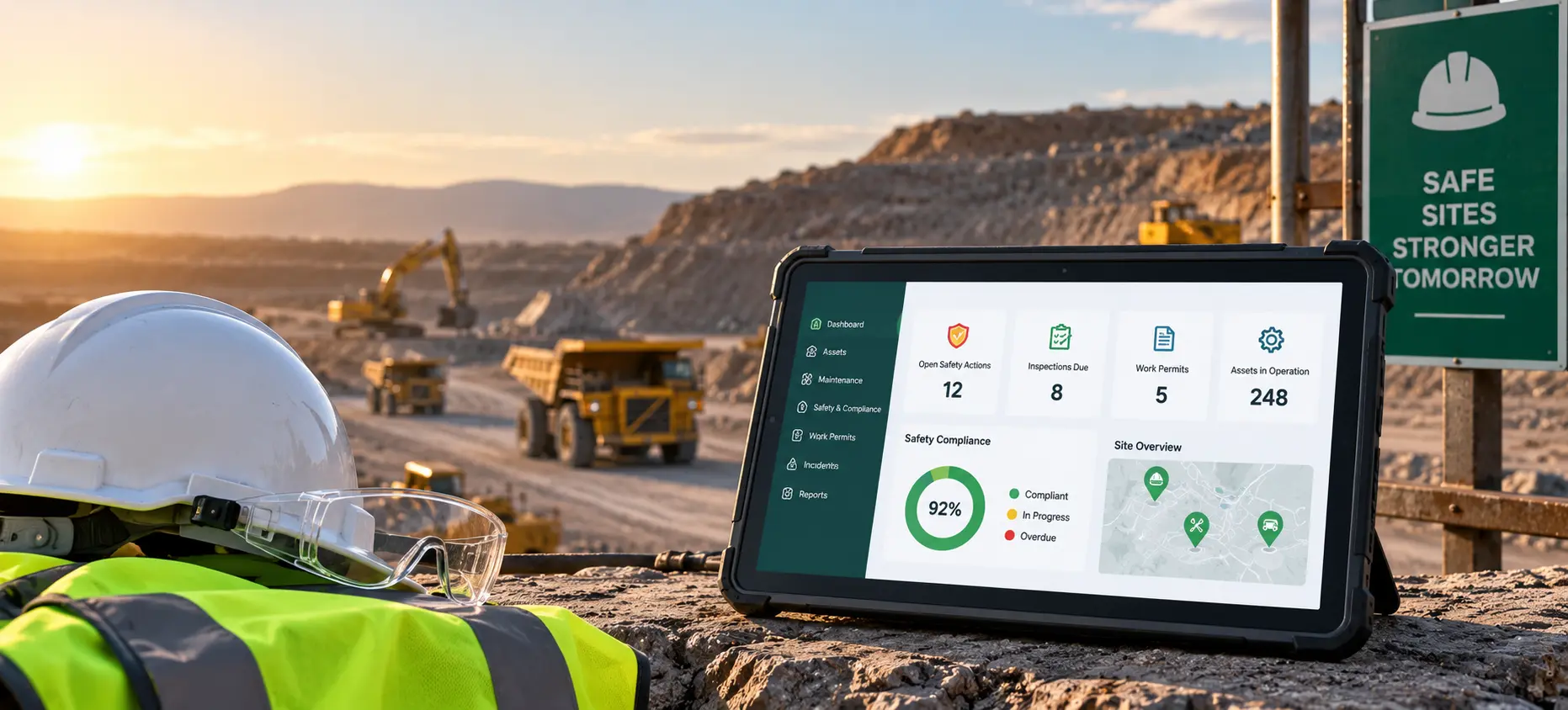
CAFM Software helps Safety Managers at Tanzania’s mining sites connect facility inspections, asset records, maintenance tasks and corrective actions. It can link hazards to responsible teams, deadlines and completion evidence, giving Safety, Facilities, Engineering and Operations teams clearer visibility of unresolved risks while providing traceable records for management reviews, internal assurance and compliance activities.
Why CAFM Software matters for connected facility safety at Tanzania’s mines
The difficult part of a safety inspection is often not identifying a defect but controlling what happens afterwards. A damaged workshop fitting, defective fire-safety asset or electrical-facility issue needs to become assigned work with an appropriate priority, deadline, responsible party and verification step. When inspection findings and work orders sit in different systems, that chain can become fragmented.
A computer aided facility management system can establish a shared operational record across workshops, stores, offices, utilities, access-controlled areas and worker-support facilities. This is particularly relevant to geographically dispersed Tanzanian mining operations, where remote locations, mobile teams, contractors and variable connectivity can complicate communication and maintenance coordination.
Reliable asset histories add useful context. If the same generator, fire-safety asset, workshop installation or building service repeatedly develops defects, Safety and Maintenance teams can see the pattern rather than treating every finding as an isolated incident. This supports risk-based prioritisation and better-informed maintenance decisions.
Records and workflows should be configured around the mining operation’s applicable Tanzanian safety, inspection, maintenance, emergency-readiness and recordkeeping requirements. CAFM Software can support the evidence trail and operational controls required by the organisation; it does not itself establish or guarantee legal or regulatory compliance.
How CAFM Software Turns Mining-Site Hazards into Accountable Maintenance Work
The strongest safety use case is a closed-loop workflow. A mobile inspection can record a defect against a precise asset or location, supported by photographs, timestamps and field notes where appropriate. The facility management platform can then route the issue into a controlled corrective-maintenance process.
A typical workflow for mining sites in Tanzania is:
- Safety or operational personnel record a facility defect during an inspection.
- The finding is linked to the relevant asset and mine-site location, assigned a risk-based priority and routed to the responsible team.
- Maintenance or an authorised contractor completes the work and records supporting evidence.
- Safety verifies the required corrective action before the issue is formally closed.
This connection makes CAFM Software more useful for facility-safety oversight than disconnected inspection findings and maintenance logs. Recurring inspections, preventive-maintenance schedules, escalation rules and asset histories can expose overdue work and repeated failures before they disappear within separate departmental records.
Facilities management software can also exchange relevant information with maintenance, ERP, procurement, identity and access management, or reporting systems. For contractor work, permissions can provide appropriate access to assigned tasks without exposing unnecessary site information. Audit trails can record status changes, responsibilities and completion evidence for subsequent management review.
Where CAFM Software Creates Practical Safety Value Across a Tanzanian Mining Site
Integrated facility management software can provide Safety, Maintenance, Engineering and Facilities teams with a common view of preventive maintenance, corrective actions, contractor activities and emergency-equipment readiness. That visibility is useful when facilities are distributed across a large Tanzanian mining operation rather than concentrated in a single building.
Trend information can reveal repeated defects at one workshop, an asset requiring unusually frequent maintenance or persistent overdue actions in a particular location. These patterns can help managers decide where engineering intervention, replacement, additional inspection or contractor-performance review deserves attention.
Larger mining organisations may incorporate these capabilities within an integrated workplace management system (IWMS), bringing facilities, assets, maintenance and workplace information into a wider operating environment. Established facilities-management practices such as accurate asset registers, planned maintenance, service-level monitoring and verifiable work histories can be adapted to mine-support buildings without distracting from the site’s safety priorities.
Role-Specific CAFM Software Visibility for Mining Teams
The system should provide role-specific visibility. Safety Managers need access to risk, inspection and closure status without becoming administrators for every facilities process, while Maintenance and Engineering teams need enough technical information to execute work efficiently. Contractors should receive only the access required for their assigned responsibilities.
Implementing CAFM Software for Tanzania’s Mine-Site Safety Operations
Implementation should begin with assets and locations where maintenance failure could create meaningful safety consequences. Establish dependable asset identifiers, location hierarchies, ownership, inspection frequencies, maintenance requirements, escalation paths and acceptable closure evidence before attempting a wider deployment. Accurate data and explicit accountability generally provide more immediate value than activating numerous modules simultaneously.
Pilot Safety-Critical CAFM Workflows at Tanzanian Mining Sites
A pilot can focus on one facility area or defined workflow, such as workshop inspections or safety-critical building assets. Suitable performance measures include corrective-action closure time, overdue actions, repeat defects and preventive-maintenance completion. Field testing should also evaluate mobile and offline usability under the connectivity conditions encountered at Tanzanian mining sites.
Scale CAFM Software with Governance and Role-Based Access
As deployment expands, teams should assess audit trails, configurable workflows, role-based access, integrations, reporting, scalability, data governance and operational support. Permissions should correspond with the responsibilities of Safety, Engineering, Maintenance, Operations, Facilities and contractors.
Workspace reservation capabilities may be relevant to administrative offices or shared facilities, but they should remain secondary to safety-critical inspection, asset and work-management priorities. For mine sites, implementation value depends primarily on whether CAFM Software helps teams identify risk, initiate action and demonstrate verified closure.
Conclusion
CAFM Software creates practical value for Safety Managers at Tanzanian mining operations when hazards, inspections, assets, maintenance activities and closure evidence become parts of one traceable workflow. Connected information improves visibility of unresolved facility risks and reduces the likelihood of corrective work becoming lost between departments or contractors.
A focused rollout should begin with safety-critical assets and measurable workflows. Over time, reliable asset histories and accountable maintenance processes can support preventive action, operational continuity and more defensible facility-safety records across dispersed mining sites.
Key Takeaways
- CAFM Software strengthens corrective-action accountability by connecting facility hazards and inspections with assigned work, deadlines, completion evidence and verification.
- The platform reduces fragmented safety information by bringing asset histories, preventive maintenance, inspections and corrective-action records into a shared operational environment.
- This approach improves mine-site safety visibility by combining dependable asset data, defined responsibilities and measurable workflows before wider deployment.
See how eFACiLiTY can support asset visibility, maintenance accountability and facility-safety workflows at Tanzanian mining operations. Contact us to explore the approach.
FAQ
Q1. What is CAFM Software?
CAFM Software is technology for managing facility assets, maintenance, work orders, inspections, spaces and related operational records within a central system. For mining-site Safety Managers, it can connect facility hazards and corrective tasks with responsible teams, deadlines, asset histories and completion evidence, improving visibility and accountability across safety-critical facilities.
Q2. Can CAFM Software track safety inspections and corrective actions at mining sites?
Yes. When configured for mine-site workflows, CAFM Software can record inspection findings, associate defects with specific assets or locations, generate corrective work, assign responsibility and monitor deadlines. It can also retain completion evidence, helping Safety Managers identify overdue actions and recurring facility problems without reconciling separate inspection and maintenance records.
Q3. What should a Tanzanian mining site consider before implementing CAFM Software?
A Tanzanian mining site should prioritise safety-critical assets and high-value workflows, then assess asset-data quality, field connectivity, responsibilities, integrations, audit trails and reporting needs. Configuration should reflect applicable local safety and recordkeeping requirements while supporting remote working conditions, mobile users, contractors and suitable evidence for corrective-action closure.