Introduction
For IT managers at Bahrain-based banks, insurers, investment firms and other financial services organisations, facilities technology is increasingly an operational data issue. Maintenance, physical assets, contractors, space and workplace services often span separate applications and spreadsheets, creating challenges around cybersecurity, identity, integrations, availability, auditability and business continuity.
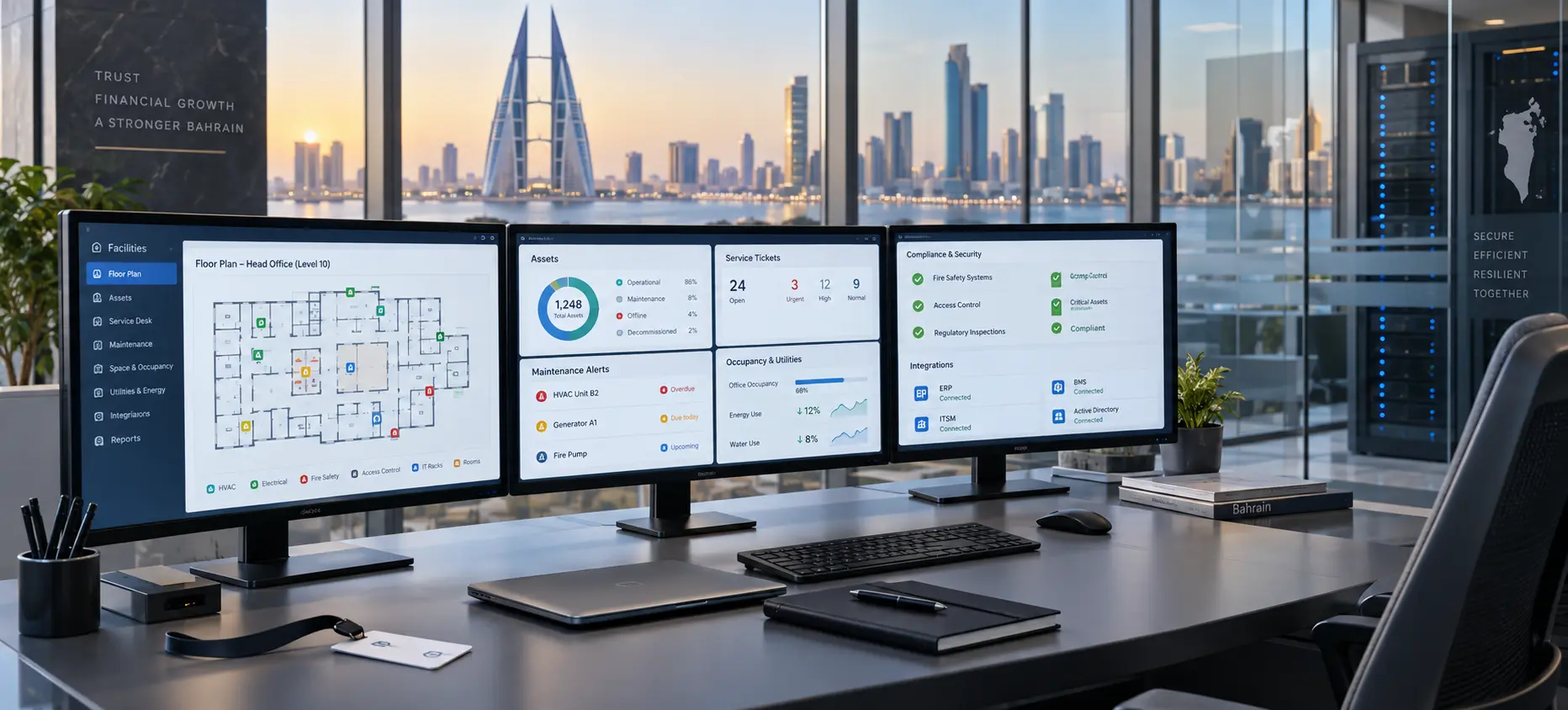
CAFM is a digital approach to managing facilities, assets, maintenance, space and workplace operations through centralised data and workflows, giving IT and facilities teams at Bahrain financial services firms greater operational visibility, control and traceability.
How can CAFM help IT managers at Bahrain financial services firms?
CAFM helps IT managers at Bahrain financial services firms centralise facilities data, automate maintenance and workplace workflows, integrate building operations with enterprise systems and improve reporting. A well-governed platform can strengthen access control, audit trails, asset visibility and business continuity while reducing fragmented applications, duplicated data and manual processes across financial workplaces.
Why CAFM matters to Bahrain’s regulated financial workplaces
A bank headquarters, insurer’s office or branch network may depend on spreadsheets, maintenance applications, building technologies, occupancy tools and separate contractor records. Fragmentation makes it harder to establish authoritative asset records, trace service activity and maintain consistent controls across customer-facing premises and data-sensitive areas.
For insurance facility management and other regulated financial environments, auditable records covering assets, incidents, maintenance, workplace services and suppliers can improve operational oversight while IT retains appropriate access and data controls. CAFM can provide a common operational record without removing the need for clearly defined system ownership and governance.
Bahrain’s climate also makes cooling reliability a significant continuity consideration. CAFM can connect HVAC assets with preventive maintenance schedules, service histories, energy information and lifecycle planning. Failure of cooling or other critical building infrastructure can affect technology environments, employee productivity and customer services.
For financial firms in Bahrain, CAFM implementation should therefore be assessed against currently applicable local privacy, cybersecurity, outsourcing, records-management and business-continuity requirements. Facilities technology should form part of the organisation’s wider operational risk and technology architecture rather than being treated as an isolated system.
How CAFM fits into a financial firm’s IT architecture
A computer-aided facility management system can provide a governed operational system of record for locations, assets, maintenance, work orders, contractors, space and selected workplace services. Whether suppliers describe their offering as facilities management software, facility management software or a facility management platform, IT teams should focus on architecture, controls, interoperability and data ownership.
CAFM integrations, identity and operational data
Technical evaluation of computer-aided facility management software should examine APIs and integrations with SSO and identity and access management, HR, ERP and procurement systems, building management systems, IoT sensors, access or visitor technologies and reporting platforms.
Teams should establish authoritative data sources, role-based permissions, API security, retention requirements, audit logging and integration monitoring. For example, HR may remain authoritative for employee identities while CAFM owns facilities asset and location records. These boundaries help prevent centralisation from becoming another source of inconsistent master data.
CAFM workplace services and data governance
Where requirements extend beyond core facilities operations, integrated workplace management software or an integrated workplace management system can incorporate employee-facing space services. A workspace reservation system within CAFM can connect room and desk reservations with utilisation data and wider facilities workflows rather than creating a standalone booking-data silo.
For financial firms in Bahrain, IT teams should consider the sensitivity and purpose of occupancy, visitor and workplace information before deciding what data needs to be collected, retained or integrated. Applying data minimisation and role-based access can reduce unnecessary exposure while preserving operational value.
How to Implement CAFM Securely and Measure Its Value
Before configuration, Bahrain financial firms should map critical assets, locations, existing data sources, facilities workflows, integrations, reporting obligations, user roles and data owners. This creates a practical baseline for deciding what belongs in CAFM and what should remain authoritative in another enterprise system.
Security assessment should cover deployment architecture, encryption, authentication, privileged and supplier access, audit logs, backups, recovery, availability, API controls, vulnerability management and incident responsibilities. Data residency and hosting decisions should be assessed against verified, currently applicable Bahrain requirements and the firm’s own risk policies rather than assuming cloud or on-premises deployment is inherently compliant.
CAFM Deployment, Adoption and Measurable Outcomes
A phased CAFM deployment can begin with asset registers, planned maintenance, reactive work orders, SLA tracking and contractor management before extending to additional workplace processes. Data cleansing and a consistent asset and location taxonomy deserve early attention because inaccurate source records can undermine otherwise successful automation.
Facilities, IT, cybersecurity, procurement, risk and business-continuity stakeholders should agree ownership before rollout. Performance should then be measured against a documented baseline, using measures such as:
- Critical asset downtime and mean time to resolve;
- Planned versus reactive maintenance and SLA attainment;
- Integration availability and data completeness; and
- Contractor performance, energy trends and administrative effort.
These measures connect facilities outcomes with the technical health of the platform. An interface that repeatedly fails, for example, can weaken CAFM data quality and erase automation gains even when individual maintenance KPIs appear satisfactory.
Conclusion
CAFM can give IT teams at Bahrain financial services firms a controlled operational architecture connecting facilities information, assets, maintenance, workplace services and enterprise systems. Its value depends less on an isolated feature checklist than on secure integrations, sound governance, clean data, user adoption and measurable outcomes. Evaluation should therefore reflect each organisation’s actual resilience, cybersecurity, regulatory and facilities requirements in Bahrain.
Key Takeaways
- CAFM enables Bahrain financial services firms to improve operational visibility and traceability by centralising facilities, asset, maintenance and workplace information.
- The CAFM platform can reduce technology and process fragmentation when integrations, identity controls, master-data ownership and security requirements are established before deployment.
- A well-governed CAFM approach delivers measurable value by tracking maintenance outcomes, SLA performance, data quality, integration health and administrative efficiency together.
See how eFACiLiTY could support a unified CAFM architecture around your financial firm’s existing systems, security requirements and workplace operations in Bahrain. Contact us to explore your requirements.
FAQ
Q1. What is CAFM?
CAFM, or computer-aided facility management, is software that centralises facilities assets, maintenance, space, service requests and operational data. For Bahrain financial services firms, it can help IT and facilities teams govern workflows, improve visibility, automate routine processes and connect building operations with relevant enterprise systems through a controlled platform.
Q2. How should a Bahrain financial services firm integrate CAFM with its IT systems?
Start by defining authoritative data sources, identities, integration requirements and ownership boundaries. CAFM may connect with SSO, HR, ERP, procurement, building systems and workplace technologies. IT teams should validate API security, permissions, audit logging, resilience, data quality and currently applicable Bahrain requirements before moving integrations into production.
Q3. Which CAFM metrics matter most to IT managers?
IT managers should monitor integration availability, authentication and access issues, data completeness, platform uptime and support performance alongside facilities measures such as SLA attainment, critical asset downtime and maintenance completion. Combining technical and operational metrics shows whether CAFM is reducing system fragmentation, maintaining reliable data flows and improving service resilience.